



Revolut says it has cut its AI coding inference costs by roughly 90 percent in less than a year by making self-hosted models its default, instead of relying mainly on services such as Anthropic's Claude Code and OpenAI's Codex. The figures come from David Abitbol, who leads AI operations and infrastructure at the company, in a talk at the AI Engineer conference in New York, published on YouTube on 29 October 2026. The Register covered it on 3 November under the headline “British fintech Revolut slashes AI coding costs 10x by cutting out Claude and going self-hosted.”
What Revolut reported
- Users: about 2,000 software engineers.
- Model: GLM, an open-weight model from the Chinese developer Z.ai. According to The Register, Revolut first adopted GLM-5.1 and then moved to GLM-5.3.
- Hardware: 56 Nvidia B200 GPUs, which The Register equates to seven eight-GPU DGX B200 systems.
- Cost: about $0.30 per million input and output tokens, roughly a tenth of the cost of Codex or Claude Code, The Register says.
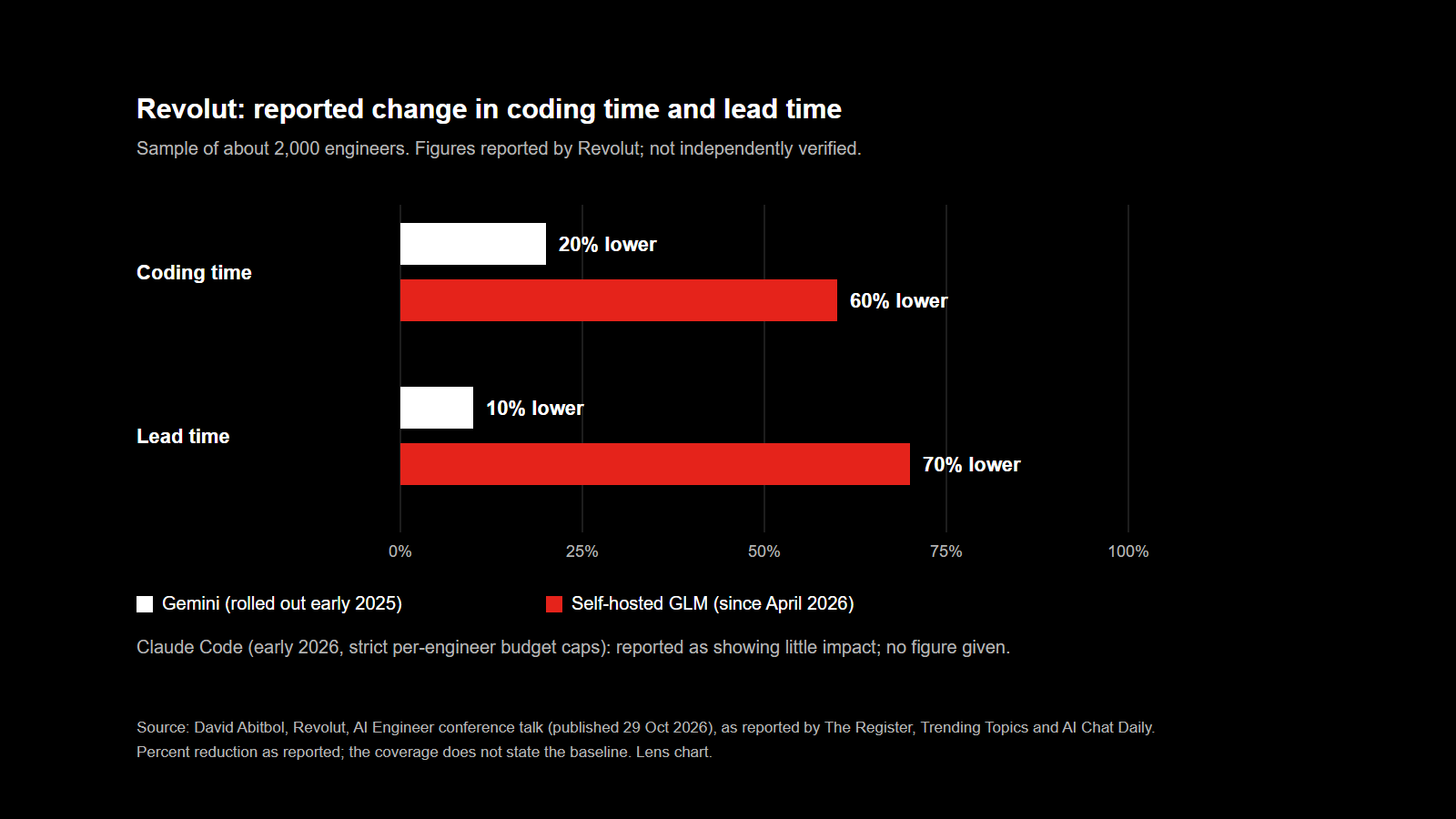
- Results: a 60 percent improvement in coding time and 70 percent in lead time, according to Abitbol.
From Gemini to Claude Code to GLM
The Register reports that Revolut deployed Google's Gemini in early 2025 and Claude Code in early 2026. Trending Topics and AI Chat Daily report that Abitbol put the Gemini effect at about a 20 percent cut in coding time and a 10 percent cut in lead time, meaning the time from picking up a task to merging it, and that Claude Code, introduced with strict per-engineer budgets, showed little benefit at first.
“We were seeing engineers spend $1,000 a month, $10,000 a month with not so much ROI, and so when we launched it we launched it with strict budget limits,” Abitbol said, according to The Register. Revolut then began looking at self-hosting. AI Chat Daily reports that it started in April 2026.
Abitbol said the largest gains were not in writing code. “The bottleneck for engineering is not necessarily coding,” he said, as quoted by AI Chat Daily and Trending Topics. The Register reports that the gains came from letting models handle debugging and Jira and Confluence tickets once tokens were no longer rationed. Dealroom notes that Revolut's comparison does not separate the model change from other changes, such as the removal of token limits.
Hardware and tuning
The Register describes GLM-5.1 as having roughly 754 billion total parameters, 40 billion of them active per generated token, needing about 380 GB of GPU memory for the weights alone. It reports that the biggest performance gains came from tuning hyperparameters, NVFP4 quantization, separating prefill from decode and adjusting context length, not from adding GPUs. Hugging Face, checked directly by Lens, lists GLM-5.1 at about 753.9 billion parameters under an MIT license, created on 3 April 2026.
AI Chat Daily reports that, between April and August, time to first token fell from over 10 seconds to about 1.6 seconds on the same 56 GPUs, while throughput rose from about 3 requests per second to more than 7. Dealroom gives the baseline as about 14 seconds. The talk's YouTube description says the tuning made the same GPUs 88 percent faster. Abitbol called out-of-the-box inference “terrible,” according to Trending Topics.
Revolut caps context at about 256,000 tokens. “Long context is a scam,” Abitbol said. His targets are a time to first token under 3 seconds and about 200 tokens per second, and The Register reports that engineers signing in after 5 p.m. get closer to 800.
What stays outside GLM
GLM is text-only, so Revolut uses a model router to send vision queries to models such as Gemini or GPT Luna while code generation stays on GLM, according to The Register. Claude Code and Codex remain available. “The billing is flat, we don't have any bill shock at the end of the month, and the frontier is the exception,” Abitbol said. The Register's headline refers to cutting out Claude, while its article says GLM has not replaced GPT or Claude entirely.
Data, jurisdiction and security
Abitbol acknowledged a “stigma” around Chinese open-source models, according to Trending Topics. Trending Topics and Dealroom report that Revolut uses only the published weights and runs them on infrastructure in the United States, not through Z.ai's hosted service in China. The Register reports that Abitbol said the main concern is access through APIs running in China; the article adds that when the models run on-premises or on regional cloud resources, “there's really nothing to worry about.”
StartupHub.ai reports that inference stays in jurisdictions covered by a data equivalency framework (the US, EU, UK and Israel), with GPU providers that retain no data by default, and that coding agents run in a sandbox with a human in the loop and command allow-lists.
What the coverage leaves open
StartupHub.ai and AI Chat Daily report that the 30-cent figure excludes cloud spend, staffing and observability. Trending Topics reports that Abitbol did not say whether Revolut owns or rents the B200s, and estimates about $1.7 million to $2.2 million for 56 chips, if bought, at the $30,000 to $40,000 per chip range attributed to Nvidia's Jensen Huang at the B200's launch. StartupHub.ai says the results depend on the 56 GPUs, steady tuning and Revolut's ability to shape load, and that smaller teams may not see the same results.
Revolut serves more than 80 million customers, according to AI Chat Daily. A secondary share sale in July 2026 valued it at $115 billion, as covered in an earlier Lens post.
Sources and notes
Sources: The Register (Tobias Mann) and Trending Topics, read in full; Dealroom News, StartupHub.ai and AI Chat Daily; the AI Engineer video page (title, description, chapters); and Z.ai's Hugging Face repositories. Lens did not watch or transcribe the talk, found no Revolut statement on the figures, and did not verify them independently. StartupHub.ai names the model GLM 4.5, while The Register reports GLM-5.1 then GLM-5.3; Hugging Face lists GLM-4.5 at about 358 billion parameters. Thumbnail photo: “Rear of rack at NERSC data center - closeup” by Derrick Coetzee via Wikimedia Commons, CC0; cropped. Illustrative photo; it does not show Revolut's infrastructure.
Image: Lens chart built from figures reported by Revolut's David Abitbol. Thumbnail: Derrick Coetzee via Wikimedia Commons (CC0).

