


Origin Robotics’ Blaze Interceptor in 2026: Deliveries to Three NATO States, a French Selection and an Anduril Memorandum

Origin Robotics, a Riga company founded in 2022, has had three announcements about its Blaze interceptor drone this year: first deliveries to three NATO states in February, a French selection in June and a memorandum of understanding with Anduril in September. None of the reports Lens read gives quantities, contract values, speed, range or price.
February: first deliveries
Latvian Defense Minister Andris Sprūds announced on February 6, 2026 that Latvia, Estonia and Belgium had received the first Blaze interceptors, and said they were the first NATO states in Europe to deploy a “fully autonomous interceptor drone system,” according to LSM. The article describes Blaze, “according to the manufacturer,” as “a man-portable, rapidly deployable interceptor” designed to defeat fast-moving aerial threats including loitering munitions and hostile UAVs, with a high-explosive fragmentation warhead. The minister’s claims are not independently verified.
June: France
At Eurosatory on June 17, 2026, the Latvian Investment and Development Agency announced that the French Armed Forces had selected Blaze, following a contract signed after a several-month evaluation by the French defence procurement agency, according to LSM. DSV, a French defence technology integrator, will supply Blaze to the French forces, and DSV and Origin Robotics will set up assembly and manufacturing in France, with technology transfer and a local supply chain. The first systems are due “in the coming weeks,” with training starting at the same time, and France would be the fourth European NATO member to deploy Blaze. Origin’s co-founder and CEO Agris Ķipurs said “Interceptor drone capabilities have become one of the most critical elements of modern defence.” No quantities or contract value were given.
September: Anduril
Origin Robotics and Anduril signed a memorandum of understanding on September 24, 2026 in Los Angeles, during a Latvian trade mission that accompanied President Edgars Rinkēvičs’s US visit, Resilience Media reported. The companies agreed to “explore integrating” Blaze with Anduril’s Lattice command-and-control platform. Planned work in Latvia includes demonstrations and validation covering data exchange, operating procedures and performance against different drone threats. It is a memorandum, not a contract: the financial terms were not disclosed, the companies are funding the integration themselves, and the demonstration date was not given. Origin commercial director Mārtiņš Marenis said the memorandum “is focused on air defence capabilities in Latvia and NATO’s eastern flank,” and that it should not be read as a direct route into US procurement.
How Resilience Media describes Blaze
Resilience Media describes a four-rotor interceptor that debuted in 2025 and is built to chase airborne targets such as Shahed-family attack drones. Radar guides the aircraft toward the target and onboard computer vision then guides the intercept, with an operator kept in the loop. The article describes how Blaze would work with Lattice in conditional terms; the combined system has not been shown in a live test.
The company and its funding
- Agris Ķipurs and Ilja Nevdahs founded Origin Robotics in 2022. They previously built the consumer drone company AirDog, which they sold to Alarm.com in 2020, according to Resilience Media.
- It raised €4 million in pre-seed funding in 2024: €2.4 million in venture funding and €1.6 million in grants from the EU and Latvia’s Ministry of Defence. LSM adds that it received €4.5 million from the European Defence Fund, approved in late 2024, for a target designation capability, which LSM says is not a Blaze contract.
- Lens found no report of a 2026 equity round. A search-result summary reported that Latvia’s cabinet approved a first contract under a multi-year Blaze framework on April 21, 2026, financed through the EU’s Security Action Fund, with its value and quantity undisclosed; Lens did not read the underlying reports.
Related: Lens’s overview of drone-interceptor startups.
Sources and notes
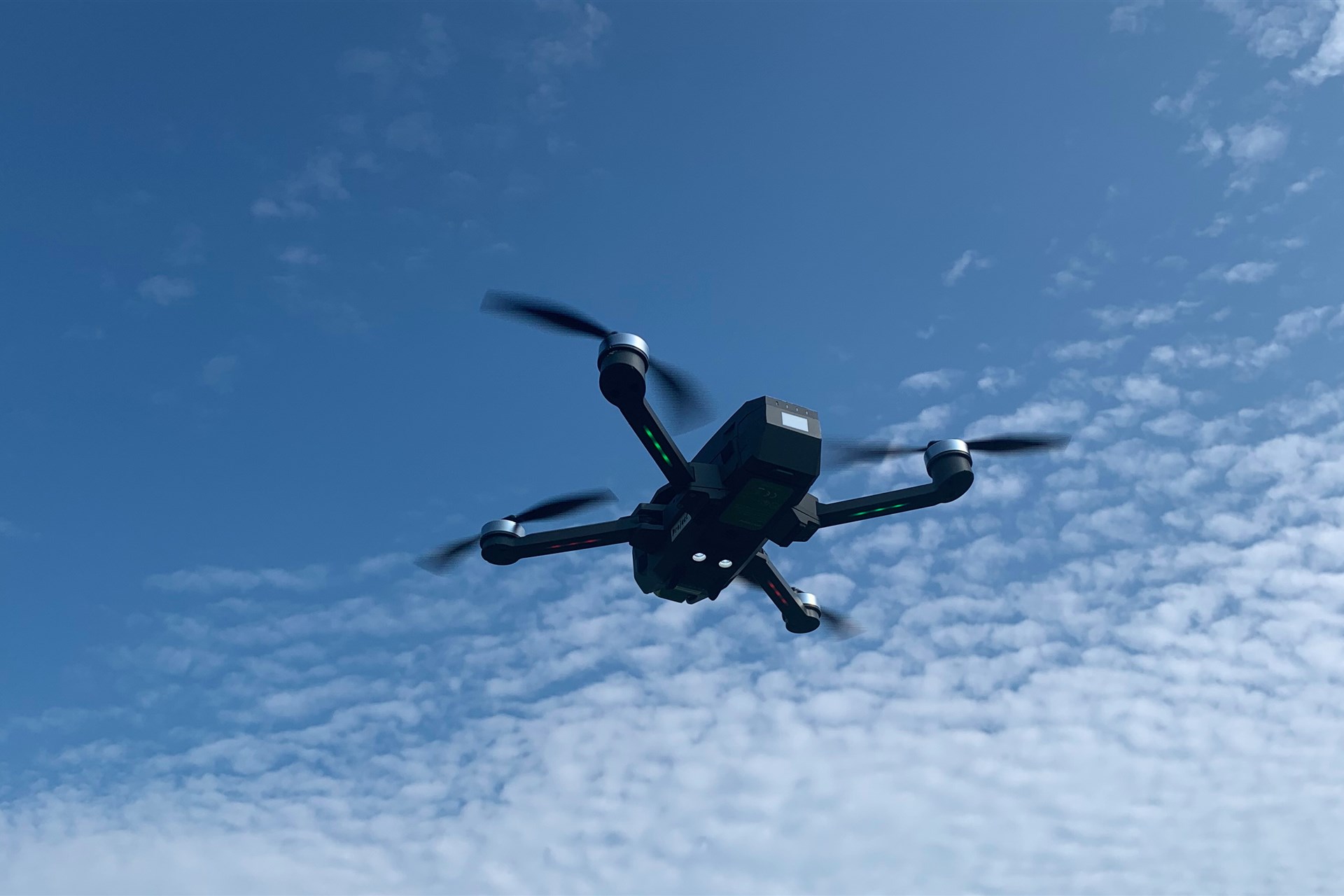
Sources: LSM, February 6, 2026; LSM, June 17, 2026; Resilience Media, September 25, 2026. Notes: the LSM February page shows no year in its text, and Lens inferred 2026 from its address and image path. The “fourth NATO member” count and the NATO-codification claim come from the companies or the investment agency and were not independently verified. Janes’s reporting on the Latvian framework contract is paywalled and was not read. Thumbnail photo: “Quadcopter Drone in flight” by Project Kei, CC BY-SA 4.0, via Wikimedia Commons, August 2, 2020; cropped. Illustrative stand-in: it shows a generic quadcopter, not a Blaze.
Image: Project Kei (CC BY-SA 4.0), via Wikimedia Commons.

