


The Startups Building Drone Interceptors: 2026 Rounds, Reported Specs and Company Claims
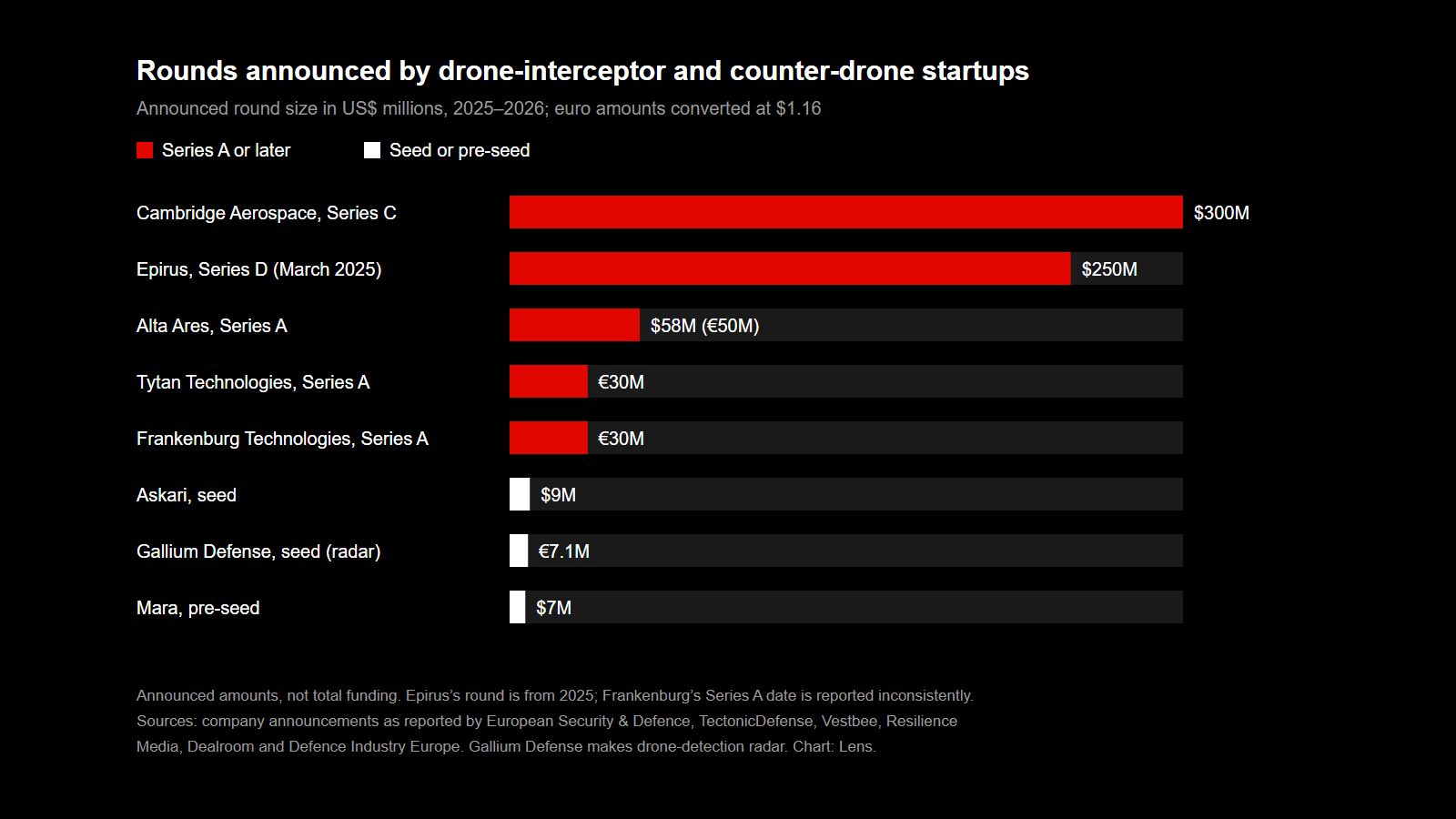

A group of startups in Europe and the United States is building small, low-cost interceptors and other systems meant to bring down attack drones such as Shahed and Geran types. Lens collected the funding rounds reported for 2026, plus one from 2025, and what each company says its product does, using company announcements as reproduced by trade outlets. Product figures and traction claims come from the companies unless noted, and none of the reports Lens read includes independent test results.
Rounds and what each company says it builds
- Tytan Technologies (Munich): a €30 million Series A reported February 24, 2026 by Vestbee, led by Armira and the NATO Innovation Fund, with Visionaries Club, OTB Ventures, Lakestar, Magnetic, D3 and 10x Group also taking part. The company, founded in 2020 by Balazs Nagy and Batuhan Yumurtaci, says its METIS interceptor reaches 350 km/h, has a 25 km range and operates up to 5,000 meters, flies autonomously and lets one operator oversee several interceptors. The announcement names no customers or production numbers and says the money is for manufacturing in Germany, Ukraine and allied markets.
- Frankenburg Technologies (Estonia): Resilience Media reported on June 22, 2026 that Bloomberg had reported a planned €100 million Series B; the round was not confirmed as closed. Its €30 million Series A was led by Plural with SmartCap, and the article dates it inconsistently, as “February 2025” and as “earlier this year.” Sources told Resilience Media the Series A valued the company at around $400 million, which the article did not confirm. Its first and only product, the Mark I, is described as “a compact, precision-guided missile-style interceptor.” A June 2026 memorandum of understanding with Milrem Robotics would put it on Milrem’s ground robots, and the company set a goal of producing 200 missiles a day, with factories planned in Germany and the UK with partners such as Babcock. No customers are named.
- Alta Ares (France): a €50 million ($58 million) Series A reported June 9, 2026 by TectonicDefense, led by Air Street Capital with Cherry Ventures, OTB Ventures and Harpoon Ventures, up from a €2 million seed the previous May. Its X-Lock is a VTOL-type interceptor for short to mid ranges, with a top speed of 270 km/h, aimed at Shahed-style drones; a turbojet variant, Black Bird, at 670 km/h, is in prototype testing. The company, founded in 2024 and led by CEO Hadrien Canter, says it has multi-million-euro contracts with governments in Europe, the Middle East and Asia, none named, and that X-Lock is deployed across three active conflict zones.
- Askari: a $9 million seed reported June 25, 2026 by Dealroom, led by Builders VC, bringing total funding to about $11 million. Founders Robbie Van Zyl and Ben Airdo met at Georgia Tech. It makes hand-launched, computer-vision-guided interceptors that hit drones directly: Rift Alpha, with a 2 km range and a top speed of 134 mph (about 216 km/h), carried one or two to a rucksack, and a smaller Rift Bravo still in development. Askari emerged from stealth in April 2026 and says it has booked more than $2 million in procurement contracts, mostly with US special operations units, and cites “damn near 90 percent intercept rates” in early tests with a tier-one customer.
- Cambridge Aerospace (UK): a $300 million Series C announced August 10, 2026 at a $3.4 billion valuation, which Lens covered in an earlier post. The company gives its Skyhammer interceptor a range of about 30 km and a top speed of about 700 km/h, and the UK defence minister said on November 4 that it has been integrated with elements of Leonardo UK’s ORCUS system in trials (Lens report).
- Mara (San Francisco): a $7 million pre-seed reported August 26, 2026 by TectonicDefense, led by Khosla Ventures with a16z’s Speedrun accelerator and others. Its Spike system pairs a Spotter detection unit with Seeker interceptors: 300 grams, tube-launched, autonomous, 125 mph (about 201 km/h) and a range of roughly one mile, with up to 48 per unit. The company gives a price of $30,000 to about $100,000 for the full solution depending on the number of Seekers. It says it was selected for NATO’s DIANA accelerator, has development partnerships with the Czech Republic, the UK and Poland, works under research agreements with three unnamed US military organizations, and is preparing a first paid order from a European NATO partner for an exercise.
- Gallium Defense (France): a €7.1 million seed round for the GDS-10 drone-detection radar, covered in an earlier Lens post. It makes detection equipment, not an interceptor.
- Epirus (US), from 2025: a $250 million Series D reported March 9, 2025, led by 8VC and Washington Harbour Partners, with General Dynamics Land Systems among returning investors and total venture funding of “over USD 550 million,” according to Defence Industry Europe. Its Leonidas is a high-power microwave system for counter-electronics, including drone swarms. The article names no contract values or test data.
The Ukrainian reference point: Sting
Wild Hornets, a Ukrainian volunteer-founded nonprofit rather than a venture-funded startup, makes the Sting interceptor, according to DroneXL on May 21, 2026. The article gives a unit cost of about $2,000, a top speed of 315 km/h, an engagement range of up to 25 km and deployment in under 15 minutes from a flat surface, none with a named source. It attributes to Wild Hornets production above 10,000 units a month, more than 3,900 Shahed and Geran-type kills by early 2026 and hit rates of 80 to 90 percent depending on operator experience, and it gives the Shahed cost as $20,000 to $50,000, also unsourced. Another report, seen only as a search-result summary, said Wild Hornets claimed more than 11,000 drones destroyed with Stings since the start of 2026; the two kill figures were not reconciled.
What is and is not verified
- Product speeds, ranges, prices, production goals and intercept rates in the entries above come from the companies or from their announcements. The reports Lens read give no independent test results.
- An announced round is not total funding. Funding totals for the same company differ between trackers, according to search-result summaries, and Epirus’s total is given as both over $550 million and in other profiles as $540 million to $595 million.
- Tytan and Frankenburg name no customers, and Alta Ares’s government customers are undisclosed.
- Frankenburg’s Series B and the roughly $400 million valuation are reported by Bloomberg and unnamed sources, and the Series A date is inconsistent in the source.
Related coverage
Lens has also reported on the US Army’s Future Interceptor award to Lockheed Martin, in which Breaking Defense said Anduril aims to price its Steelfin interceptor at a third of the PAC-3 MSE, and on European defense startup funding.
Sources and notes
Sources: Vestbee on Tytan Technologies, February 24, 2026; Resilience Media on Frankenburg Technologies, June 22, 2026; TectonicDefense on Alta Ares, June 9, 2026; Dealroom on Askari, June 25, 2026; TectonicDefense on Mara, August 26, 2026; Defence Industry Europe on Epirus, March 9, 2025; DroneXL on Sting, May 21, 2026. Notes: the chart converts euro amounts at $1.16 per euro, the rate implied by TectonicDefense’s €50 million = $58 million, and shows announced round sizes only. The Censor.net report on Sting kills returned an error (HTTP 403) and the funding-total and Frankenburg date discrepancies come from search-result summaries. Lens did not read the companies’ own releases and could not confirm any intercept rate. Thumbnail photo: “P1-Sun interceptor drone at Dubai Airshow 2025” by Mztourist, CC BY-SA 4.0, via Wikimedia Commons, photographed November 20, 2025; placed on an extended blurred background. It shows a model of one interceptor drone on display; Lens has not matched it to any company named above.
Image: Chart by Lens from company announcements as reported by trade outlets. Thumbnail photo by Mztourist via Wikimedia Commons (CC BY-SA 4.0).

