


NATO Opens Counter-Drone Marketplace With 16 Solutions From Five Companies; Alta Ares Says It Won Six Lots

NATO launched a counter-unmanned aircraft systems (C-UAS) marketplace on 5 November 2026, according to a NATO News article of that date. The NATO Communications and Information Agency (NCIA) selected 16 solutions from five companies: Alta Ares, Axon Enterprise, Northrop Grumman, OSL UK and Quantum Systems. NATO says the systems are already deployed in Allied countries and Ukraine and cover static, transportable and on-the-move configurations. The marketplace is part of Drone Edge, an initiative that NATO says was introduced in July at the NATO Summit Defence Industry Forum in Ankara.
How it works
NATO says NCIA, which hosts the NATO Counter-UAS Centre of Expertise, manages the multi-award framework contracts, which run for one and a half years. Allies can purchase directly from the NATO catalogue without a further tender, and NATO plans regular competitions so that newer technologies reach Allies. It has allocated 3.1 million euros to fund further testing of the selected solutions by nations or NATO commands. Separately, under Drone Edge, Allies have committed to invest more than 40 billion US dollars in counter-drone capabilities over five years, which NATO says the marketplace complements.
AeroTime, which reported the launch, describes the contract terms differently in one respect. It says the frameworks last 18 months from signing with an option to extend, and that they are not purchase orders: under NCIA’s original plan, individual orders would be placed through later contracts with the selected suppliers. AeroTime notes that this sits alongside the statement that countries can order without a separate tender, and does not explain how the two fit together. It lists four evaluation scenarios: area protection of a zone up to 3 kilometres in diameter, a 20-kilometre border segment, a convoy up to 300 metres long moving at up to 50 km/h, and point protection of a single high-value site.
Alta Ares’s claim
AeroTime reports that Alta Ares announced on 5 November that it had secured six of the 16 lots, covering area defense and border protection, and that it was the only supplier selected for area defense across fixed, deployable and mobile setups. The article does not say NATO confirmed the figure, and says NATO has not yet published the full lot-by-company breakdown. No lot counts are given for the other four suppliers, and neither NATO nor AeroTime names their products in the catalogue; AeroTime mentions Alta Ares’s Blackbird interceptor only in a photo caption and does not say it is included. Lens covered Alta Ares in an earlier overview of counter-drone interceptor startups.
Background
According to AeroTime, NCIA notified nations of the planned framework on 17 October 2025, with a one-year term and awards expected by 30 January 2026, so the competition predates Drone Edge. It reports that Drone Edge launched on 7 July 2026 in Ankara with the over-40-billion-dollar commitment (35.6 billion euros), and that on 27 July 2026 the NATO Support and Procurement Agency set up five separate frameworks for tactical and deployable systems, naming Axon, BSS, DEFSECINTEL, JISR and CS Group France. AeroTime also reports that Alta Ares signed a memorandum of understanding with Airbus Defence and Space in June 2026.
Sources and notes
Sources: NATO News, 5 November 2026, and AeroTime’s report on the launch. Neither contains direct quotations from named officials. Lens did not read Alta Ares’s own announcement, so the six-lot figure is AeroTime’s account of it; the “already deployed” description is NATO’s own. AeroTime says the original 2025 notice limited eligibility to operationally proven systems and excluded man-portable and wearable systems, and does not confirm those limits still apply. The full list of the 16 solutions has not been published in the sources Lens read.
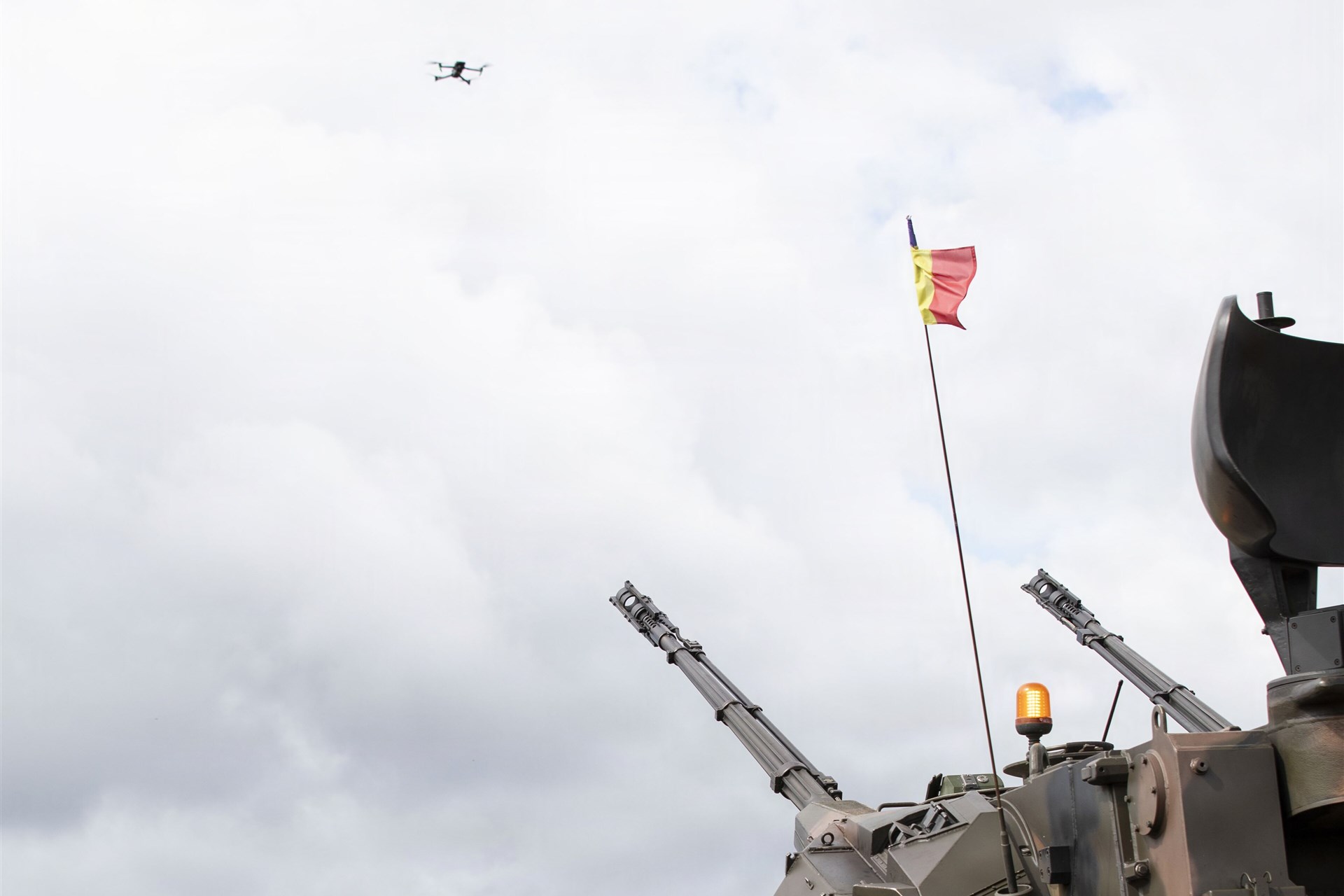
Image: A Romanian Gepard 35 mm self-propelled anti-aircraft gun tracking a drone during joint anti-UAS training at Bemowo Piskie Training Area, Poland, in August 2026. Photo: US Army Reserve Staff Sgt. Emilie Lenglain, public domain, via Wikimedia Commons. Stand-in photograph; the Gepard is not among the systems named in the marketplace.

