


Brave1 Says MaXon Systems’ Interceptor Automates 95% of Shahed Interceptions After Kharkiv Combat Test

A counter-drone system from the Ukrainian start-up MaXon Systems automates 95% of the process of intercepting Shahed-type attack drones, from launching the interceptor to shooting down the target, according to Brave1, Ukraine’s state-backed defence technology cluster. In a news item dated 8 June 2026, Brave1 said the technology had passed combat testing in the Kharkiv region and that soldiers of the B12 unmanned systems unit of the 12th Separate Special Purpose Center were the first to use it. Mykhailo Fedorov, Ukraine’s defence minister at the time, announced the result the same day, Militarnyi reported. MaXon Systems is a member of the Brave1 cluster.
How the system works, according to Brave1
Brave1 said the drone integrates with Ukraine’s radar network, which lets it track aerial targets in real time. The operator selects a target in a dedicated program and gives the command to engage, and the program then guides the drone to the target on its own. As the drone approaches, artificial intelligence (AI) identifies and locks onto the Shahed. Brave1 said control remains with the human operator, who can call off the attack at any moment.
What the company told Defender Media
In an interview published on 8 June by Defender Media, a Ukrainian defence technology outlet, MaXon co-founder and chief executive Oleksii Solntsev described the interceptor as a small fixed-wing drone. According to the interview:
- Performance: it carries a 1 kg warhead, can patrol for up to 70 minutes, pursues targets at 200 to 250 km/h and can hold 300 km/h for several minutes. Its operating radius is 30 km.
- Automation: launch and climb, flight to the selected target and terminal guidance are all automated. The operator can choose the speed and method of approach. An AI system from a Dutch partner, which the interview does not name, handles detection and terminal guidance.
- Navigation: the system uses beacons from a partner company and onboard sensors, so the crew can track the interceptor where GPS is unavailable.
- Combat trials: Solntsev said the system had several confirmed Shahed kills and that 90 to 95% of the engagement process was autonomous, with pilots occasionally adjusting the flight path.
- Cost: about $3,500 per interceptor.
Solntsev said MaXon was moving into early scaling and preparing to fulfil its first order from a military unit, and that the company had started the codification process for the system. Defence Blog described codification as the formal registration with Ukrainian defence authorities that precedes official military procurement. Solntsev said the company plans to develop remote control of several launch stations by a single operator and to upgrade its interceptors to counter jet-powered Shaheds.
Funding
Brave1 said its support helped MaXon close an investment round and take the technology from prototype to combat deployment within a year. Reported funding:
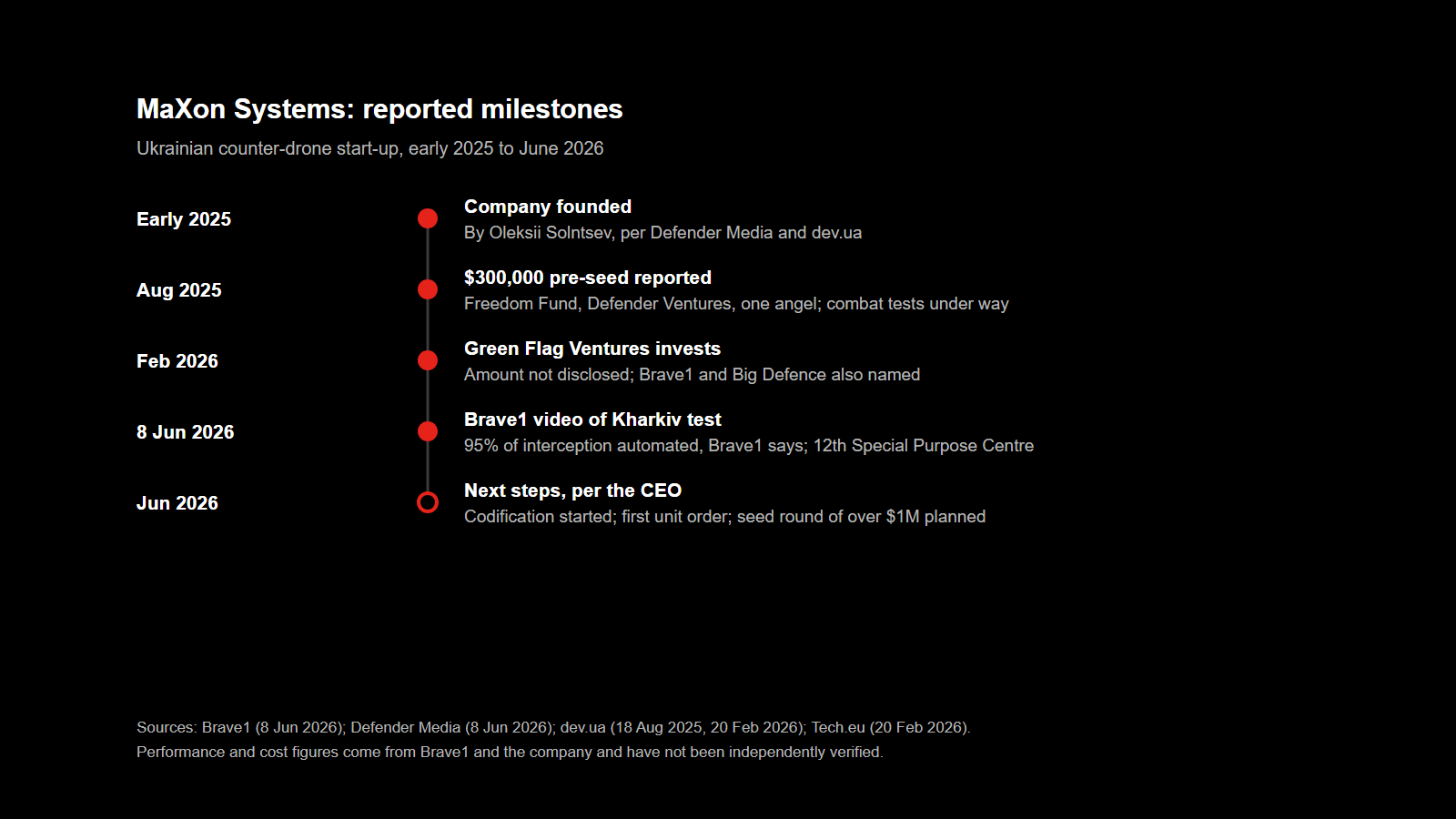
- August 2025: dev.ua, citing Defender Media, reported a $300,000 pre-seed round from Freedom Fund, Defender Ventures (the fund of the Defence Builder accelerator) and one business angel.
- February 2026: the US fund Green Flag Ventures announced an investment in MaXon without disclosing the amount, according to Tech.eu, Kyiv Post and dev.ua. Tech.eu listed Greenflag Ventures, Brave1, Freedom Fund VC and Big Defence as participants in the round.
- June 2026: Defender Media reported that MaXon had closed its pre-seed round, with Green Flag Ventures, the Swedish fund Hede Capital and the Finnish investor Big Defence joining the earlier backers. Solntsev did not disclose the total and said MaXon plans to raise more than $1 million in a seed round.
Earlier development
Solntsev founded MaXon in early 2025 and previously co-founded SmartZavod, a Ukrainian-German manufacturing technology project, according to dev.ua. In August 2025 the company was developing interceptors launched from aerostats, or tethered balloons, dev.ua reported; Defender Media said that concept was later postponed and the current interceptor, launched from the ground, was developed essentially from scratch. Kyiv Post reported in February 2026 that Fedorov had said the system was tested in the Kyiv and Chernihiv regions. According to DOU, a Ukrainian IT community site, MaXon’s company profile there lists up to 20 employees.
Lens has also covered other counter-drone interceptor start-ups and their funding rounds.
Sources and notes
Read in full: Brave1’s news item “Ukrainian drones are already shooting down Shaheds in autonomous mode” (8 June 2026); Defender Media’s interview with Solntsev (8 June 2026); Militarnyi (8 June 2026); UNITED24 Media (8 June 2026); Defence Blog (9 June 2026); Tech.eu (20 February 2026); Kyiv Post (23 February 2026); dev.ua on the pre-seed round (18 August 2025) and Green Flag investment (20 February 2026); DOU (in Ukrainian; no date shown on the copy Lens read); and Razom (8 June 2026, in Ukrainian). Lens did not watch Brave1’s video, did not read Fedorov’s own post or Green Flag Ventures’ LinkedIn post, and did not read Defender Media’s August 2025 article except as cited by dev.ua. Lens saw only headlines, from NPR (16 July 2026) and Meduza (25 August 2026), reporting that Fedorov was removed as defence minister in July 2026. The performance, kill and cost figures come from Brave1 and the company and have not been independently verified. Conflicts: UNITED24 wrote that Brave1 reported the system on 22 May, while Brave1’s page is dated 8 June; Razom attributed a $300,000 investment to Green Flag Ventures, while dev.ua tied the $300,000 to the August 2025 round with Freedom Fund and Defender Ventures; Brave1 said “within a year” and Fedorov, as reported by Militarnyi, said less than a year. The chief executive’s name is spelled Oleksii Solntsev by Defender Media, Oleksiy by Defence Blog and Alexey by dev.ua, and the fund appears as both Green Flag Ventures and Greenflag Ventures. Thumbnail photo: “MD-550 Shahed-136 20260702 122912cr” by Zenwort via Wikimedia Commons, licensed under CC BY-SA 4.0; cropped. It shows the destroyed MD-550 engine of a Shahed-136 drone, photographed on 2 July 2026. Illustrative photo; it does not show MaXon’s interceptor or the events described.
Image: Lens chart built from the figures above. Thumbnail: Zenwort via Wikimedia Commons (CC BY-SA 4.0).

