


Foundation’s Phantom Humanoids in Ukraine and Its $24 Million in US Military Research Work: What Has Been Reported

Foundation Future Industries, a San Francisco company building a humanoid robot called Phantom, sent two Phantom MK-1 units to Ukraine in February 2026, the company told TIME, according to Militarnyi on March 13, which relayed TIME’s report of March 9. The company also reports about $24 million in US military research work. Lens did not read TIME, CNBC or WIRED directly; their reporting is described here as relayed by the outlets named.
What the robots did in Ukraine
- March: Militarnyi, citing TIME, said they were intended for resupply and reconnaissance. Co-founder Mike LeBlanc said they would be “invaluable for resupplying and conducting reconnaissance, especially in places drones cannot reach.”
- May 30: The Next Web, Babel and Militarnyi, citing CNBC, said the tests involved logistics in hazardous areas, such as supply pickups, backed by the US government and conducted with Ukrainian officials.
- July: AI Weekly, citing WIRED, said their use was limited to support and reconnaissance and that they were not authorized to use lethal force autonomously.
No Ukrainian unit, location or official assessment has been named in any report Lens read. The company describes the tests as the first known deployment of humanoid robots in a combat theater; The Next Web noted that the units performed support tasks and that no humanoid robot has fired a weapon in a conflict. The Next Web and Babel, citing CNBC, reported that the MK-1 lacks waterproofing and sufficient battery life.
The $24 million
- TIME reported in March that Foundation had research contracts totaling $24 million with the US Army, Navy and Air Force, and that Marine Corps trials were planned to train Phantom to place breaching charges on doors (via Militarnyi).
- The figure became a news story on April 23, when Eric Trump and chief executive Sankaet Pathak discussed it on Fox Business (Fox Business, Mediaite, New Republic).
- The Next Web reported on April 26 that these are research agreements, not production orders, that they include an SBIR Phase III designation, and that some came through Foundation’s acquisition of Boardwalk Robotics, including an Air Force SBIR award of about $1.8 million.
- Forklog, relaying WIRED on July 17, reported that Foundation pointed to two contracts inherited from Boardwalk and three projects run through IHMC, that WIRED found no confirmation of a new contract for the full amount, and that the SBIR registry lists the Boardwalk Air Force award under Phase II.
Lens did not find a government contract record for the total.
Eric Trump’s role
Fox Business described Eric Trump as Foundation’s chief strategy adviser and said he has invested in the company; Mediaite said the title was given in March. A Foundation spokesperson told CNBC that he had been an investor before becoming an adviser (The Next Web, Babel). No investment amount has been disclosed. On Fox Business, Eric Trump said: “We are America First. We have to win this race,”. Senator Elizabeth Warren wrote after the appearance: “Is the Pentagon just a cash machine for Trump's kids now? This looks like corruption in plain sight,” according to Democracy Now on April 24.
The company and its plans
- Founded in April 2024, according to The Next Web. Pathak previously led the fintech company Synapse, which filed for bankruptcy in 2024; co-founders include Mike LeBlanc and Arjun Sethi (The Next Web).
- About $21 million raised, with the company seeking $500 million at a valuation above $3 billion (The Next Web, April 26).
- Production targets, all company claims: 10,000 units in 2026 and 50,000 by the end of 2027 (The Next Web, April 26); “thousands of units this year” and deployment with the US military within 12 to 18 months (CNBC, via The Next Web, May 30). A unit cost of about $150,000, or a lease of about $100,000 a year (The Next Web).
- Specifications differ: The Next Web gave the MK-1 a payload of 44 lb; Foundation’s Phantom page now lists 88.2 lb (40 kg) without naming the model. Both give a weight of 176 lb and a speed of 1.7 m/s.
Pathak told WIRED, as relayed by Forklog: “We are exploring several kinetic solutions.” Rodney Brooks, professor emeritus at MIT, told WIRED, also via Forklog: “The transition from a reliable lab demonstration to initial deployment in robotics always takes at least 10 years.”
Related: Ukraine’s Brave1 grants for military humanoid robots; Mykhailo Fedorov’s “Army of Robots”.
Sources and notes
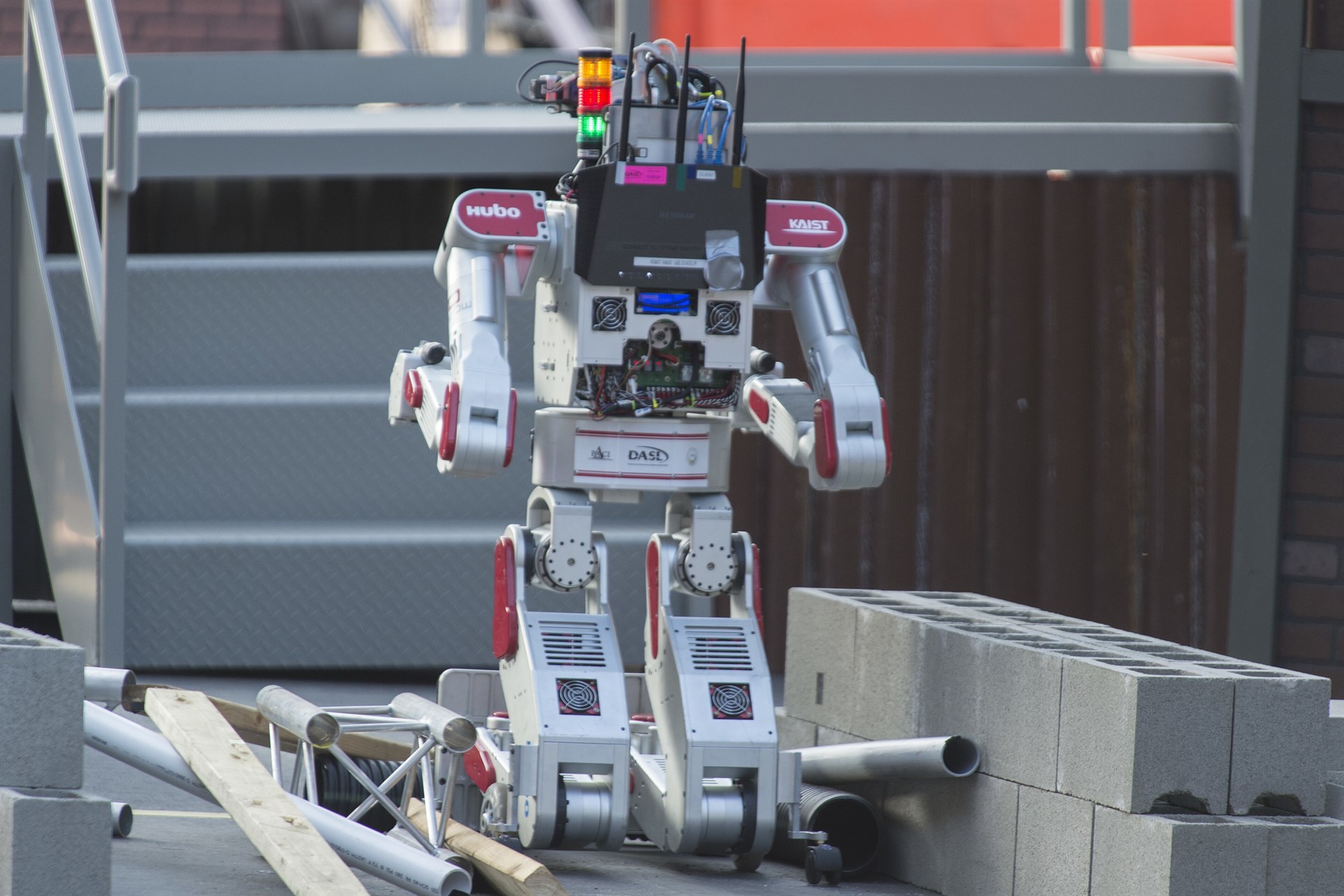
Sources: Militarnyi, March 13, 2026 and May 31; Fox Business, April 23; Mediaite, April 23; New Republic, April 23; Democracy Now, April 24; The Next Web, April 26 and May 30; Babel, May 31; Forklog, July 17; AI Weekly, July 19; Foundation, Phantom page, read November 12. Notes: TIME (March 9), CNBC (May 30) and WIRED (July) were not read directly. Gwara Media dates the delivery to March 13, which is when the first reports relaying TIME were published. The Next Web gives Warren’s wording slightly differently, and the platform she posted on was not stated in the sources read. Whether the SBIR designation is Phase III or Phase II is unresolved. Thumbnail photo: KAIST’s DRC-HUBO humanoid crossing a debris field at the Pentagon-funded DARPA Robotics Challenge finals in Pomona, California, June 2015, by Master Chief Petty Officer John Williams, U.S. Navy, public domain, via Wikimedia Commons; the robot carries its own Hubo, KAIST and DASL lettering. Illustrative stand-in: it does not show a Foundation robot.
Image: MCPO John Williams, U.S. Navy (public domain), via Wikimedia Commons.

