


ECB Survey: Euro Area Firms Plan to Fund AI Mostly With Internal Funds; 22% Applied for Bank Loans

The European Central Bank (ECB) said 22 percent of euro area firms applied for bank loans in the third quarter of 2026, compared with 23 percent in the second quarter, according to results of its Survey on the Access to Finance of Enterprises (SAFE) posted on 26 October 2026. The main reason firms gave for not applying was that they had sufficient internal funds, cited by 50 percent. In the previous round, published on 20 July 2026, the ECB reported that firms planning investment in artificial intelligence (AI) expected to pay for it mainly from internal funds (72 percent), with bank loans, grants and leasing each at around 16 percent.
Bank loans in the third quarter
The third-quarter results come from the survey’s 40th round, conducted between 26 August and 2 October 2026 among 12,822 euro area enterprises, of which 11,917 (93 percent) had fewer than 250 employees. The ECB said first-time respondents made up the majority of this round’s sample, which it said makes the answers to numerical questions challenging to interpret at this stage.
According to the report, 18 percent of small and medium-sized enterprises (SMEs) applied for bank loans in the quarter, compared with 29 percent of large firms. The share of firms citing sufficient internal funds as their reason for not applying rose to 50 percent from 45 percent. Discouraged borrowers, meaning firms that needed a loan but did not apply for fear of rejection, made up 4 percent of firms. Among firms that considered bank loans relevant, 7 percent reported obstacles to obtaining one, up from 5 percent.
A net 5 percent of firms reported lower availability of bank loans, after a net 1 percent in the second quarter, while a net 2 percent reported lower needs for bank loans. The ECB’s bank loan financing gap indicator, which captures the difference between changes in needs and availability, stood at a net 2 percent, compared with a net 3 percent in the previous quarter. Looking ahead, a net 8 percent of firms expected access to bank loans to worsen over the next three months.
Interest rates and other terms
A net 46 percent of firms reported higher bank interest rates in the third quarter, up from 42 percent in the second quarter, according to the ECB. Large firms reported increases more often (net 55 percent, up from 41 percent) than SMEs (net 38 percent, after 43 percent). A net 27 percent reported higher other financing costs such as charges, fees and commissions (31 percent previously), and a net 14 percent reported stricter collateral requirements (10 percent previously). On balance, 5 percent of firms reported an improvement in banks’ willingness to lend, compared with 6 percent in the second quarter. The ECB’s July press release had put the net share reporting higher interest rates at 42 percent in the second quarter, against 26 percent in the first.
How firms plan to pay for AI
The second-quarter round, conducted between 21 May and 26 June 2026 among 5,087 firms, included ad hoc questions on AI. According to the ECB’s report on that round, 49 percent of firms plan to invest in AI technologies and tools, such as software licences, over the next 12 months, 46 percent in training employees, 40 percent in data and infrastructure and 12 percent in hiring AI specialists, while 38 percent did not select any of these categories.
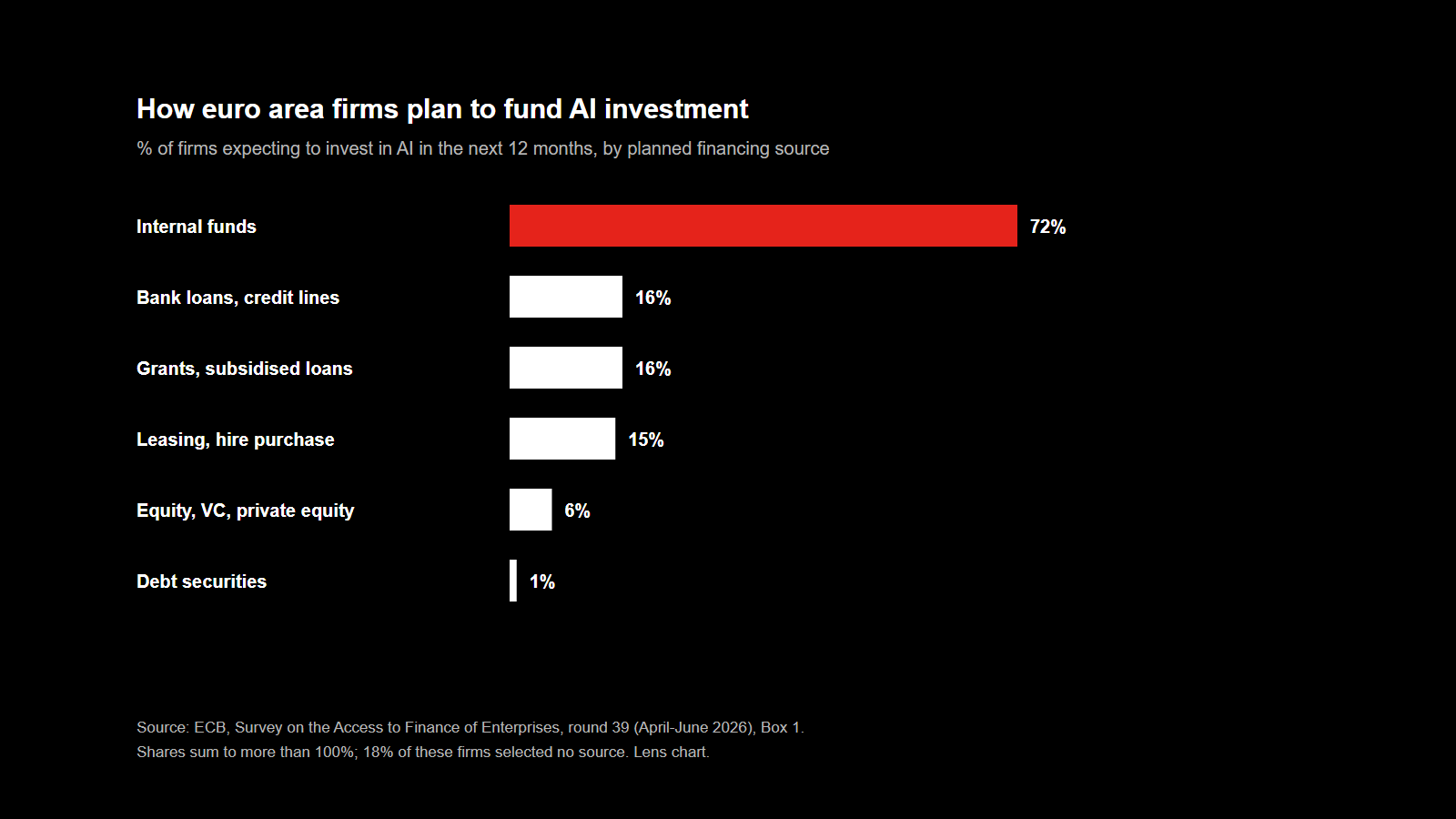
Among firms expecting to invest in AI, 72 percent plan to use internal funds, 16 percent bank loans, 16 percent grants, 15 percent leasing, 6 percent equity or venture capital and 1 percent debt securities, the report said. The press release described bank loans, grants and leasing as each accounting for around 16 percent. The six shares sum to 126 percent (Lens arithmetic). A further 18 percent of these firms did not select any financing option, which the ECB said likely means they remain undecided. The ECB also said more large firms than SMEs plan to rely on internal funds, bank loans and leasing. Lens has separately reported on how AI is changing startup formation.
Sources and notes
Primary sources read in full: the ECB’s SAFE report for the third quarter of 2026 (the page metadata gives 26 October 2026 as its online date), the ECB press release of 20 July 2026, and the SAFE report for the second quarter of 2026, including its Box 1 on AI investment. A “net” figure is the share of firms reporting an increase minus the share reporting a decrease. Third-quarter figures cited here refer to firms asked about July to September 2026; about half of the sample was asked about April to September 2026, and the ECB reports those six-month answers separately. The AI financing shares are percentages of firms that expect to invest in AI over the next 12 months, not of all firms. The questionnaire options were bank loans and credit lines; grants or subsidised bank loans; leasing or hire purchase; debt securities; equity capital, venture capital or private equity; and internal funds. The press release rounds bank loans, grants and leasing to around 16 percent each; the report gives 16, 16 and 15 percent. The third-quarter report gives large firms’ second-quarter bank loan availability as a net 4 percent in its overview and a net 3 percent in its Section 2.2; the July press release gives a net 4 percent. No figure in this article relies only on search summaries or secondary coverage. Thumbnail photo: “Seat of the European Central Bank and Frankfurt Skyline at dawn 20150422 1” by DXR via Wikimedia Commons, licensed under CC BY-SA 4.0; cropped. The European Central Bank's headquarters tower on the River Main in Frankfurt at dawn, with the city's banking skyline in the distance. Illustrative photo.
Image: Lens chart built from the figures above. Thumbnail: DXR via Wikimedia Commons (CC BY-SA 4.0).

