


How AI Is Changing Startup Formation: Reported Data From Carta, AWS and Harvard-INSEAD


Several data sources report changes in how startups are formed and staffed since generative AI tools became widely available. This reference summarizes three of them: Carta’s data on solo founders, an AWS survey of AI-native startups, and a Harvard Business School and INSEAD working paper on AI-native firms. Each uses its own sample and definitions.
Solo and small founding teams: Carta
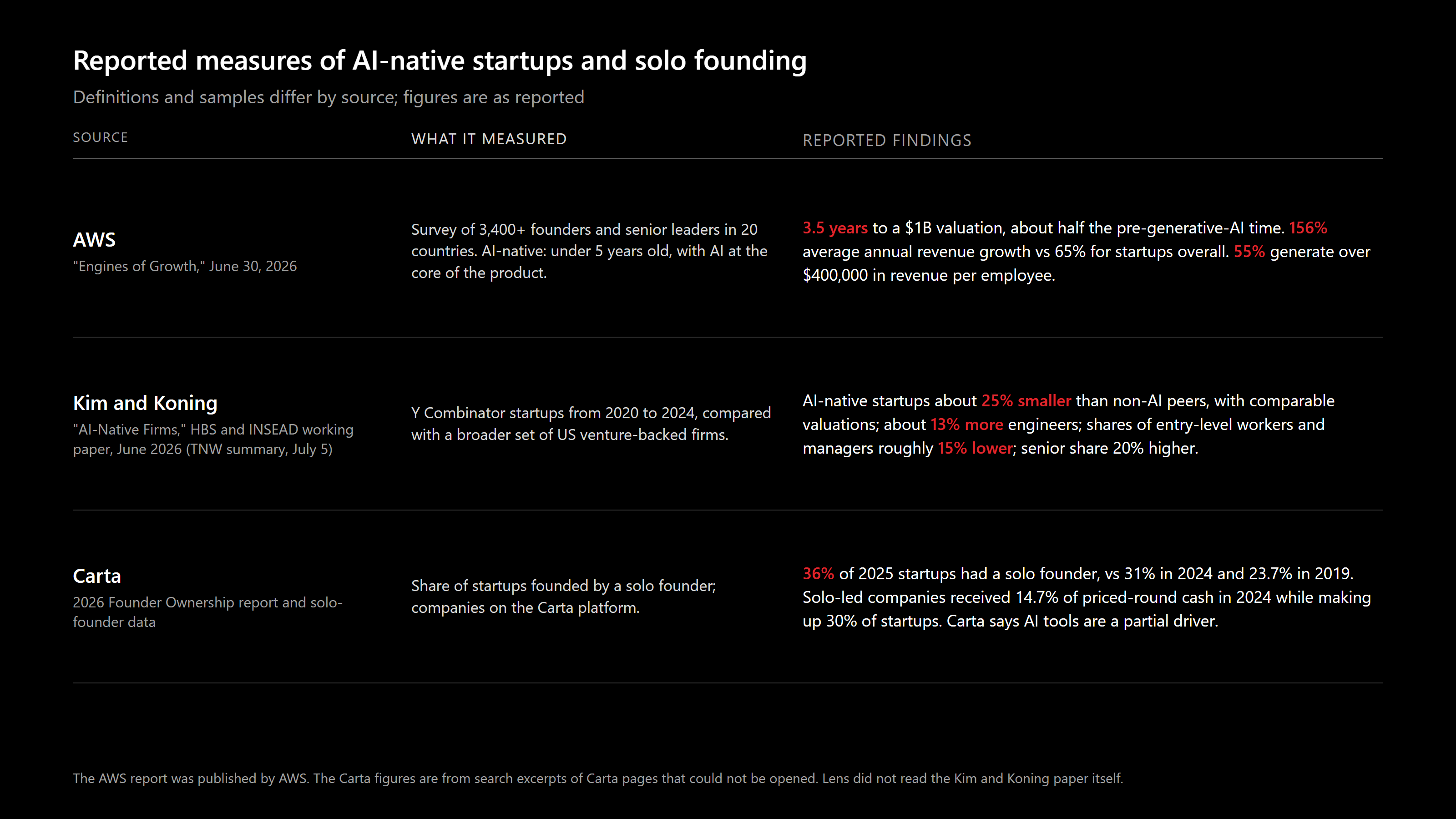
Carta reports that about 36% of startups founded on its platform in 2025 had a solo founder, against 31% in 2024, according to its 2026 Founder Ownership Report. Carta’s earlier solo-founder data put the share of new startups with a solo founder at 23.7% in 2019 and 36.3% in the first half of 2025, and put solo founders at 18% of Carta companies in 2016. Carta says the rise is driven partly by AI tools. Larger founding teams have become less common: in 2024, three-founder companies were 16% of new startups, four-founder companies 7% and five-founder companies 4%, each the lowest level in ten years, according to Carta. Solo-led companies made up 30% of 2024 startups and received 14.7% of the cash raised in priced equity rounds that year.

AI-native startups: AWS survey
AWS published its Global Startup Trends report, “Engines of Growth,” on June 30, 2026, based on a survey of more than 3,400 founders and senior leaders in 20 countries. It defines AI-native startups as companies under five years old that build products with AI at their core. The report says AI-native startups reach a $1 billion valuation in 3.5 years, roughly half the time of the pre-generative-AI era, with half the staff. It reports average annual revenue growth of 156%, against 65% for startups overall, and says 55% of AI-native startups generate more than $400,000 in revenue per employee. It also reports that 98% of AI-native startups employ dedicated in-house AI talent, against 70% of large enterprises, and that the US, UK, Germany, Israel and Singapore hold 60% of AI-native startups. The report was published by AWS, a cloud provider.
Headcount and workforce mix: Harvard Business School and INSEAD
A working paper by Hyunjin Kim of INSEAD and Rembrand Koning of Harvard Business School, “AI-Native Firms,” dated June 9, 2026, compares Y Combinator startups from 2020 to 2024 with a broader set of US venture-backed firms, according to The Next Web’s July 5, 2026 summary. Another summary says the paper counts a startup as AI-native if it uses AI internally to raise employee productivity or embeds AI in products so customers can automate work that once required human teams. According to The Next Web, AI-native startups are 25% smaller than non-AI peers, with comparable valuations; they employ 13% more engineers; their shares of entry-level workers and managers are roughly 15% lower; and their share of senior workers is 20% higher.
Examples of small-team companies
Reporting describes several companies with small headcounts relative to revenue. Gamma has about 50 employees and reports more than $100 million in annual recurring revenue. Dealroom describes Medvi as having one employee and outside partners. Sacra lists approximately 40 to 45 employees at Midjourney. Funding details and caveats for these companies are in Lens’s companion article, Companies Reported to Reach Large Revenue or Valuation With Little or No Outside Funding.
Definitions and scope
- AWS: AI-native means a company under five years old that builds products with AI at its core. The data come from a survey, and the report was published by AWS.
- Kim and Koning: AI-native means a startup that uses AI internally to raise employee productivity or embeds it in products to automate work. The sample is Y Combinator startups from 2020 to 2024 compared with a broader set of US venture-backed firms.
- Carta: The data measure the share of startups with a solo founder among companies on the Carta platform.
Sources and notes
AWS: AWS Global Startup Trends report press release, June 30, 2026. Harvard Business School and INSEAD: The Next Web, July 5, 2026. Carta: 2026 Founder Ownership Report; solo-founder data, 2016 to 2025; Solo Founders Report. The Carta figures are from search excerpts of Carta pages that could not be opened; Carta’s data appear as 31% for the 2024 solo-founder share in one place and as 30% of 2024 startups in another. The AWS figures are from its press release; its methodology was not reviewed. The Kim and Koning paper was not read; a separate search summary of it says the 25% figure applies to the Y Combinator sample and about 12% to a broader sample, a distinction The Next Web does not make. Graphics: Lens, from the cited reporting. Thumbnail photo: a laptop on a desk, 2014. Photo by www.Pixel.la Free Stock Photos via Wikimedia Commons, released under CC0; cropped. Illustrative photo; it does not show the companies or data described.


