


UK Minister Says Skyhammer Interceptor Has Been Integrated With Elements of ORCUS Counter-Drone System in Trials

UK Minister for Defence Readiness and Industry Luke Pollard said in a parliamentary answer that Cambridge Aerospace’s Skyhammer interceptor “has been successfully integrated with elements of the ORCUS counter-uncrewed air system during UK trials,” UK Defence Journal reported on November 4, 2026. He added that “further integration, testing and assurance activity is continuing to develop the capability,” including its “command-and-control and sensor interfaces.” The question was asked by Ben Obese-Jecty, the Conservative MP for Huntingdon.
The two systems
- Skyhammer: UK Defence Journal describes it as a Cambridge Aerospace interceptor aimed at Shahed-style attack drones, with a company-stated range of about 30 km, a top speed of about 700 km/h and a payload of roughly 2 kg. It is turbojet-powered, launched from a ground-based tube and guided autonomously after launch, takes target-tracking data from an external command-and-control system, and uses radar-derived targeting plus a terminal electro-optical seeker. Development began in January 2025, with initial flight testing about six weeks later.
- ORCUS: a modular counter-drone system developed by Leonardo UK under the RAF’s Project Synergia program, combining radar, radio-frequency detection and electro-optical sensors to detect, track and identify aircraft, with long-range thermal imaging. UK Defence Journal says it can use electronic countermeasures against some drones, reached initial operating capability in September 2020 and is operated by RAF Regiment personnel.
Contract and Gulf context
UK Defence Journal reported that the Ministry of Defence announced in April plans to buy the interceptor and its launchers for UK forces and Gulf partners, with first deliveries possible from May, and that Pollard watched a Skyhammer test in Jordan shortly after the contract was signed. Defense Express wrote on November 7 that one can assume the integration is “designed specifically to protect Persian Gulf countries” from jet drone raids. That is its own assessment, based on preliminary information that Britain planned to transfer Skyhammer to Gulf countries, Skyhammer desert trials in Jordan in May 2026, Britain’s delivery of ORCUS to Kuwait in 2026, a reported shortage of conventional interceptors in the region, and ORCUS’s portability, which it says lets it fit in a Chinook’s cargo bay. Neither article gives prices, contract values or order quantities.
Lens has reported on the company’s funding in Cambridge Aerospace Raises $300 Million at a $3.4 Billion Valuation in Series C Led by DFJ Growth.
Sources and notes
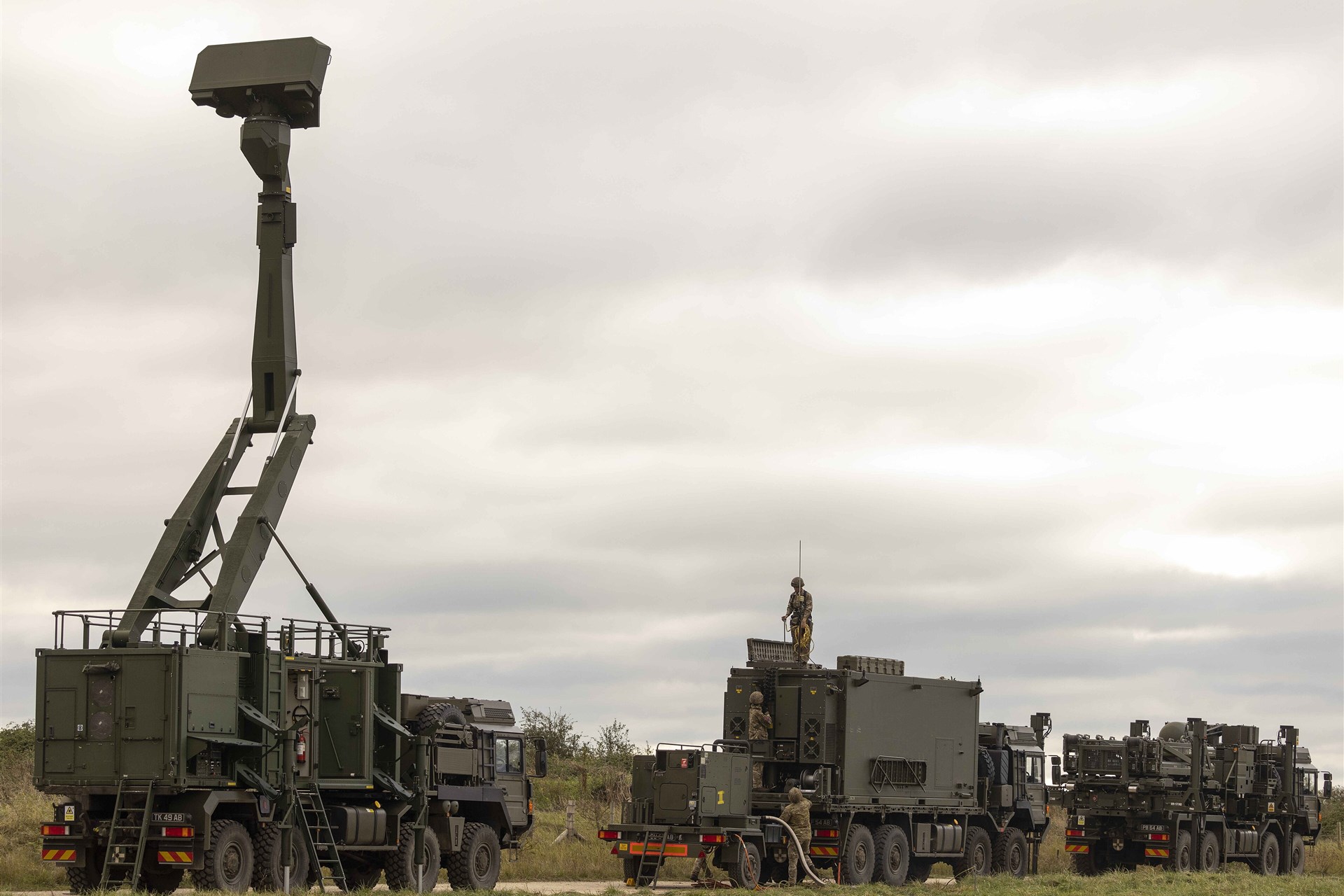
Sources: UK Defence Journal, George Allison, November 4, 2026; Defense Express, November 7, 2026 (no named author). Notes: Lens did not read the parliamentary record, and UK Defence Journal does not give the date of Pollard’s answer or say which ORCUS elements were integrated. The Kuwait delivery is stated by Defense Express and was not verified. The Gulf-market framing is Defense Express’s assessment, not a confirmed buyer or contract. Thumbnail photo: “Royal Artillery Sky Sabre system” by the Ministry of Defence, showing soldiers of 16th Regiment Royal Artillery, November 4, 2021, via Wikimedia Commons; cropped. Contains public sector information licensed under the Open Government Licence v1.0. Illustrative stand-in: it shows Sky Sabre, a different UK air defense system, not Skyhammer or ORCUS.
Image: Ministry of Defence (Open Government Licence v1.0), via Wikimedia Commons.

