


U.S. Approves Possible $100 Million Sale of Up to 1,500 APKWS II Guidance Kits to Jordan

The US State Department identified a possible Foreign Military Sale to Jordan of Advanced Precision Kill Weapon System II (APKWS II) rockets and related equipment on November 2, 2026, according to Army Recognition. Australian Defence quoted the notice as covering “up to 1,500 WGU-59A/B or B/B” kits, as all-up rounds or guidance sections, with an “estimated total cost” of $100 million. Defense Express reported on November 5 that this works out to about $66,670 per rocket on its “rough calculation.”
What the notice covers
- Items listed: launchers, Mk-152 high explosive warheads, MK66 rocket motors, proximity fuzes, WTU-1/B practice warheads, inert MK66 rocket motors, support equipment, publications and technical documentation, transportation, and US government and contractor engineering, technical, training and logistical support.
- Stated rationale, as quoted by Australian Defence: the sale “will improve Jordan’s capability to meet current and future threats,” provides “enhancement to its air defense capability in support of the Middle East Air Defense pillar,” will “allow for the reduction of sustained US support over time” and will “provide increased security for US military assets stationed in Jordan.”
- The prime contractor named is BAE Systems of Nashua, New Hampshire.
- The approval is for a “possible” sale, the quantity is “up to” 1,500, and the cost is an estimate. Army Recognition says the sale is subject to completion of the Foreign Military Sales process and that the aircraft Jordan intends to use has not been established.
Figures Defense Express compares
Defense Express puts Jordan’s unit cost at about $66,670 and says it is about twice the US domestic cost, a figure the article does not state and links to an earlier Defense Express article. It compares this with a UAE sale it gives as $1.041 billion for 10,000 kits, or $104,100 each, without naming a source. The article says the price gap “could be explained” by differences in versions, configurations, accompanying services and delivery timelines, that the exact reason is not officially stated, and that approval prices are maximum possible values. Its headline says Jordan’s price is “half of UAE’s bill”; by Lens’s arithmetic, its per-unit figures put Jordan’s at about 64% of the UAE’s.
Other APKWS approvals this year
The Defense Post reported on May 4, 2026 that State Department approvals that month covered 10,000 APKWS II all-up rounds each for Israel and Qatar at an estimated $992.4 million each, and 1,500 air-to-air configured guidance sections for the UAE at an estimated $147.6 million. Those UAE figures do not match the sale Defense Express cites, and Lens could not tell whether they describe different approvals. The Defense Post said an emergency was cited to justify immediate approval of those sales.
Use against drones
Defense Express calls APKWS a “relatively cheap means of intercepting drones” and says it “proved effectiveness in intercepting drones” in Ukrainian and American hands. It describes the system as laser-guided kits fitted to 70 mm unguided Hydra rockets, launched from helicopters, fighters, the ground-based Vampire air defense system and naval platforms, and says Jordan has F-16A/B Block 20 MLU fighters and AH-1F helicopters that can employ it. It estimates strike drones at about $50,000 and says Geran-4 jet drones cost more than $100,000. It also recalls that US APKWS II output was planned to rise from 25,000 to 35,000 per year over seven years.
Sources and notes
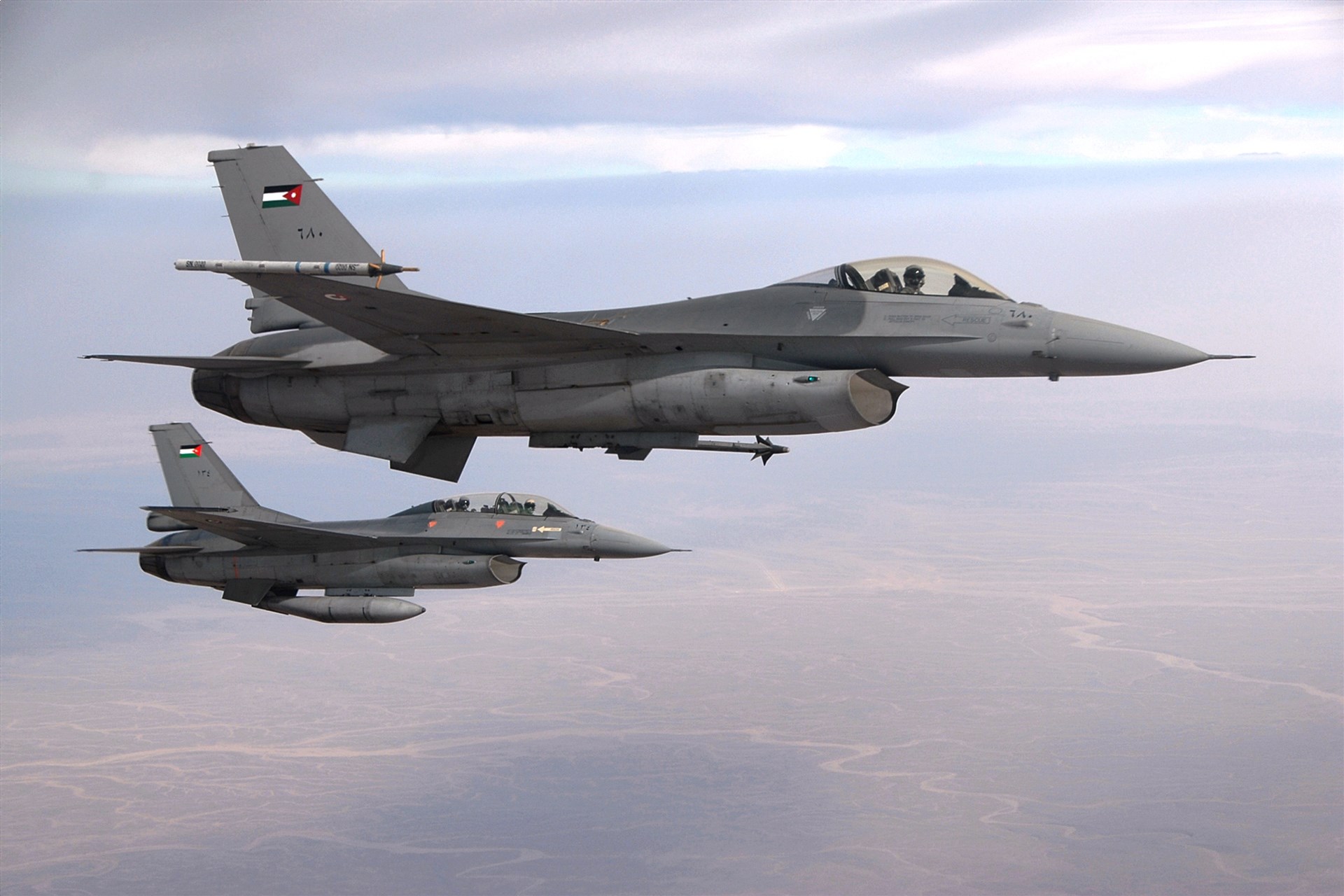
Sources: Australian Defence, November 4, 2026; Army Recognition, November 3, 2026; The Defense Post, May 4, 2026; Defense Express, Borys Gulkevych, November 5, 2026. Notes: Lens did not read the State Department notice itself. The Army Recognition article gives no quantity or value, and Defense Express does not name the notice or its date. The quantity and cost come from Australian Defence’s account of the notice, which gives no separate date for the determination. The cost is an estimated ceiling, not a contract. Thumbnail photo: “Two F-16 of the Royal Jordanian Air Force” by Caycee Cook, U.S. Air Force, public domain, via Wikimedia Commons, October 19, 2009; cropped. Illustrative photo; it shows Jordanian F-16s, not APKWS rockets or this sale.
Image: Caycee Cook, U.S. Air Force (public domain), via Wikimedia Commons.

