


Five US Departments Sign Counter-Drone Agreement With FAA Safety Review for Systems Used at Home

On 9 November 2026 the US Department of Homeland Security announced an expanded interagency counter-drone effort alongside the departments of Transportation, War, Energy and Justice. DefenseScoop reports that the five departments signed a memorandum of understanding (MOU) that sets a more unified federal process for testing and deploying counter-drone technology inside the United States. The effort was led by the White House Task Force to Restore American Airspace Sovereignty, and the DHS release names the Federal Aviation Administration (FAA) and Federal Communications Commission (FCC) as partners.
What the agreement does
According to the DHS release, the MOU creates a multi-agency process for assessing counter-drone technology and fielding it while protecting aviation. Agencies will work with the FAA and FCC on systems that detect, track, stop or take control of dangerous or unauthorized drones, and will collaborate on technical requirements, field testing and data sharing. The FAA may supply requirements, standards and guidance, and the Department of Transportation may advise on how such systems fit the civilian transportation system.
The release says the FAA would promptly review proposed systems and carry out safety risk assessments to check that safety protocols and airspace deconfliction measures are adequate. It would share technical data on unsafe conditions and recommend ways to reduce risk, and if it decides more mitigation is needed it can impose its own protective measures, including airspace restrictions. DefenseScoop reports that the agencies did not publish the text of the signed MOU, and the DHS release gives no funding amounts and cites no specific statute.
Prior steps and what prompted it
The release cites two earlier actions: an FAA temporary flight restriction along the southern US border, and an FAA safety assessment of the Department of War’s high-energy laser counter-drone system. DefenseScoop says the agreement follows a recent surge in unauthorized drone incursions over US military bases and sensitive national security sites, including Fort McNair in Washington, D.C., and concern that jamming and other counter-drone methods can disrupt radar, communications and GPS on passing commercial aircraft. It reports that Devin Kowalski, assistant director of the FBI’s Critical Incident Response Group, told a media roundtable that officials are planning for worst-case drone uses, including explosive, biological or chemical payloads and panic at large events.
Statements from officials
The DHS release quotes several officials; the quotations below are excerpts as Lens read them. Homeland Security Secretary Markwayne Mullin said the action “will help counter cartel drone threats, protect our personnel” and that DHS “will not stop building on the historic progress made to secure the southern border”. Transportation Secretary Sean P. Duffy said: “We’re taking a proactive, whole-of-government approach to protecting American airspace”. FAA Administrator Bryan Bedford said: “The safety of our National Airspace System is the Federal Aviation Administration’s (FAA) top priority”. Secretary of War Pete Hegseth said high-energy lasers “can be deployed rapidly and safely alongside civilian aviation”; DefenseScoop quotes him as saying the department has “demonstrated on the Southern Border” that this is possible. Energy Secretary Chris Wright said: “Protecting American energy infrastructure is essential to our national security”.
FBI Director Kash Patel pointed to the bureau “seizing over 700 drones during the World Cup” and a “first of its kind National Counter-UAS Training Center”. Attorney General Todd Blanche said the FBI arrested five men this summer who are accused of planning to deploy explosive-armed drones in and around a White House event that drew thousands of visitors; the release does not describe the case further.
Sources and notes
Sources: the DHS news release dated 9 November 2026 and DefenseScoop’s report of the same date. Lens did not see the MOU itself, and the Washington Times report could not be opened. The DHS release uses “Department of War” for the Pentagon, while DefenseScoop calls it the Defense Department. DefenseScoop says the task force was created by a 2025 executive order; the DHS release links to a June 2025 presidential action without describing it. A DroneLife headline says the agreement could cut counter-drone reviews to 24 hours; Lens did not find that figure in the DHS release or in DefenseScoop. The charges described by Blanche are allegations as stated in the release.
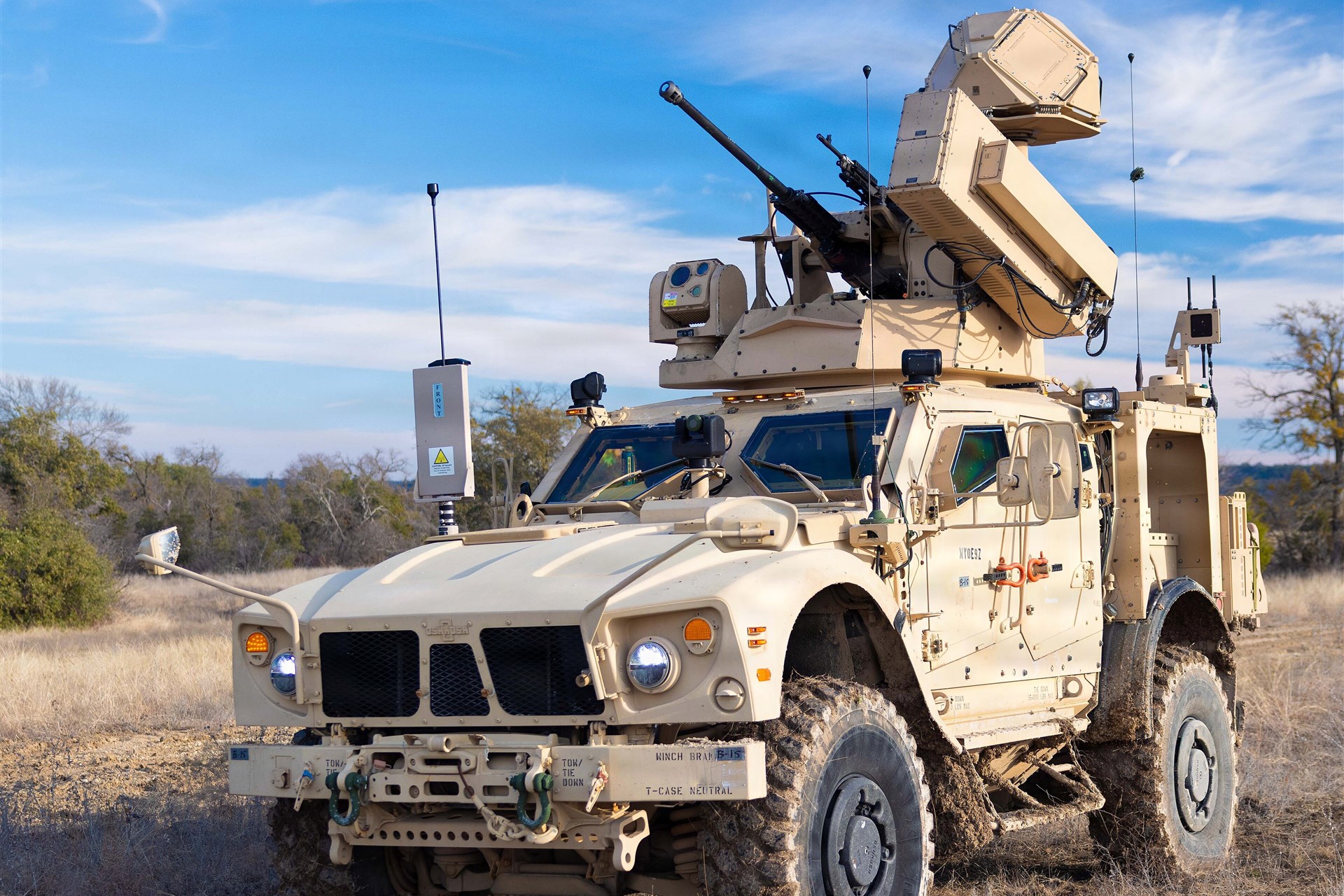
Image: A US Army Mobile-Low, Slow, small unmanned aircraft Integrated Defeat System (M-LIDS) vehicle during counter-UAS training, photographed 29 January 2026. Photo: Capt. Russell Shirley-Jones, US Army (DVIDS), public domain, via Wikimedia Commons. Stand-in file photograph; the agreement does not name this or any specific system.

