


Ukraine Offers Allied Defense Firms Free Access to Its Battlefield Drone Footage to Train AI

Ukraine is offering allied defense companies free access to its archive of battlefield drone footage to train artificial-intelligence weapon systems, The New York Times reported on November 12, 2026, according to DroneXL. The archive, called Avengers Labs, is run by Ukraine’s Defense Ministry and draws mostly on footage from its Delta battlefield system, the ministry says.
Who gets access
- The United Kingdom signed the only agreement reached so far, in August, and up to 12 British companies are first in line, selected by the UK Ministry of Defence in a competition, according to DroneXL’s account of the reporting.
- The Times reports that Kyiv is in talks with other governments, which it does not name.
- The ministry counts more than 30 Ukrainian companies training models on the platform and says three resulting products are in combat use.
Terms reported
- Access is free to allied firms, which pay in software: any company that trains a model must license what it builds back to the Ukrainian military, the Times reports.
- Companies cannot view or download the footage. It is encrypted on a cloud service outside Ukraine and used in an isolated system.
- The ministry said in a September 25 release that data is anonymized and delayed, and that foreign firms enter only after export-control procedures. Access runs through government-to-government agreements.
- The Times reports that the licence has no human-rights clause. Ukrainian officials say each receiving government must make its military follow the Geneva Conventions and other treaties.
Size of the archive
The figures differ by unit. The ministry cites more than five million annotated battlefield frames; the Times describes more than five million drone surveillance and strike videos. The ministry said in August that its detection system processes more than 100,000 drone video streams a month. DroneXL notes that the sources do not reconcile frames and videos.
Concerns raised
The Times quotes Anna Bacciarelli of Human Rights Watch saying a “black box obscures accountability” when a weapon picks its own target; Oleksandra Matviichuk of the Center for Civil Liberties urging caution about sharing data with states that have not accepted the Rome Statute principle on handing over war-crime suspects; and Kateryna Bondar of CSIS questioning how useful footage of Russian equipment would be in other conflicts. A review conference under the UN Convention on Certain Conventional Weapons meets November 16 to 20 to decide whether to open talks on autonomous weapons.
Sources and notes
This post is based on DroneXL’s article of November 12, 2026 by Haye Kesteloo, which relays The New York Times’ reporting and Ukrainian Defense Ministry releases from August and September 25. Lens read DroneXL as extracted text and did not read the Times article or the ministry releases directly. An anonymous executive’s claim in the Times of false-positive rates below 5% cannot be checked and is not repeated as fact. Lens did not contact the ministry or the companies.
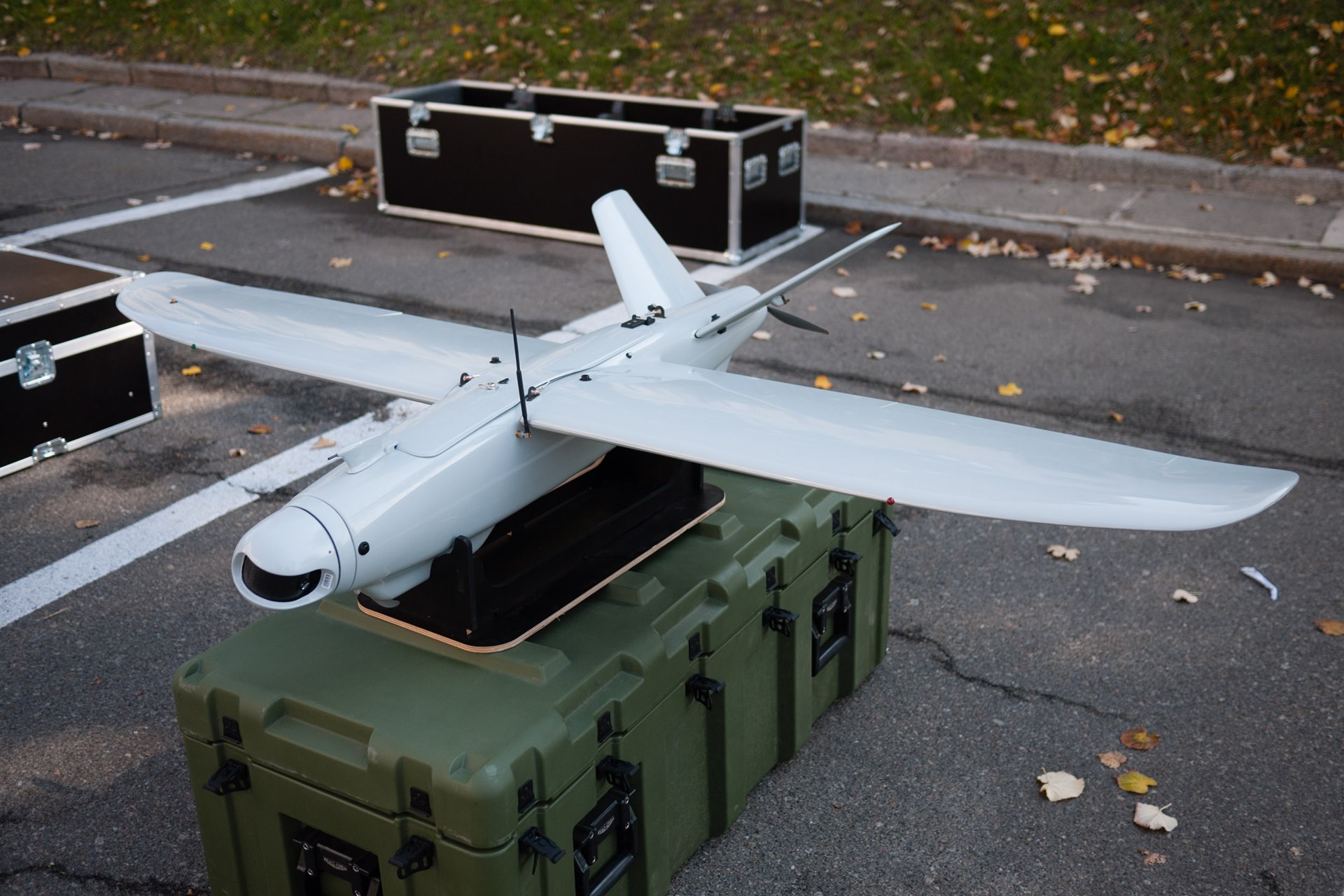
Image: a Ukrainian Leleka-100 reconnaissance drone on display in Kyiv in 2021, VoidWanderer, CC BY-SA 4.0, via Wikimedia Commons. The drone is shown for illustration and is not connected to the Avengers platform.

