


UK-Led JEF Nations Plan Naval Agreement to Counter Russian Submarines, Financial Times Reports

The Financial Times has reported that the United Kingdom and Nordic and Baltic partners plan to form a naval grouping within the UK-led Joint Expeditionary Force (JEF) to counter Russian submarines, according to a Russian-language summary of the report that was provided to Lens. Lens could not read the FT article. This post sets out what that summary says and what the Royal Navy, JEF defence ministers and other outlets have published about the plan, which the Royal Navy calls the Northern Navies Initiative.
What the FT is reported to say
- The agreement is planned within the JEF, under London's lead.
- Its main task would be to deter Russian submarines in the North Atlantic, the Arctic and the Baltic Sea.
- Participants intend to move from memoranda of understanding to practical cooperation among naval, air and land forces.
- The North Atlantic and Arctic matter more for NATO security because melting ice is opening new sea routes and because critical undersea communications cables run through the region.
The JEF
The JEF was founded in 2014 and has ten members: the UK, Denmark, Estonia, Finland, Iceland, Latvia, Lithuania, the Netherlands, Norway and Sweden. All ten are NATO members. In a statement on 2 October, JEF defence ministers meeting at Keflavik Air Base in Iceland reaffirmed the Baltic Sea region, the High North and the North Atlantic as the grouping's core area and described its role as “below the threshold of Article V.” They said JEF nations “do not seek confrontation and pose no threat to Russia, but Russia should be in no doubt that we will defend ourselves.”
The Northern Navies track so far
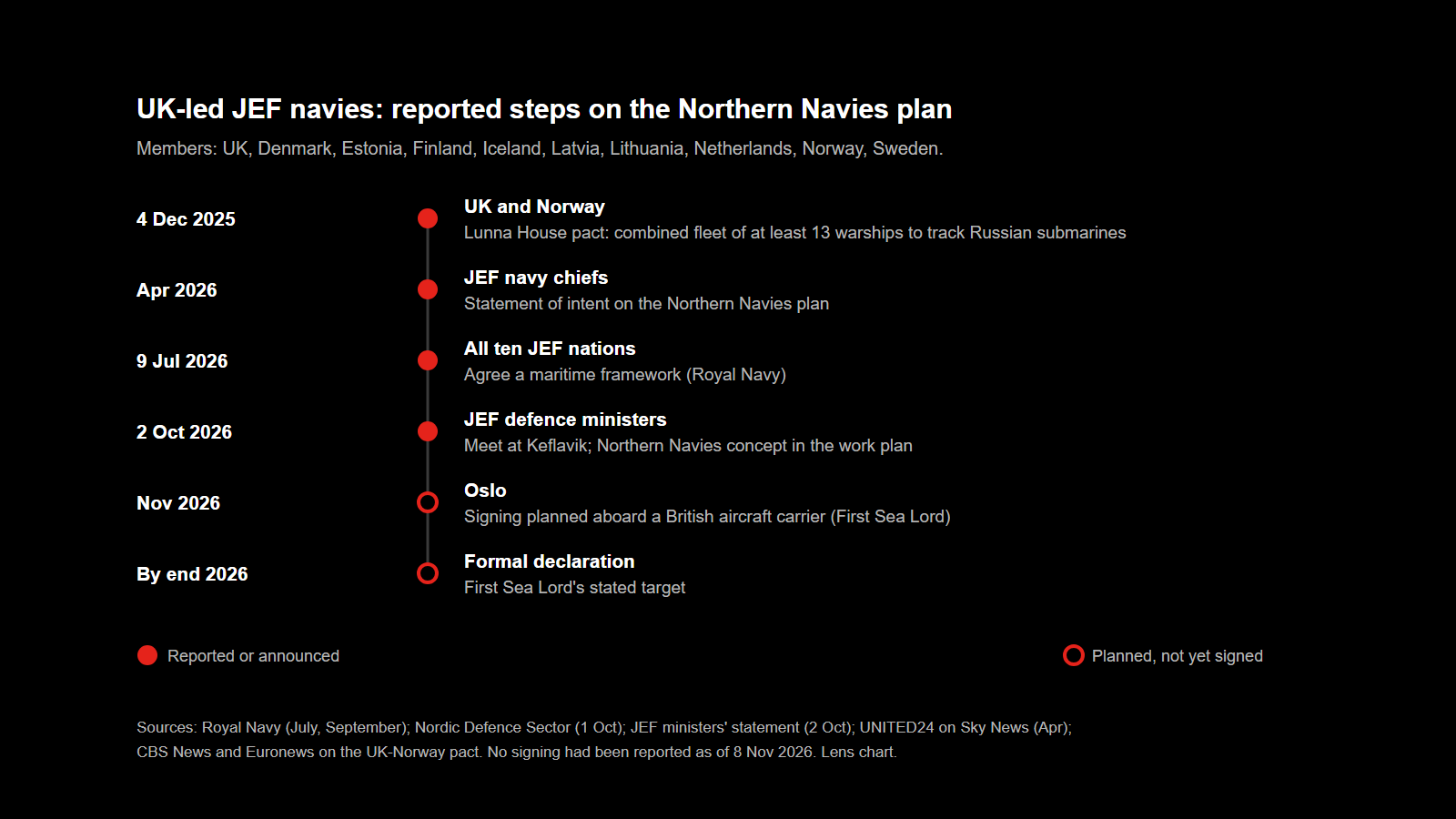
- December 2025: the UK and Norway signed the Lunna House Agreement. CBS News and Euronews reported a combined fleet of at least 13 warships, eight British and at least five Norwegian, to track Russian submarines and protect undersea infrastructure.
- April 2026: First Sea Lord Gen Sir Gwyn Jenkins hosted JEF navy chiefs and called for “moving from irregular responses towards a much deeper partnership,” according to the Royal Navy. UNITED24, citing Sky News on 29 April, reported that naval leaders signed a statement of intent and that Jenkins wanted a formal declaration signed by the end of the year.
- 9 July: the Royal Navy said all ten nations agreed a maritime proposition to align doctrine, training, planning, sustainment and capability development, with the aim that navies can “substitute, swap, or mix equipment, parts, ammunition, or personnel.” Jenkins called it a “historic change” and described “a forward, high-readiness force capable of responding rapidly in the early stages of escalation and seamlessly transitioning into NATO command if required.”
- 29 September: the Royal Navy said the initiative has the backing of all ten members and that a final agreement would commit them to more joint exercises and planning, shared training, logistics, procurement and capability development. It said the Atlantic Future Forum and International Sea Power Conference would be held on HMS Prince of Wales in Oslo in November.
- 1 October: Jenkins told Ruotuväki, the Finnish Defence Forces' magazine, that the ten nations would sign a naval cooperation agreement in Oslo in November aboard a British aircraft carrier. “We are going to train more together, operate more together and our doctrine is going to be better aligned,” he said, according to Nordic Defence Sector.
- 2 October: the ministers' statement listed work on the Northern Navies concept, noted Canada's application to join the JEF framework and said the next leaders' summit will be in Reykjavik next spring.
Submarines and cables in the official material
The Royal Navy's July release cites “undersea threats, seabed infrastructure risks and advancing technologies,” and its April release says Russian aggression on the surface and undersea has grown more brazen. Portsmouth News reported in April that HMS St Albans monitored a pair of Russian “Gugi” spy submarines loitering over undersea cables, and that the UK Ministry of Defence counts a 30 percent rise in Russian vessels sighted in UK waters over two years.
UK Defence Journal quoted Rear Adm Andy Perks saying the Royal Navy remains committed to the submarine as its principal anti-submarine capability until the 2060s at least, with up to 12 new nuclear-powered attack submarines planned from 2039. Portsmouth News described an Atlantic Bastion programme pairing Type 26 frigates, which specialise in hunting submarines, with autonomous platforms.
Where the summary and the releases differ
The Royal Navy releases Lens read describe interoperability, training, planning and capability development, and none of them describes a submarine-specific agreement or mentions land forces. The submarine focus and the air and land forces in the FT summary are not confirmed there. Lens found no published text of the agreement and no report that it has been signed as of 8 November.
Sources and notes
Sources: Royal Navy releases of 9 July, 22 April and 29 September; the JEF defence ministers' statement; Nordic Defence Sector; UK Defence Journal; Portsmouth News; UNITED24. The CBS News, Euronews and Sky News items were seen only through search summaries. The Russian-language summary did not name its outlet. Thumbnail photo: “HMS Anson August 2022” by the Ministry of Defence via Wikimedia Commons, licensed under the Open Government Licence v1.0; cropped. Illustrative photo of a British Astute-class submarine; it does not show the events described.
Image: Lens chart built from the dates above. Thumbnail: Ministry of Defence via Wikimedia Commons (OGL v1.0).

