Trump, Xi and Putin Meet in Shenzhen and Issue a Four-Point Declaration on Energy, International Justice, Nuclear War and the UN
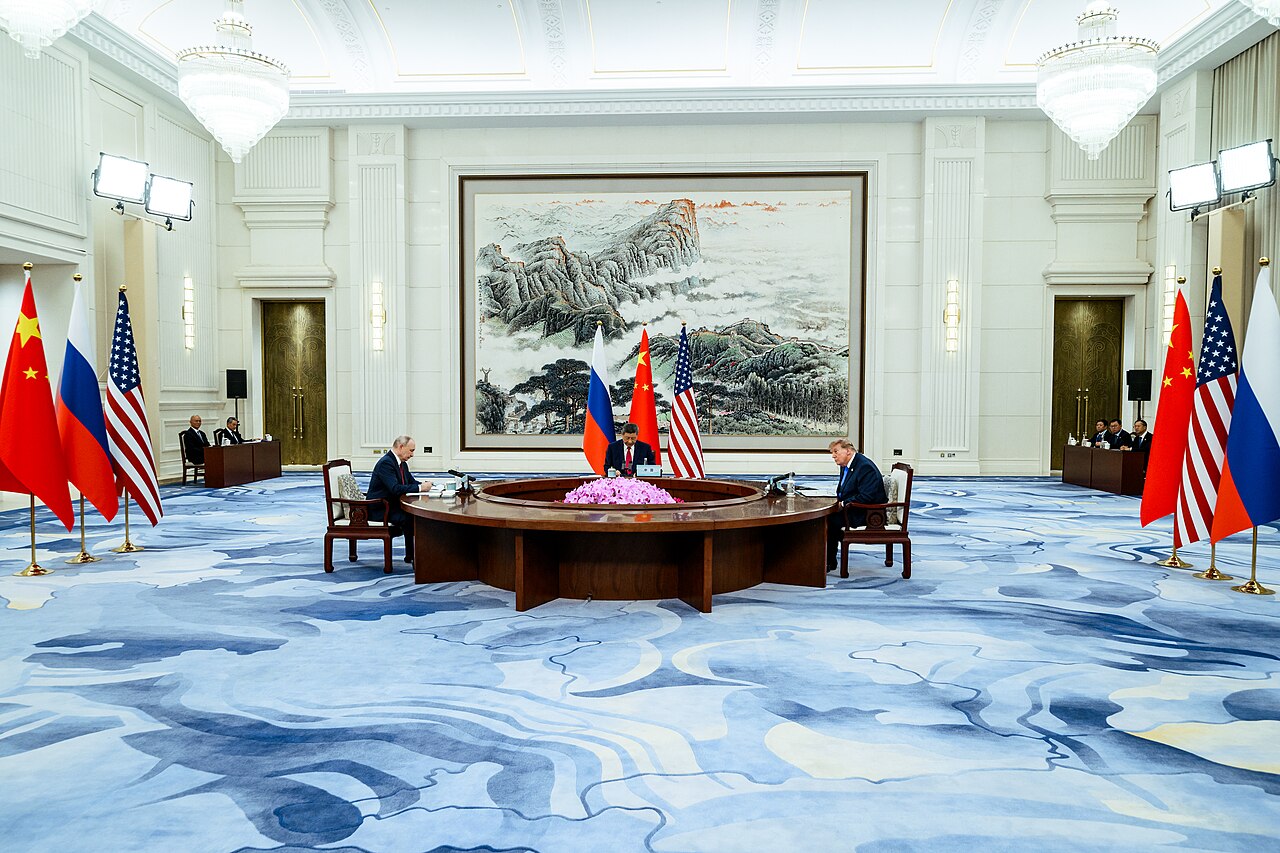

US President Donald Trump, Chinese President Xi Jinping and Russian President Vladimir Putin met in Shenzhen, China, on Thursday 19 November 2026, on the sidelines of the Asia-Pacific Economic Cooperation (APEC) summit, and issued a four-point joint declaration on energy supplies, international justice, nuclear war and reform of the United Nations, according to CBS News, RFE/RL and Anadolu Agency. RFE/RL describes it as the first time the current heads of state of the three largest nuclear powers have held a trilateral meeting without other leaders present. The reports Lens read say the declaration does not mention Ukraine, and none of them reports a concrete agreement beyond the declaration; CBS News headlined its report that the leaders “appear to achieve little.”
The meeting
Anadolu Agency reports that the meeting lasted roughly 80 minutes, from 4.30 p.m. to 5.50 p.m. local time. CBS News calls it a “roughly hour-and-a-half-long meeting,” and Al Jazeera says it ran “more than one-hour-long.” CBS News reports that Trump met Xi alone for about an hour beforehand and also met Putin separately on the sidelines. Xi chaired the APEC meeting, according to Al Jazeera. Lens reported the announcement of the meeting on 15 November in an earlier post; this post covers what happened.
What the declaration says
- Energy. The three plan to “increase the production and supply of refined petroleum products for the benefit of all nations,” according to RFE/RL, Al Jazeera and Anadolu, which quote the text. CBS News describes a commitment to increase gas and oil production “for the benefit of all countries.”
- International justice. The statement recognizes state consent and respect for the immunities of state officials, and says the International Criminal Court (ICC) and similar bodies must not abuse their jurisdiction, in RFE/RL’s wording. RFE/RL notes that Putin is indicted by the ICC over the abduction of Ukrainian children.
- Nuclear war. The leaders reaffirmed that “a nuclear war cannot be won and must never be fought” (RFE/RL, Anadolu) and pledged a dialogue on reducing nuclear risks and preventing the proliferation of nuclear weapons. RFE/RL’s analysis calls the first line “boilerplate language” that Xi has used for years, and calls the dialogue pledge vague.
- United Nations. They committed to reforming the UN so that it can respond more effectively to global challenges (CBS News).
The Kremlin published the statement first and the White House later provided the same text, according to CBS News. RFE/RL says it appeared on the Kremlin’s website and from the Chinese news agency Xinhua before the White House published it. CBS News and RFE/RL report that it does not mention Ukraine, and RFE/RL says it does not name the Iran war. Lens did not read the texts themselves.
What the leaders said
- Trump. In opening remarks he said: “We are really making history. The three of us have a great deal to discuss” (RFE/RL). Afterwards he said it “went great,” according to RFE/RL, and in a phone call with NBC’s Gabe Gutierrez called it “a 12 on a scale of zero to 10,” CBS News reports. Al Jazeera reports that Trump said Xi agreed the Strait of Hormuz must stay open and Iran must not have nuclear weapons; Anadolu quotes him: “We’re not going to let Iran have a nuclear weapon.” CBS News says he left for the flight home without speaking to reporters on the ground and planned a press conference at noon on Friday.
- Putin. CBS News quotes him: “We will not negotiate after the attacks on the Crimean bridge,” referring to the Ukrainian strike on the Kerch bridge earlier that week, and says he ruled out direct negotiations with Ukraine. Al Jazeera quotes him describing the discussion as “very frank,” helping the leaders “to better understand one another,” and says a Kremlin spokesperson described Ukraine as not the “central topic.” RFE/RL reports that he said Russia had proposed that European leaders come to Moscow for peace talks.
- Xi. Chinese Foreign Ministry spokesperson Mao Ning said Xi noted that the summit was “positive, constructive, and very productive” (RFE/RL).
Reactions and analysis
- Elizabeth Wishnick, an expert on Chinese-Russian relations at the CNA Corporation, told RFE/RL: “Putin came away with a lot. He was the biggest winner at this meeting.”
- Sari Arho Havren, an associate fellow at the Royal United Services Institute (RUSI), said Putin’s isolation “was tremendously reduced” in optics, “maybe also in reality because of the joint ‘peace declaration,’” and that “I think Xi Jinping very much got what he wanted” (RFE/RL).
- Yun Sun, director of the China Program at the Stimson Center, called it “high-profile and well-choreographed. You can call it a success” (RFE/RL).
- Friedrich Merz, the German chancellor, said a “Yalta format cannot bring peace” and called the meeting a “photo op,” RFE/RL reports.
- Tim Kaine, the Democratic senator on the Foreign Relations Committee, said “Vladimir Putin is not a friend” and called the photographs “concerning” (CBS News).
Context
CBS News notes that the US-China tariff truce is set to expire on 10 January next year. RFE/RL reports that Trump and Putin last met in person in Alaska in August 2025. Al Jazeera reports that Trump has invited Putin to the G20 in Miami next month.
Where reports differ
- Length. Anadolu gives roughly 80 minutes with clock times; CBS News says roughly an hour and a half; Al Jazeera says more than an hour.
- Wording of the text. CBS News gives “no winners in a nuclear war” and gas and oil production; RFE/RL, Al Jazeera and Anadolu quote “a nuclear war cannot be won” and “refined petroleum products.” Al Jazeera’s 19 November report gives only “stable energy flows” for energy.
- Iran and Ukraine. Anadolu says the leaders “exchanged views” on ending the Russia-Ukraine war and on curbing nuclear proliferation amid the Iran war; Al Jazeera says there was no reference to the Iran war at the summit apart from Trump’s remark.
- The Crimean bridge remark and Trump’s rating. Each appears only in CBS News among the pages Lens read.
- Framing. CBS News: “appear to achieve little.” RFE/RL: “no breakthroughs.” Al Jazeera’s headline calls it “groundbreaking,” in quotation marks. Anadolu calls it “historic.” No leader or official is quoted calling it the first such meeting; that word is RFE/RL’s and Anadolu’s.
- Venue. Al Jazeera’s captions name it both “Kylin Villa” and “Qilin Shanzhuang State Residence”; the other reports say only Shenzhen.
Sources and notes
Lens read CBS News, 19 November, RFE/RL’s report on the declaration and four takeaways, Al Jazeera’s 19 November and 20 November reports, and Anadolu Agency’s wrap-up, all through automated page summaries. Lens did not read the Kremlin readout or the White House text of the declaration, so quotations from the declaration are as given by those outlets. Reports from Moscow and Beijing, including Putin’s remarks on Ukraine and Xi’s words, are as relayed by those outlets.
Image: the three leaders at a round table during the trilateral meeting in Shenzhen on 19 November 2026. Photo: The White House, public domain, via Wikimedia Commons.