


Neufangled Robotics Sells Stringman, an $795 Open-Source Cable Robot That Reaches a Whole Room

Neufangled Robotics is selling Stringman, a room-scale cable robot with a gripper that hangs from lines anchored in a room’s ceiling corners, for $795, according to the company’s website. The product’s Hacker News submission drew 836 points and 246 comments. All figures below are the maker’s own claims.
What the maker says it does
- The maker says Stringman “reaches an entire room with four motors” and works from above, so it can reach cluttered floors that wheeled or legged robots cannot.
- It compares Stringman with a 0.75 m serial arm using the same motors: Stringman averages 1.9 kg of payload over its work volume versus 0.32 kg for the arm, and about 185 cubic meters of work volume per $1,000 versus 0.35, a gap the maker calls “roughly 500×.”
Specifications listed
- Work area: rooms 3 to 10 meters across the diagonal and 2.3 to 4 meters high.
- Payload: up to 2.2 kg near the floor and 1.9 kg on average, measured at the 28 N line-tension limit, net of the 638 g gripper, in a 7 × 7 × 3 meter room.
- Speed and cameras: about 0.4 m/s traverse; two anchor cameras at 1920×1080 and 30 fps and a gripper camera at 684×384 and 60 fps.
- Compute and connectivity: an external PC as controller, a Raspberry Pi Zero 2 W in the gripper and Pi 3A+ units in the anchors; 5 GHz Wi-Fi with QR-code setup, with the gripper on 2.4 GHz only.
- Build: 3D printed, with glass-fiber PET for structural parts. About 1,000 hours of testing in real homes to date, cumulative. The page states no precision figure.
Open source
The maker says Stringman is OSHWA-certified and publishes its mechanical CAD, circuit boards and control software and firmware on GitHub, along with STL files, a bill of materials, a build guide, a Python API and an MCP server. It says the robot can run air-gapped on a local network, with the interface served locally and AI models running on the owner’s hardware.
Installation and caveats
- Installation needs walls with studs or columns for the anchors, a computer with an NPU or GPU to run the controller, a handheld drill and a step ladder. Calibration takes about five minutes.
- The lines stay overhead while installed. Rooms with ceiling fans work if anchors sit at or below blade height, and low objects in the middle of a room make installation impossible.
- At the 28 N tension limit, which the maker compares to a backpack’s weight, the motors relax and the lines can be pulled loose.
- Remote operation is off by default. Binding the robot to an account enables remote access, and the maker says it does not store forwarded robot data.
- The page does not say whether the product ships as a kit or pre-assembled, and it gives no shipping dates or stock information. The maker says “as few as 50 episodes can be enough” for some models, such as DiT, to learn a behavior.
Sources and notes
This post is based on the Stringman page at neufangled.com as read on November 6, 2026, and Hacker News counts. Lens did not test the robot, did not review the GitHub files and did not contact the company. The Hacker News title gave the price as about $800; the page lists $795.
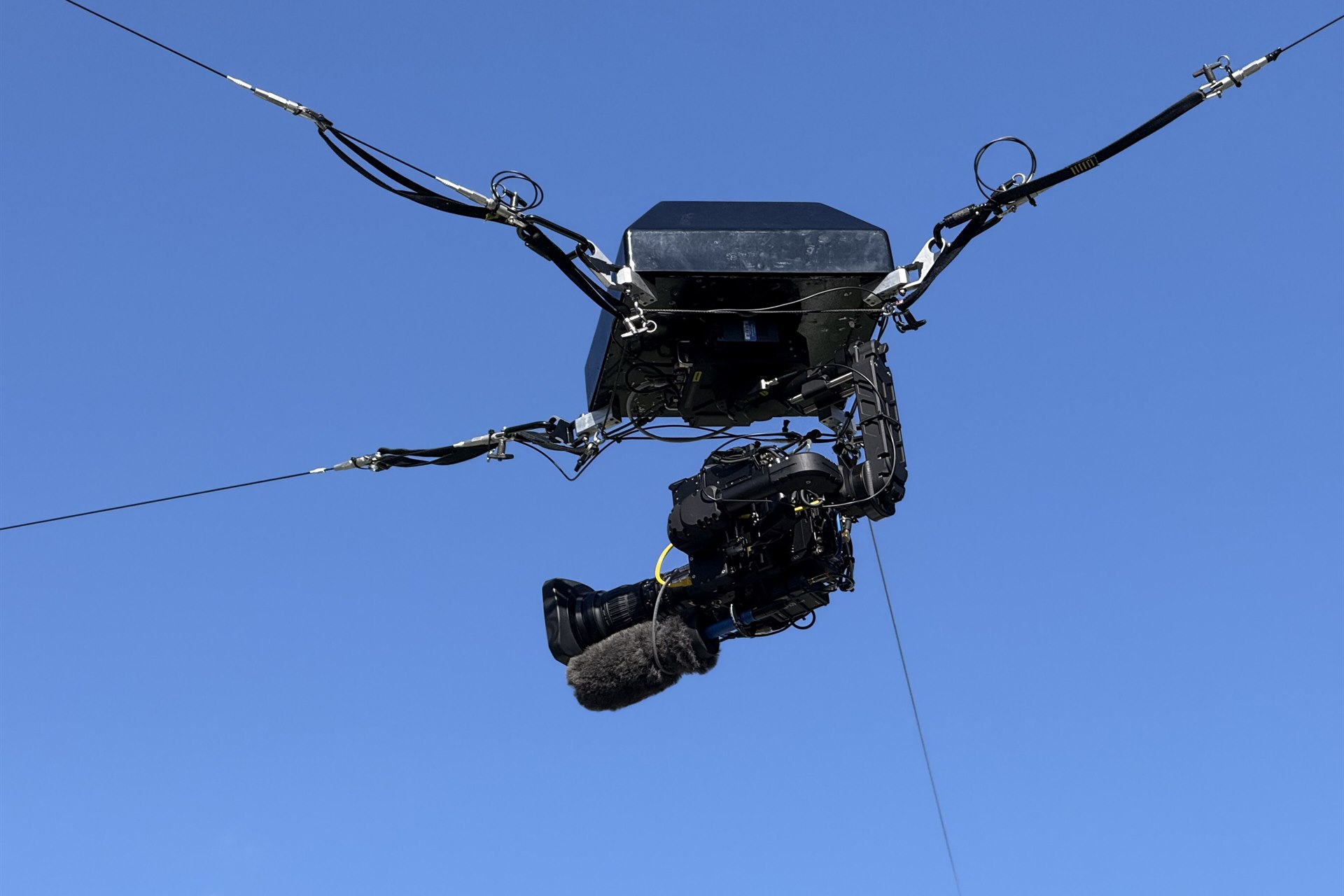
Image: a cable-suspended broadcast camera (Skycam) above Beaver Stadium in Pennsylvania, by Famartin via Wikimedia Commons, licensed under CC BY-SA 4.0; cropped. Illustrative photo of the cable-driven principle; it is a camera rig, not Stringman, and does not show the events described.

