SpaceX Starship Ship 42 Caught by Launch Tower After 14 Orbits on Flight 15; Booster Lost
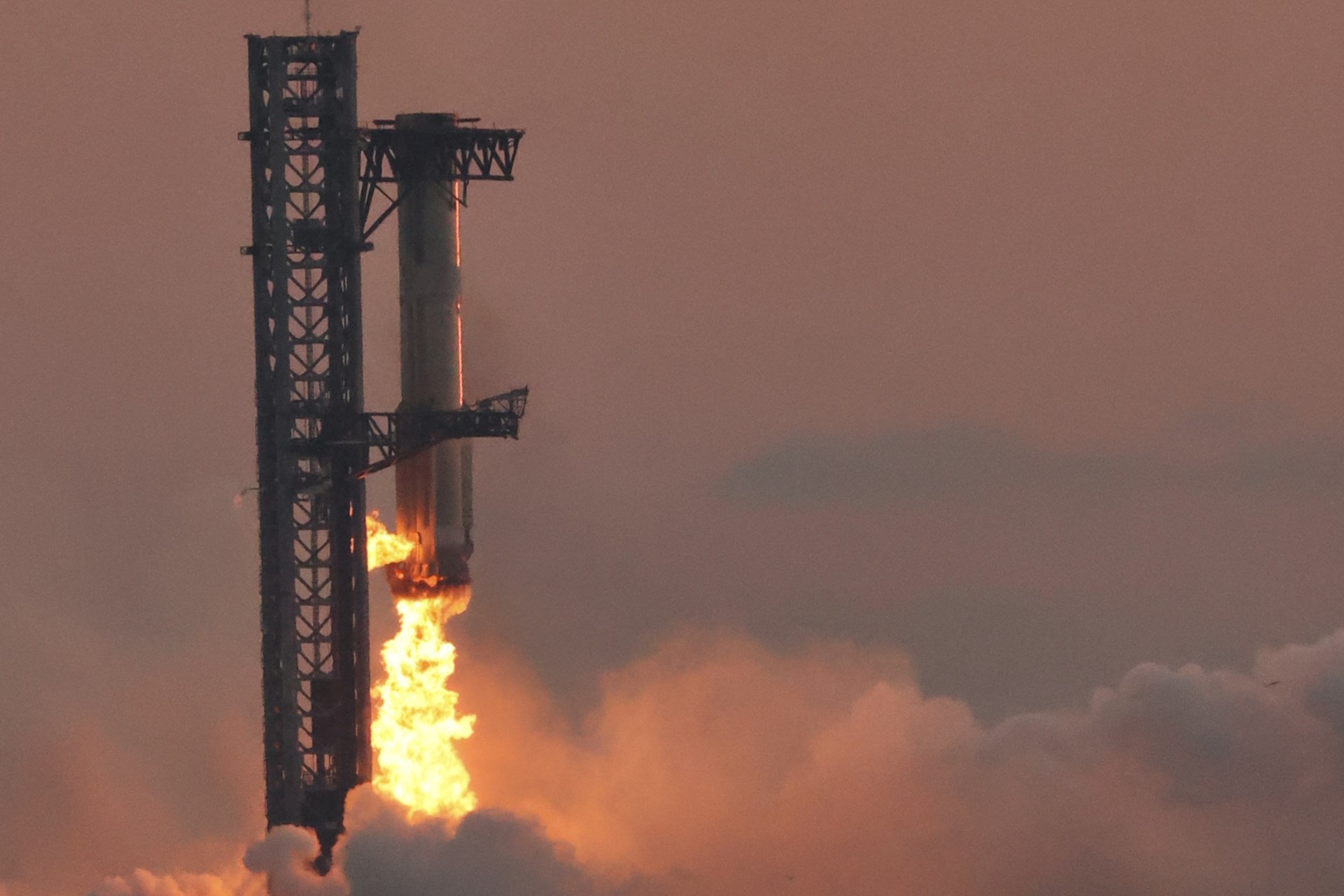

SpaceX’s Starship upper stage, Ship 42, was caught by the mechanical arms of the launch tower above Pad 2 at Starbase, Texas, on Saturday 14 November 2026, after about 22 hours in flight, according to CBS News, Al Jazeera, CNBC and Spaceflight Now. CBS News described it as the first recovery of a Starship from orbit; earlier ship flights ended in planned ocean splashdowns. On the same flight, the Super Heavy booster did not return to the tower and exploded before reaching the water in the Gulf of Mexico. Lens published an earlier post on the Flight 15 launch before the ship’s landing.
Launch and orbit
Flight 15, the 15th Starship test flight, lifted off from Starbase on Friday 13 November 2026 at 4:47 p.m. Central Standard Time (22:47 Coordinated Universal Time, UTC), according to Spaceflight Now. CBS News says the two-stage vehicle stands 407 feet (124 metres, per Al Jazeera) tall and produces about 16 million pounds of thrust at liftoff from 33 Raptor engines on the booster.
The ship reached orbit, released 26 Version 3 Starlink satellites and flew 14 orbits, according to Spaceflight Now, CNBC and Al Jazeera. Al Jazeera says it was Starship’s second trip to orbit. CNBC reports that SpaceX has said one Starship can carry up to 60 Version 3 satellites, and that SpaceX obtained Federal Aviation Administration authorization for the flight on Friday.
The ship catch
Spaceflight Now gives the catch time as 3:20 p.m. Central Standard Time (21:20 UTC) at Pad 2. Its text does not state the date, while CBS News and Al Jazeera place the catch on Saturday. Counting from the 22:47 UTC liftoff, 21:20 UTC on Saturday is 22 hours 33 minutes later (Lens arithmetic).
Spaceflight Now says the ship reentered over the Pacific, crossed Mexico and the southwestern US, turned back over the ocean and lined up for the tower. CBS News says the ship flipped upright after relighting three of its six Raptor engines, slowed to a near hover, and was gripped by the arms moments before its engines shut down. Al Jazeera says SpaceX reported that everything on the ship, including the heat shield, appeared to work well.
The booster
Spaceflight Now says Booster 22 was due to return to Pad 2 about 6.5 minutes after liftoff. Instead it was sent to an offshore splashdown and exploded before reaching the water. SpaceX had caught boosters after three earlier launches, according to CBS News and Al Jazeera; Spaceflight Now says no Version 3 Super Heavy booster has yet returned successfully.
CBS News reports that Elon Musk wrote on X that the problem was a slight underperformance of engines, and that the booster loss does not change SpaceX’s timeline to reach high-volume, fully reusable Starship flights.
What comes next
CBS News says SpaceX plans orbital refueling tests over the next several flights. According to CBS News, NASA wants a Starship variant to carry astronauts to the lunar surface in 2028, which would need several tanker flights to refuel the lander in Earth orbit, and NASA is open to using Blue Origin’s Blue Moon Mark 2 lander depending on which is ready first. Al Jazeera says SpaceX expects to begin launching Starships from Kennedy Space Center in Florida within the next few months, without giving a date.
Where reports differ
On why the booster did not return: Spaceflight Now says commentator Dan Huot first said during the webcast that the guidance, navigation and control system triggered an automated abort, then said about 16.5 hours into the mission that a guidance issue was not what kept the booster from returning. CBS News says the booster was diverted because of a guidance problem. Al Jazeera says SpaceX’s Kate Tice said the engines stopped firing too soon on the way back and that the guidance system then sensed the booster was out of position. Search summaries of Space.com and NASASpaceFlight reports, which could not be opened, say Tice described the boostback burn, the engine firing that turns the booster back toward the launch site, ending early after a low fuel mass alarm. Musk described the problem as engine underperformance. The cause was still under investigation, according to Al Jazeera.
On timing: Spaceflight Now’s article text gives liftoff as 22:47 UTC, but one photo caption gives 4:48 p.m. Central Standard Time, and the earlier Lens post gave about 22:48 UTC.
Sources and notes
Read in full through a text-extraction tool: CBS News (William Harwood, updated 14 November 2026), Al Jazeera (AP and Reuters, 15 November 2026), CNBC (Lora Kolodny, 14 November), a CNBC launch report from 13 November, Spaceflight Now live coverage and the Anadolu Agency briefing of 15 November, which says the tower caught the ship after a mission of more than 22 hours. Statements are paraphrased because exact wording could not be checked against the raw pages. Not opened: Space.com pages (only headlines came back), NASASpaceFlight (403 error) and SpaceX’s own flight page (only its title loaded), so SpaceX statements come from the outlets above and the Space.com detail from a search summary. Musk’s X posts were not read directly. Al Jazeera lists a 265 km (165 miles) figure beside the orbit count without saying what it measures, so it is not used here.
Image: A SpaceX Super Heavy booster is caught by the launch tower’s arms at Starbase, Texas, during Starship’s fifth flight test on 13 October 2024. Photo: Steve Jurvetson (CC BY 2.0), via Wikimedia Commons; cropped. Archive photo from 13 October 2024: it is not from the events described.