


Space Industries opens a satellite factory near Turin built for serial production
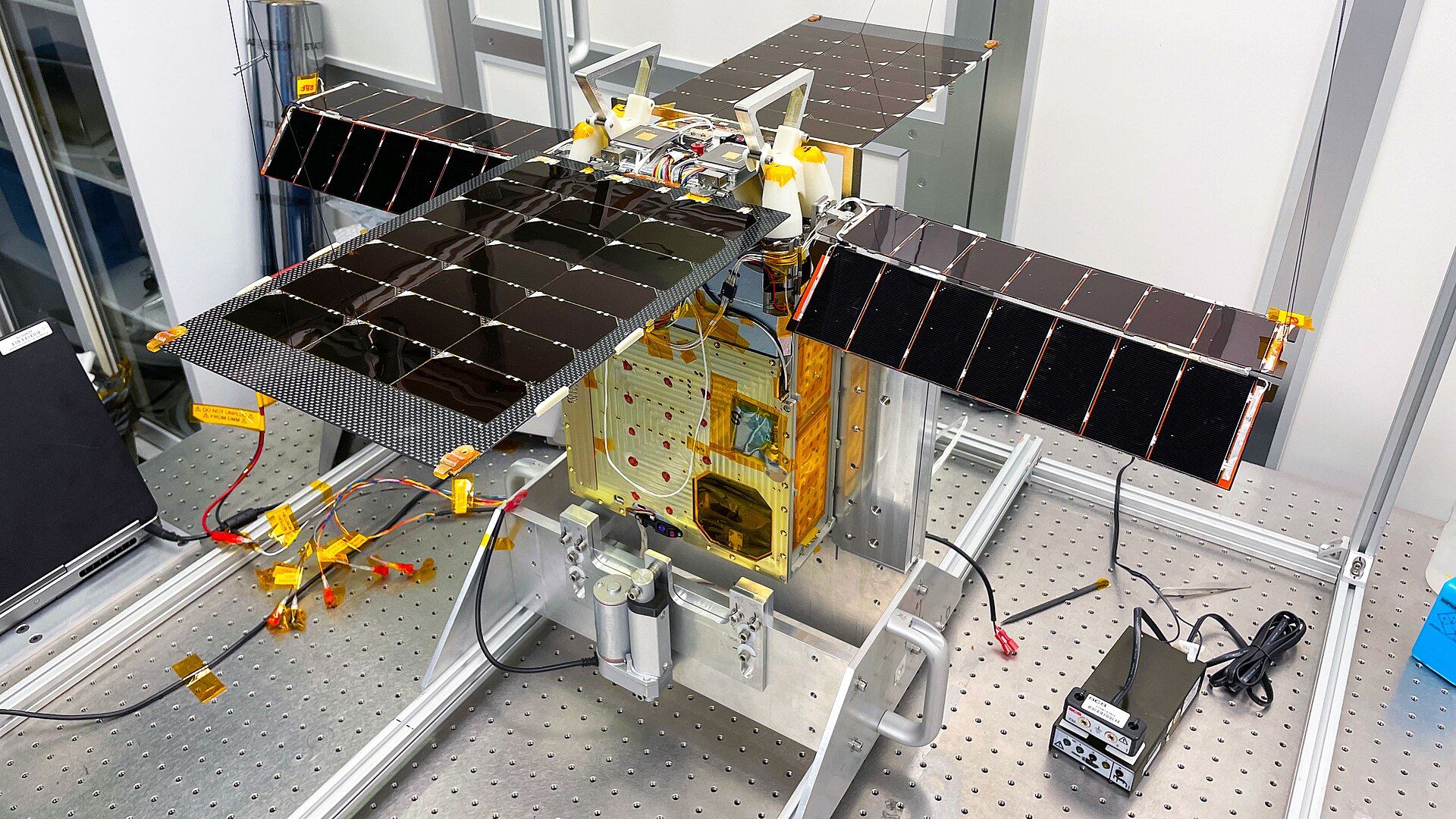

Space Industries, an Italian company founded in 2025, inaugurated its Stellar Hub on October 28 in Settimo Torinese, just outside Turin. According to Euronews, the 8,000 square meter site is built for assembling, integrating and testing satellites and spacecraft of up to 600 kg, and it is designed for mass production, serving customers from single satellites to larger constellations. The Italian outlet CorCom, which also reported the opening on October 28, gives the plant a theoretical maximum of up to 140 satellites a year.
The opening comes about a year after the date given in early reports. Satnews reported in March 2025 that the production space would open by the fall of 2025, and a July 2026 report said the inauguration was expected by the end of this year. The company’s plans, headcount and facility figures have also changed between those reports and this month’s, as set out below.
What opened in Settimo Torinese
Euronews describes a facility with 8,000 square meters in total, including a 2,000 square meter clean room that it says is among the largest in Europe. Up to 12 separate integration areas allow several programs to run in parallel. Environmental, vibration and transmission tests are carried out on the same site, and the test facilities include a thermal vacuum chamber and a vibration test area.
The plant is aimed at three kinds of customer, Euronews reports: those buying single satellites, those ordering small and medium series, and operators of larger constellations. Euronews does not give an annual output figure, and it says the investment was not disclosed. CorCom, by contrast, attributes an investment of more than €20 million to Comat, the industrial group that Satnews identified in 2025 as the majority shareholder, and states the 140-satellite theoretical capacity.
Euronews reports about 40 employees now, a target of more than 200 by 2030, and annual turnover of €30 million targeted for the same year. It also says the company has three contracts secured. CorCom names one customer, D-Orbit, with which it says a contract has been signed. The value and volume of that contract were not disclosed in the report.
Who is behind the company
Euronews says Space Industries S.p.A. was founded in Turin in 2025 by the Comat group and Giuseppe Santangelo, an Italian-American entrepreneur with long aerospace experience. A March 2025 report in Satnews adds that the Micelli family, which owns Comat, is the majority shareholder and that Santangelo, a co-founder, became chief executive that February. Satnews also lists previous roles for Santangelo, including a position as managing director of Tyvak International in 2023.
In that 2025 report, Santangelo described the satellite assembly and testing market as underserved and said the company wanted to become the obvious choice for it. He called Space Industries “an open model” that needs partners to multiply value. The company’s headquarters at that time were at Palazzo Asinari di San Marzano in Turin, with production at the Settimo Torinese plant, according to Satnews and the Italian outlet Ticonsiglio.
Italian officials have taken an interest. On July 20, Anna Maria Bernini, the minister for university and research, visited the site, according to a report by the news agency ANSA carried by SoldiOnline, and a similar report in La Nazione. The mayor of Settimo Torinese, Elena Piastra, and representatives of the Italian Space Agency and the National Institute for Nuclear Physics were among those present. According to the ANSA account of her remarks in Italian, Bernini described the plant as a bridge between present and future and said the space economy is moving from technological craftsmanship to industrial scale.
How the figures have changed
The numbers attached to the plant differ between reports, and the differences are worth setting side by side. None of the sources reviewed explains them, so they are presented as reported.
On size, Satnews in March 2025 described a production area of about 6,000 square meters with about 3,000 square meters of clean room. Ticonsiglio the same month gave a clean room of over 2,500 square meters. Hoist Magazine in August 2025 cited about 3,500 square meters of clean rooms. A company announcement from the battery developer 1414 Degrees in August 2026 said nearly 8,000 square meters in total, including over 2,500 square meters of clean room. Euronews and the July 2026 ANSA report give 2,000 square meters of clean room.
On the satellites themselves, Satnews in 2025 described a plant for satellites of up to 500 kg. The 1414 Degrees announcement describes serial production of small satellites in the 100 to 500 kg range, Hoist cited up to 700 kg, and Euronews and ANSA say up to 600 kg. On investment, the 2025 plan was €15 million in total according to Satnews and Ticonsiglio, the 1414 Degrees announcement refers to approximately 15 million in planned investments through 2030 without naming a currency, and CorCom now reports more than €20 million from Comat.
On output and jobs, the 2025 plan aimed at roughly one satellite per working day, or more than 200 a year, by 2029 or 2030, with up to 40 satellites in parallel at about 100 days each, and about 300 jobs over five years, according to Satnews and Ticonsiglio. Reports this year describe a theoretical maximum of up to 140 satellites a year and a target of more than 200 employees by 2030. This suggests the commercial plan has been scaled to a smaller headcount and a lower stated capacity than the 2025 ambition, though the company has not said so in any source reviewed.
Partners and early work
1414 Degrees, a company listed on the Australian Securities Exchange, published an announcement on August 6 describing a phased program with Space Industries and a firm called Orbit Boy Ltd to evaluate its silicon-anode battery technology for satellite power systems. According to that announcement, Space Industries would integrate the batteries into a representative satellite energy-storage system and qualify them in-house, and would plan to use them in its serial platforms if results are positive. It would also introduce the battery maker to its customers and to the European satellite supply chain. Revenue for 1414 Degrees depends on successful qualification and binding contracts, the announcement says.
The same announcement describes the Stellar Hub as offering assembly, integration and testing in one place, and describes Space Industries as focused on serial production of small satellites using an industrialized manufacturing model. The ownership description matches the other reports: Comat, an Italian industrial group, with Santangelo leading the company.
Europe’s wider space push
The factory opened as European governments prepare to decide how much to spend on space. The European Space Agency (ESA) holds an Intermediate Ministerial Meeting on December 15 at La Nuvola convention center in Rome, according to its own media invitation. The agenda covers Europe’s presence in low Earth orbit after the International Space Station, its presence on and around the Moon, and how to reinforce autonomy while keeping international partnerships. ESA’s Council, in an October 22 release, described the meeting as a key step toward programme and financial decisions at an event the release calls CM28.
Euronews reported on October 26 that ESA’s director general, Josef Aschbacher, has proposed about €10 billion over ten years for a European crewed spaceflight system, against an estimated €5 billion that continuing to buy foreign services could cost over the same period. Euronews describes these as projections and not allocated funds, and the figures could not be confirmed from a second source. The article also reports that Isar Aerospace’s Spectrum rocket reached orbit on September 5 and that ESA awarded The Exploration Company €760 million on September 10 for the next phase of its cargo capsule program.
A satellite plant is not a launcher, and Euronews’s coverage of the ESA debate concerns crewed flight and cargo, not satellite manufacturing. The connection is the broader theme of autonomy. This suggests that a factory able to assemble and test satellites in Europe addresses one link in the chain, while launch and crewed access are others.
What to watch
The first test for the plant is delivery. Reports from early 2025 expected a first satellite around early 2026, and none of the sources reviewed says whether that happened. The three contracts Euronews mentions and the D-Orbit contract reported by CorCom will show what the plant is building and at what volume.
The second is capacity against demand. The 140-satellite figure is a theoretical maximum, and the company’s own 2030 targets of more than 200 employees and €30 million in turnover are modest beside the 2025 plan of about 300 jobs. Whether the plant fills its integration areas will depend on orders that, apart from the contracts named above, have not been published. The ESA ministerial meeting on December 15 is the next scheduled occasion on which European governments will weigh their space priorities.
Sources
- Euronews: Space Industries opens Stellar Hub in Turin, one of Europe’s largest satellite factories, October 28
- CorCom (Corriere delle Comunicazioni): Space Industries inaugura lo Stellar Hub, October 28
- SoldiOnline (ANSA): report on Minister Bernini’s visit to the Stellar Hub, July 20
- La Nazione (ANSA): Bernini visita nel torinese la fabbrica di satelliti, July 20
- Satnews: Space Industries debuts, €15 million invested to produce more than 200 satellites a year, March 13, 2025
- Ticonsiglio: Space Industries Torino, 300 hires for the new satellite factory, March 10, 2025
- Hoist Magazine: Space Industries Stellar Hub, August 11, 2025
- Kalkine Media (company announcement): 1414 Degrees partners with Space Industries Turin, August 6
- Euronews: Europe weighs €10bn plan to launch its own astronauts ahead of Rome space summit, October 26
- ESA: media invitation, Intermediate Ministerial Meeting 2026
- ESA: key outcomes of the 350th ESA Council meeting, October 22
Image: Lunar Flashlight Post-Integration.jpg by Credits: NASA/JPL-Caltech, Public domain, via Wikimedia Commons. Illustrative photo; it does not show the events described.


