


Shield AI Says Its Hivemind Software Flew Multiple Air Force Combat Drones as a Team for the First Time; Air & Space Forces Reports Two Anduril FQ-44As and No Pilot Aboard
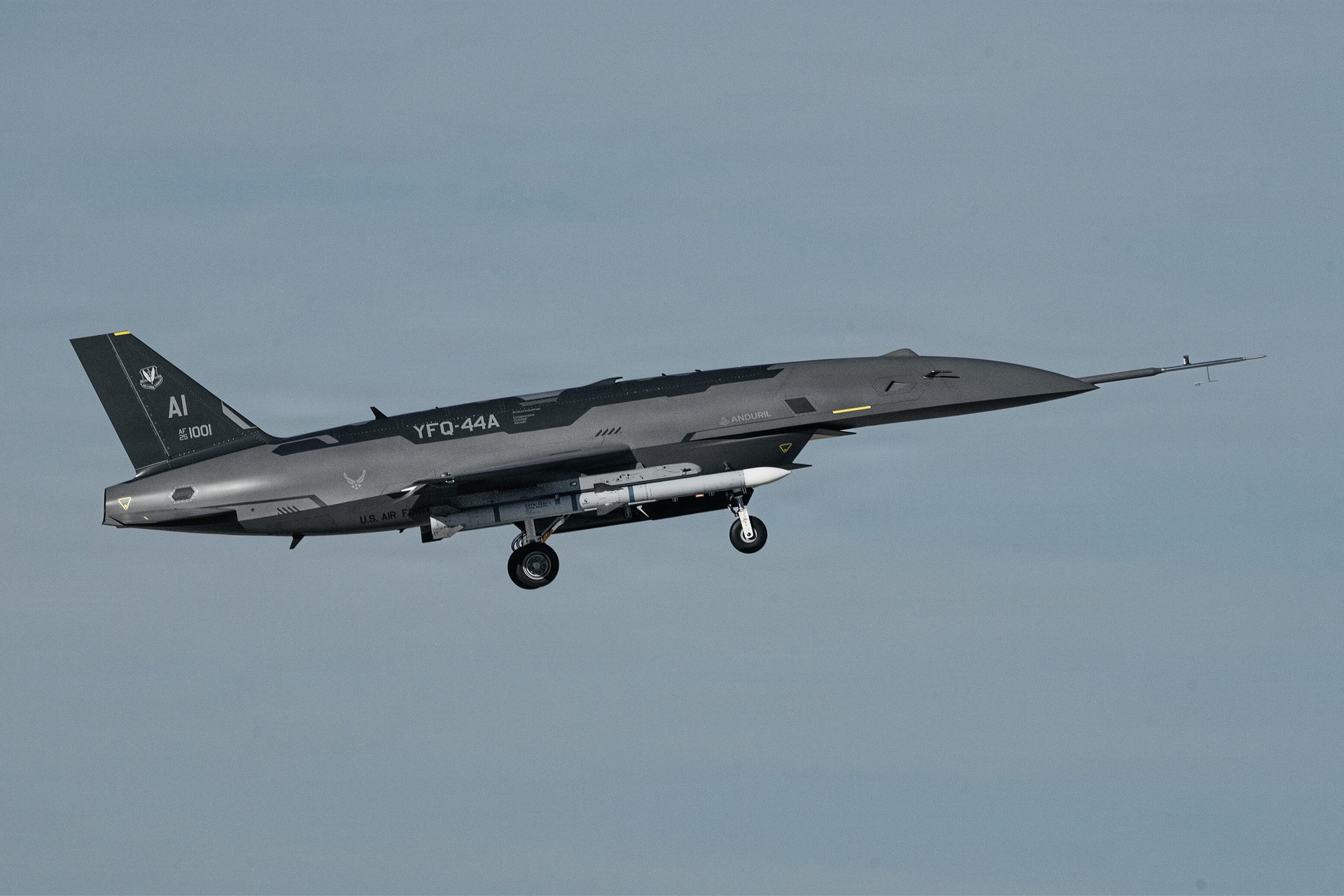

Shield AI announced on 9 November 2026 that its Hivemind mission-autonomy software flew multiple US Air Force collaborative combat aircraft (CCAs) as a coordinated team on 26 October, which the company describes as a first. The release says the flight demonstrated “collaborative mission execution rather than independent aircraft simply operating in the same airspace”. It gives no number of aircraft, does not name Anduril or a location, and does not say who or what directed the aircraft. Those details come from Air & Space Forces (Stephen Losey, 9 November), which interviewed Todd Wesley, Shield’s vice president of Hivemind engineering. It reports that two Anduril-built FQ-44A aircraft flew at the Nevada Test and Training Range, that no human pilot was in the air, and that an operator on the ground gave high-level directions while the aircraft engaged a virtual threat. Lens found no statement from the Air Force or Anduril about the flight.
What Shield says
According to the release, on 26 October Hivemind enabled multiple CCAs to execute a multi-ship formation and tactical beyond-visual-range air combat maneuvers. Shield calls it the second of “two firsts” in three weeks for the CCA program; the other, it says, was an 8 October flight in which an F-22 pilot directed one FQ-44A Fury, and the two dates Shield gives are 18 days apart. Wesley said in the release: “Every flight gives us data that goes into the next software release.” Shield says Hivemind’s shared software base is integrated on more than 40 uncrewed systems across air, land, sea and space; that is a company claim.
What Wesley told Air & Space Forces
Wesley said: “The initial test in early October was essentially a stepping stone to this capability.” He also said: “This was kind of a graduation, so to speak, exercise beyond what happened in early October.” According to the article, there was no human pilot in the sky on 26 October, unlike on 8 October. Wesley said flights with CCAs carrying and employing live munitions will come later but he could not say when. The article reports that Shield’s next steps include more complex engagements, more aircraft, “teams of teams” and swapping aircraft between teams in flight.
The earlier test
Shield and Air & Space Forces date the earlier flight to 8 October at Edwards Air Force Base, California, where an F-22 pilot acted as an airborne “quarterback” for one FQ-44A, sending high-level directives that Hivemind interpreted and executed in real time. The Air Force and Anduril described that flight on 16 October, according to The War Zone, Air & Space Forces and Defence Industry Europe, as using onboard autonomy software and did not name Hivemind or any product.
Background
In February 2026 Shield said Hivemind had completed its first flight test aboard Anduril’s YFQ-44A, and Calibre Defence, citing an Anduril release, reported that control switched in flight to Anduril’s own Lattice software. On 17 June 2026, DefenseScoop reported, the Air Force selected Anduril’s FQ-44A Fury and General Atomics’ FQ-42A Dark Merlin for the first operational CCA production, and that it plans to choose a primary autonomy provider by summer 2027 from a competition in which Anduril, Shield AI and Collins Aerospace advance. Air & Space Forces and Defense News report that the Air Force wants 500 CCAs in the field by 2032.
Where accounts differ
- The “first”: The claim in Shield’s headline and X post is narrow: Hivemind flew multiple CCAs as a team for the first time. Air & Space Forces and Defense News describe it as a first for the CCA program in their own voices. No source attributes the claim to the Air Force or Anduril. Anduril said in February that testing would include multi-ship flights, and The War Zone reported in October that a Fury flew in formation with F-35s in September, without the F-35s commanding it.
- Number of aircraft: Shield says “multiple”; Air & Space Forces and FlightGlobal’s headline say two; Defense News says the release did not specify.
- Human role: Air & Space Forces reports a ground operator and no pilot aloft. Shield’s X post, as quoted by SOFX, says: “The pilot sets the plan, and Hivemind carries it out across the team.” The release is silent on a ground operator.
- Designation: Shield and Air & Space Forces write FQ-44A, FlightGlobal’s headline writes YFQ-44A, and no source says whether the aircraft were prototype or production standard.
What was not disclosed
No source gives distances, durations, weapons, the number of maneuvers, or what the virtual threat was or how many there were.
Sources and notes
Sources, read through summaries: Shield AI’s release of 9 November 2026 and its release of 26 February 2026; Air & Space Forces (Stephen Losey, 9 and 16 October and 9 November); Defense News (Cristina Stassis, 10 November); SOFX (11 November), Interesting Engineering (Kaif Shaikh, 10 November), Army Recognition (10 November) and MiGFlug (10 November), which largely rewrite those; The War Zone and Defence Industry Europe (16 October); DefenseScoop (17 June); Calibre Defence (3 March); and The Defense Post (16 February). FlightGlobal and Defense Daily are paywalled. Lens did not read Shield’s X post directly or any Air Force or Anduril statement on the 26 October flight, and no article body states the year of the flight, which Lens takes as 2026 from the date of the release. The location and the ground operator rest on a single interview.
Image: An Anduril YFQ-44A collaborative combat aircraft carrying an inert missile during a captive-carry test at a California test location, February 2026. Photo: US Air Force (Secretary of the Air Force Public Affairs, via DVIDS), public domain, via Wikimedia Commons; cropped. Stand-in image of a single aircraft in a different test; it is not the 26 October flight.

