


Reward AI's OM-1: One Policy, Trained on Human Hands, Now Driving Humanoids
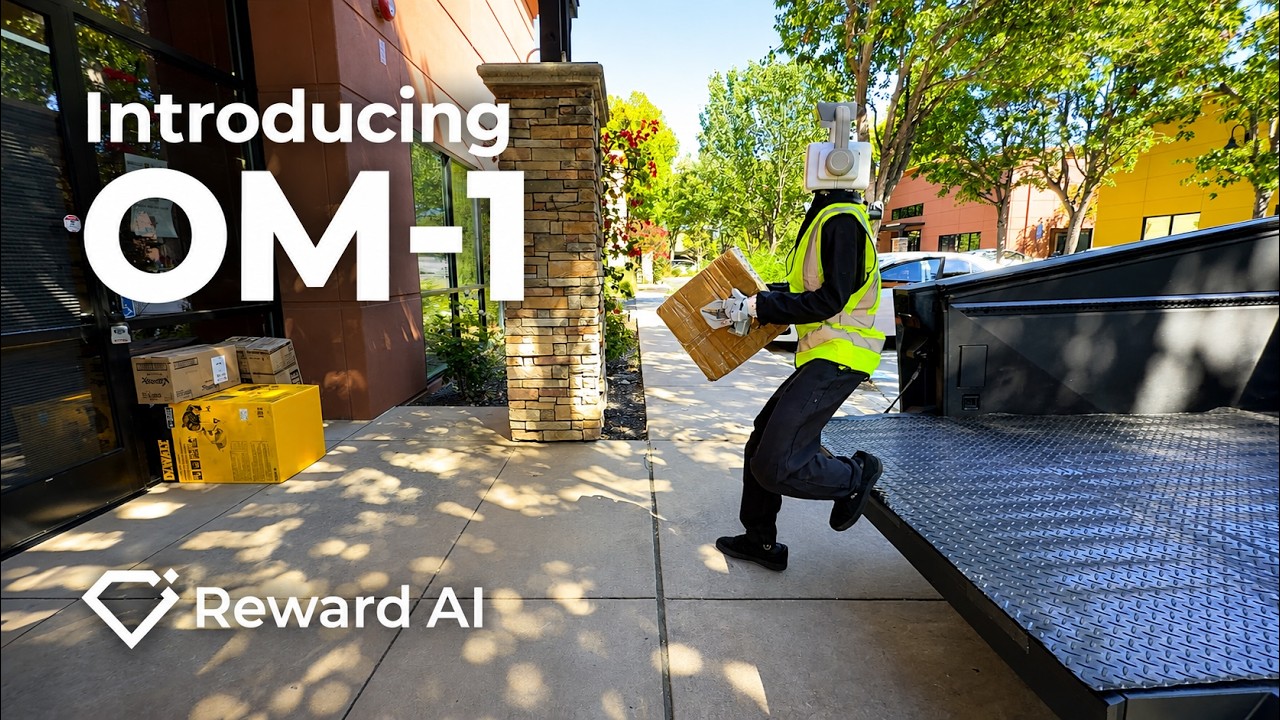

In 77 seconds, a humanoid robot unloads parcels from the bed of an angular pickup truck, carries them to a doorstep, lifts a package off a carpeted stair, mops a kitchen floor, collects black socks from a staircase and takes a green bottle out of a refrigerator. Every frame carries the same caption: “fully autonomous, 1x speed.” The reel, posted on October 27, 2026 by the startup Reward AI, is the company's public showcase for OM-1, a robot policy it says was trained only on human demonstrations, with no teleoperation and no data recorded on a robot.
The claim matters because data is the hardest bottleneck in robotics. Language models learned from the internet; robots have no equivalent, and collecting robot data by teleoperating machines one task at a time is slow and expensive. Reward AI's answer is to leave the robot out of training altogether, learn from people, and then run the same policy on very different bodies. This article walks through what the video shows, what the company says is underneath it, and what has not yet been demonstrated.
What the 77 seconds contain
The upload is divided into five chapters, and the footage matches them. The first, “Last-mile delivery,” runs from the start to 0:28. A humanoid in a high-visibility vest stands at an open tailgate, pulls boxes from the truck bed and walks them to the entrance of a building, setting them down among other parcels by the door. Press coverage of the launch identifies the truck as a Tesla Cybertruck.
“Package picking on stairs” follows at 0:28, then “Mopping” at 0:43, “Sock picking on stairs” at 0:51 and “Fridge opening” at 1:06, before a plain end card with the company's logo. In the stair clips the robot, now in navy overalls, crouches to lift a package from the carpet and later works its way along the steps collecting socks. In the mopping clip a robot in a brown outfit stays low over a wooden kitchen floor, working a white mop pad across it. In the final chapter the robot opens a stainless-steel refrigerator and takes out a green bottle.
Three details stand out. The on-screen caption claims autonomy and real-time speed instead of leaving viewers to guess, which is a stronger statement than most robot demos make. The robot wears a different outfit in different chapters, a vest, navy overalls and brown overalls, and the reel does not say whether it is one machine or several, or what hardware it is. And a person walks through the stair scene carrying a laundry basket, a reminder that these are lived-in homes rather than a lab bench.
One Model, One Data Interface, Any Body
Reward AI's description of the video states its thesis: “Human-level manipulation requires rethinking robot intelligence. Not just adding data or compute.” It says OM-1 “unifies data, learning, and control around one principle: One Model, One Data Interface, Any Body.” In the company's technical post, the Omnibody stack has four parts: a wearable called the Omnibody Hand that records human manipulation, a data interface that fuses what the hand senses, the OM-1 policy itself, and a control layer that turns the policy's actions into motion on a particular robot. The post calls the policy the decision-making core of the stack and says the same policy deploys “from industrial arms to humanoids.”
Learning from a hand, not a robot
Most robot-learning pipelines collect demonstrations by having a person drive the robot through a task with a remote rig. Reward AI's thesis, as reported by Humanoids Daily, is that teleoperation rigs and simple two-finger grippers corrupt the data: the human adapts to the machine, and the recording reflects the machine's limits rather than the person's skill. Instead, people wear the Omnibody Hand, which the company says builds on DexCap, the Stanford motion-capture project presented at RSS 2024. According to the post, collection needs no staged setup and no supervision.
The hand has seven degrees of freedom, a deliberately simplified design rather than a joint-by-joint copy of the human hand. It captures thumb and index-finger pinching and flexion, and a distal mechanism lets it fit different hand sizes and finger lengths without per-user adjustment. Humanoids Daily adds that the middle, ring and little fingers move together for power grasps.
What the hand records is the “One Data Interface”: high-frequency tactile feedback, proximity sensing before contact, global-shutter cameras mounted in the hand, and force along the trajectory. Hand pose comes from visual-inertial tracking supplemented by electromagnetic sensing. Because touch and force are captured, a demonstration records how hard a person pressed and when contact began, not only where the fingers went.
One policy, one training stage
OM-1 reads images, tactile signals, finger proximity and hand-pose trajectories as a temporal history. The company says each stream is processed at its native sampling rate rather than resampled to a common frequency, so fast contact cues survive alongside slower vision. Its outputs are motion direction, speed, force and the timing of events such as a grasp. The post calls the architecture “novel” and built for efficient inference, but gives no parameter count, model type or latency. Humanoids Daily describes it as a transformer-based policy that predicts chunks of actions; that detail is the outlet's description, not a figure from the company's post.
Two other claims set OM-1 apart. First, the company says there is no separate pretraining and post-training: the same demonstrations “train a single policy in a single stage.” Second, it says a brand-new task, including one with difficult dynamics and long horizons, can be learned from “less than 30 minutes of data.” The post does not say how many demonstrations that represents, what the task was, or how success was scored. It also does not report the size of the overall training set.
The control layer, and the asterisk on “no robot data”
A policy that runs a neural network at every step cannot by itself guarantee smooth motion. Reward AI's control layer runs on its own high-frequency clock, so inference latency does not interrupt movement. The company says it is trained with reinforcement learning in simulation to cope with velocity- and acceleration-dependent dynamics, outside disturbances and delays, and that it smooths the transition between successive predictions online during dynamic motions such as tossing and swinging. The post's example is a refrigerator door of unknown resistance: the policy sets a reference, and the controller “holds the reference through the disturbance and settles back onto it.”
This is where the headline of “no robot data” needs careful reading. Training the policy uses no teleoperation and no on-robot experience, which is what the company says. But the control layer is trained in simulation, and a simulator has to model the robot. As the analysis site explainx.ai noted, the approach is not “humans in, robots out, with no robot modeling anywhere.” A new body still needs a simulator, reward design and calibration; those costs may be lower than collecting teleoperated demonstrations, but they are not zero. The company has not said whether identical weights run on every body or whether body-specific conditioning is used.
The numbers Reward AI published
The only quantitative result in the technical post concerns the sensor, not the robot. Reward AI mounted its electromagnetic tracker and a visual-inertial tracker on one rigid structure, moved them between two mechanical stops at eight speeds from 3 to 67 centimeters per second, and averaged ten runs per speed. The electromagnetic tracker's mean overshoot error rose from about 0.4 millimeters at the slowest speed to 9.5 millimeters at the fastest. The visual-inertial tracker's rose from about 2.1 to 24.9 millimeters. That comparison at high speed is the source of the company's “60% reduction” in mean overshoot error; the endpoints work out to about 62%.
It is a useful engineering result, because fast hand motion is exactly where human demonstrations get noisy. But it measures how accurately a hand is tracked. It says nothing about how often a robot running OM-1 completes a task. The post reports no success rates, no throughput figures, no comparison with other policies and no trial counts for the tasks in its videos.
Who is behind it
Reward AI emerged from stealth in mid-September 2026; coverage gives September 14 or 15 as the date. The company's post is signed only “Reward AI Team.” A Chinese tech report from Robot Foresight, carried by ifeng on September 15, named co-founder and chief executive Zipeng Fu, a Stanford PhD and former Google DeepMind researcher who is a co-first author of Mobile ALOHA, and co-founder and chief technology officer Chen Wang, a Stanford PhD advised by Fei-Fei Li and Karen Liu whose DexCap work the hand builds on. The same report quoted NVIDIA researcher Jim Fan congratulating the founders and calling the demo “so smooth.” No funding has been disclosed.
Where OM-1 sits among rival bets
Physical-AI startups are placing different bets on where robot data should come from. According to Humanoids Daily, Dyna Robotics and Rhoda AI lean on passive video, arguing that footage of people is enough to learn physical common sense. Skild AI and Generalist AI use in-context prompting from video demonstrations or handheld grippers. Sunday Robotics collects with a glove built around a two-finger pincer; Reward AI argues that “2-DoF grippers artificially constrain approach angles and contact points.” X Square Robot uses a nine-degree-of-freedom exoskeleton matched to a three-finger robotic hand. Reward AI's position is that a seven-degree-of-freedom hand can map to any embodiment without one-to-one kinematic matching. The explainx.ai analysis frames the main claim to verify as the removal of the robot-specific post-training stage that other systems still use.
What is still missing
The coverage of the launch is consistent on the gaps. The release consists of videos and a system description. As of September 15, no paper, code, model weights, dataset, API or parameter count had been published, and there was no benchmark table or third-party replication, according to explainx.ai. The launch videos show successful runs, with no failure footage. Terms such as “new task” and “long horizon” are undefined, as are trial counts, failure rates, recovery behavior and human-intervention counts. The robots are unnamed. Humanoids Daily notes that Reward AI must eventually show “sustained 99.9% uptime when deployed across customer fleets,” a bar that lab demonstrations do not test. And the data pipeline itself needs custom hardware, calibration, synchronization and quality control.
The September launch demonstrations, as described by Humanoids Daily and ifeng, centered on arms: unplugging an Ethernet cable, folding clothes in 17 seconds, mixing a cocktail and packaging a phone, with a humanoid opening a refrigerator the exception. The October reel moves the claim onto humanoids, into homes and onto a street, and it deserves credit for its plain labeling. But a caption cannot be audited from the outside. Nothing in the footage shows the model's inputs, how many attempts preceded each clip, or whether a person was ready to step in.
What to watch next
- A technical report with success rates, trial counts and failure cases for the tasks in the reel.
- The hardware behind each clip, and whether one set of weights ran on every body.
- A definition of the “less than 30 minutes of data” figure, including how many demonstrations it covers.
- Evidence for the scaling claim that OM-1 improves as the scale and diversity of human data grow, for which the company gives no measurements.
- Independent testing, and the first customer deployments.
If the approach holds up, it would turn a cheap, wearable device into a way of teaching many kinds of robots at once. The reel earns attention for that idea. The evidence that it works beyond a set of well-chosen clips has yet to arrive.
Sources and notes
Video: Reward AI OM-1 Model - Frontier Robot Intelligence Applied to Humanoids, Reward AI, October 27, 2026 (1:17). Company post: OM-1: Frontier Robot Intelligence, Learned Firsthand from Humans. Coverage: Humanoids Daily, explainx.ai, ifeng. The video has no captions; descriptions of its footage come from frames sampled across the video. Thumbnail: still from the video, Reward AI.

