


Radical Numerics Says It Gave a Patient AI-Designed Phages, but the Outcome Is Not Public
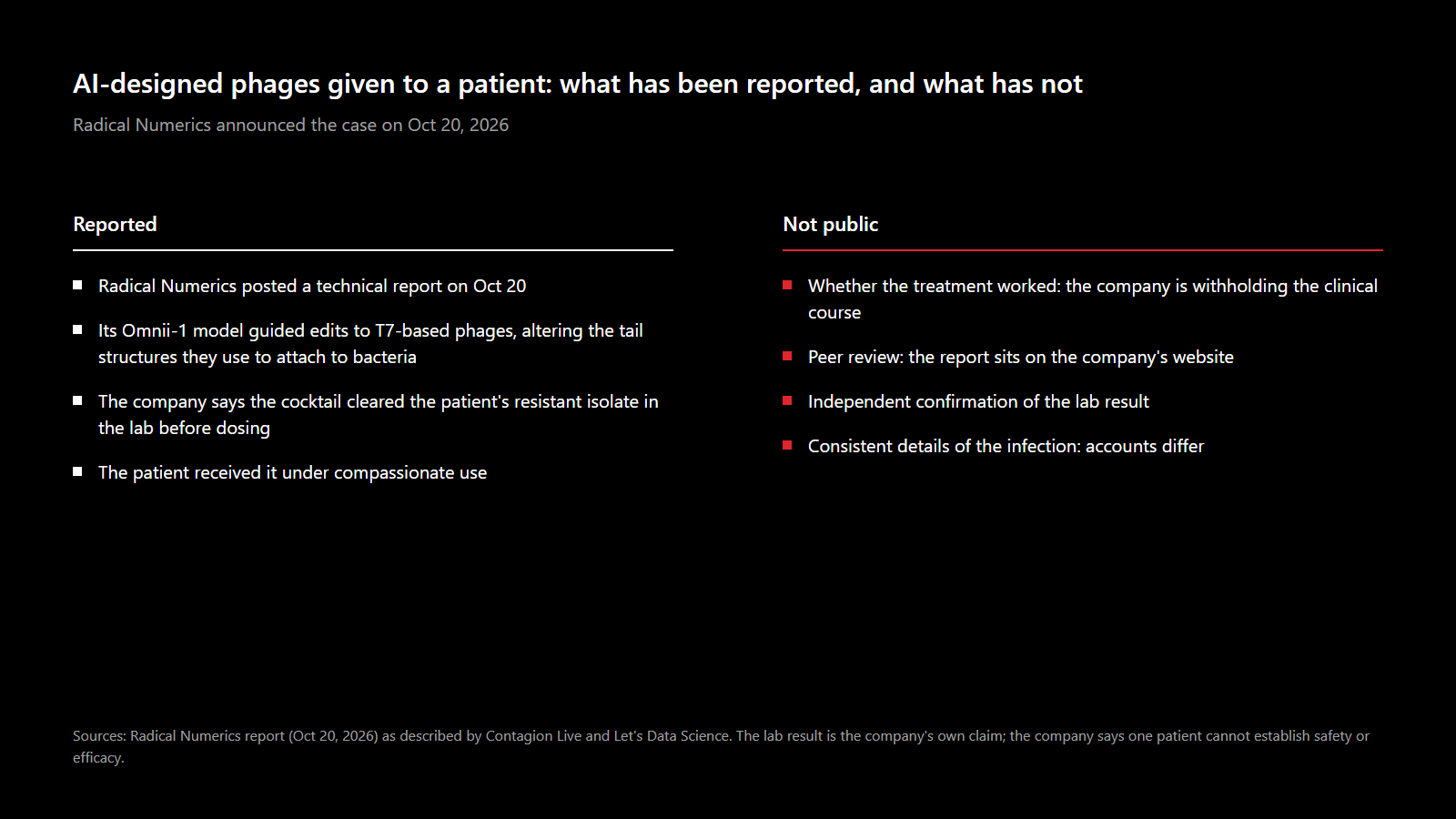

On October 20, 2026, Radical Numerics, a San Francisco AI company focused on bioscience according to press coverage, announced that it had given a patient phages designed with its Omnii-1 model, reportedly under compassionate use. The company’s technical report says the phage cocktail eliminated the patient’s antibiotic-resistant bacterial isolate in the lab before dosing. What the company has not said is whether the patient got better. This article sets out what the company and press accounts report, what none of them can yet confirm, and what outside scientists have said.
What was announced
The technical report is dated October 20, according to Contagion Live, which covered it on October 28. The company says Omnii-1, a model trained on experimentally measured data on how phages interact with their bacterial hosts, was used to identify phage genome targets to edit. According to Let’s Data Science, the company’s write-up calls the model Omnii-1, as reported by The Register, while The New York Times calls it Omnii and says it was unveiled in June.
What was engineered
According to Let’s Data Science, the phage cocktail is based on T7. The team altered the phages’ tail structures so they would recognize the surface of one patient’s bacteria; Contagion Live describes this as changing the number and shape of the phage’s leg-like structures, which lets it attach to the bacterium. The designs were synthesized as DNA and tested on the bacteria in the lab before safety evaluation and administration. The company says the cocktail “eliminated the patient’s antibiotic-resistant isolate in vitro” before it was given.
The patient and the infection
The patient received the treatment under compassionate use. Contagion Live reports it was given under an FDA compassionate use designation, and Let’s Data Science reports that company officials said the FDA authorized it. Contagion Live says the infection was E. coli that resisted both antibiotics and existing phage therapies. Other accounts differ on the pathogen, and at least one outlet noted that the company did not name the infection. The company is withholding the patient’s and clinicians’ identities and the clinical course, and says one patient’s experience cannot establish safety or efficacy.
What is not known
- Whether the treatment worked. The company has not disclosed the clinical course.
- Whether the lab result holds up outside the company. The in vitro result is the company’s own claim, and no independent data on the phages’ behavior in the patient has been reported.
- Peer review. The technical report is posted on the company’s website and has not been published in a journal.
- The “first” label. Press coverage describes this as possibly the first documented use of AI-designed phages to treat a person, but that status rests on the company’s own account.
What outside scientists say
As quoted by Let’s Data Science, Michael Baym, a Harvard microbiologist not involved in the work, said: “If it works, that’s incredible.” He also said: “My impulse is to be skeptical,” and that he would wait until treatment ends. Dr. Marisa Azad of Ottawa Hospital, who is working with Radical Numerics and so is not fully independent of the company, said: “Hunting for phages is remarkably time-consuming.”
Thomas Inglesby and Moritz Hanke of Johns Hopkins wrote a commentary on earlier 2025 phage work, not on this patient case, that states: “the ability to compose viral genomes using generative AI now exists; the governance to safely steer it does not.”
How it differs from earlier work
Lens previously covered laboratory work using the Evo models to design phages against drug-resistant E. coli. That work was reported as laboratory results. This announcement says a patient has been treated, with no result yet.
What to watch next
- Whether Radical Numerics discloses the patient’s outcome.
- Whether the technical report goes through peer review or is reproduced independently.
- Whether regulators or biosecurity researchers respond to the governance concern raised by the Johns Hopkins authors.
- Whether other groups report patient use of AI-designed phages.
The announcement is best read as a company’s report of a single case: a lab result it stands behind and a clinical result it has not shared.
Sources and notes
Coverage: Contagion Live, Let’s Data Science, IBTimes UK. Statements attributed to The Register and The New York Times are as summarized by Let’s Data Science; Lens has not independently verified the company’s claims. Graphic: Lens, from reporting by Contagion Live and Let’s Data Science. Thumbnail photo: a transmission electron micrograph of bacteriophage T2, a different phage from the T7-based cocktail described here. Photo by SnaxMikn via Wikimedia Commons, licensed under CC BY-SA 4.0; shown on a black background. Illustrative photo; it does not show the phages in this case.


