


Pope Leo urges a ban on lethal autonomous weapons ahead of the Geneva talks

Pope Leo XIV called on Friday, October 30, for artificial intelligence to be “disarmed” and urged the states meeting in Geneva in November to take concrete steps toward banning lethal autonomous weapons, according to accounts of the speech published by The Next Web, Infovaticana and Gaudium Press. He spoke at the Vatican to participants in a one-day conference on the future of AI, organized by the Pontifical Academy for Life and the Future of Life Institute, an organization led by the physicist Max Tegmark.
The address repeated a position the pope set out in May in his first encyclical, Magnifica Humanitas, but it tied the argument to a specific negotiation. The states he referred to are expected to decide in Geneva whether to open formal talks on a treaty covering such weapons.
What the pope said
The conference, titled The Future of AI: A Dialogue Between the Vatican and the Scientific World, took place on October 30, according to the Academy for Life. The Academy said the program was held at the Casina Pio IV in Vatican City and that Pope Leo received the group at the Apostolic Palace. The Next Web placed the address in the palace’s Consistory Hall, while the Catholic News Agency described a private audience at the Apostolic Palace; accounts differ on the room. Participants included members of a Vatican commission on AI and researchers. Catholic News Agency named Tegmark and Stuart Russell, a computer scientist at the University of California, Berkeley.
The pope organized his remarks into five points, according to Infovaticana and The Next Web, each referring to paragraphs of the encyclical. First, the future of AI is not fixed and depends on human choices, so people must be ready to guide, change or reject its uses; he said a reliable system that serves people is worth more than a very powerful one whose effects cannot be controlled. Second, machines are instruments, not persons, and he rejected proposals to give AI systems rights or legal personhood, arguing this would obscure human responsibility and leave those who are harmed facing a faceless entity.
Third, some decisions must never be handed to machines. Fourth, AI must serve the common good and not a privileged few. Fifth, because the ethical principles are already known, what is needed are effective international institutions. The Next Web quoted him as saying this “calls for shared standards, independent oversight and clear mechanisms of accountability.”
The weapons passage
The third point carried the pope’s call on weapons. Infovaticana’s account of the text says Leo warned that people placed on a list of suspicious subjects or in a border-control database risk being reduced to data, and that decisions on human life, freedom and the use of force must remain under effective, informed and responsible human control. The word “disarmed,” applied to AI, comes from paragraph 110 of the encyclical, which the pope cited, the account says.
He then turned to Geneva. Infovaticana reported that Leo encouraged the states that will meet there in November to take concrete steps toward prohibiting lethal autonomous weapons. The Next Web’s version says he urged those states to move toward a ban. Gaudium Press, drawing on Vatican News, said he singled out weapons that can identify and engage targets without direct human control. The exact verb differs between the accounts, and the official Vatican text was not opened directly for this report.
Not every report carried the weapons passage. The Catholic News Agency excerpt of the address did not mention weapons or Geneva, and its account is limited to the excerpts it published. The Academy for Life’s description of the day lists oversight of increasingly autonomous systems, safety, accountability and governance among the topics. The Academy’s president, Archbishop Renzo Pegoraro, said participants held a range of views rather than a common position.
What is being decided in Geneva
States discuss lethal autonomous weapons under the Convention on Certain Conventional Weapons, a treaty adopted in 1980 and in force since 1983, according to Janes. A group of governmental experts met in Geneva from August 31 to September 4 and agreed by consensus on a set of elements that could serve as the basis for an instrument governing such weapons, Janes reported. The convention’s Seventh Review Conference meets in Geneva from November 16 to 20 and will decide on next steps, including whether to launch negotiations on a legally binding instrument. The Next Web gave the same dates, citing the group Reaching Critical Will, whose own page could not be opened for this report.
The pope’s intervention follows a joint appeal by the UN Secretary-General and the president of the International Committee of the Red Cross. The appeal was read out at a UN press briefing in Geneva on August 25. It said negotiations on a legally binding instrument must begin now and that the November conference offers the clearest path for states to decide to start them. At the same briefing, Laurent Gisel of the Red Cross said the organization wants bans on unpredictable autonomous weapons and on anti-personnel systems that directly target people, with other systems restricted by target type, area, duration and scale of force.
A UN disarmament official at the briefing, Carolyne Mélanie Régimbal, stressed that the experts’ group is identifying elements of a possible instrument rather than negotiating one, and that states would have to set the mandate and timeline. Gisel said there is no confirmed evidence that fully autonomous weapons have been used to directly target people, although he called the trend concerning. The briefing did not give a count of states for or against.
Human Rights Watch gave a figure in May. In a dispatch dated May 26, it said 130 states have backed a legally binding instrument to prohibit or regulate autonomous weapons, and that states would meet in Geneva in November to consider whether to formally launch treaty negotiations. Human Rights Watch co-founded the Stop Killer Robots campaign, which seeks such a treaty, so the figure comes from an advocate for the outcome rather than a neutral count.
How the address follows the encyclical
Magnifica Humanitas was released on May 25 and runs about 43,000 words, Reuters reported. According to Reuters, the pope wrote that some autonomous weapons systems have advanced practically beyond any human reach to govern them, that military uses of AI must meet the most rigorous ethical constraints, and that entrusting lethal decisions to AI systems is not permissible. Human Rights Watch, quoting the document, said the decision on lethal force cannot be delegated to opaque or automated processes and must remain under effective, responsible human control, with responsibility clearly defined at every stage.
The pope has made the point more than once. Human Rights Watch noted that Pope Francis told the G7 in 2024 that machines should never choose to take a human life, and Infovaticana reported that Leo cited that statement at the start of the October 30 address. The Next Web reported that Leo described AI-directed warfare in May as a spiral toward annihilation, and said in September that fears about AI safety were not fake news.
The position is contested. The Next Web noted that Arthur Mensch, chief executive of the French AI company Mistral, has rebutted the pope on AI in warfare. The article did not detail his argument, and it was not possible to review it for this report.
What to watch
The next decision point is the Review Conference. The sources reviewed describe what is on the table, whether to launch negotiations, but do not say which delegations will attend or how the largest military powers will vote. The UN briefing gave no count of states for or against, and its auto-generated transcript is partly garbled.
Lens analysis: the pope’s address is a moral appeal, not a legal act, and it does not change what states can decide in Geneva. What it adds is a specific reference point. In May, Human Rights Watch reported that the November meeting was ahead; on October 30 the pope referred to the same meeting and said what he hopes it will do. Whether that affects any delegation’s position is not something the reports reviewed can answer.
The distinction the Red Cross draws is also worth following, because it narrows the debate. Its call is for prohibitions on certain systems, those that are unpredictable or that target people directly, and for restrictions on the rest, not for a ban on every autonomous system. Gisel noted at the August briefing that some autonomous systems, such as anti-missile defenses on warships, have existed for decades. Lens analysis: where the line falls between those older systems and the ones the pope wants banned is a question the conference would have to address if it opens negotiations.
Sources
- The Next Web: Pope Leo’s October 30 address on disarming AI and lethal autonomous weapons
- Infovaticana: Pope Leo XIV on AI, machines are instruments, not persons (Oct 31, 2026)
- Gaudium Press: Pope Leo XIV warns against delegating life-altering decisions to AI
- Pontifical Academy for Life: Vatican hosts leading AI scientists and experts for dialogue on the future of AI
- Catholic News Agency (National Catholic Register): Pope Leo XIV: AI can never be a person; its future depends on our choices
- Janes: Special report, autonomous weapons talks advance but verification obstacles remain
- UN Geneva press briefing, August 25, 2026 (UN Information Service)
- Human Rights Watch: Vatican urges strict regulation of artificial intelligence in war (May 26, 2026)
- Reuters (via The Star): Pope, urging AI regulation, warns some weapons now beyond human control
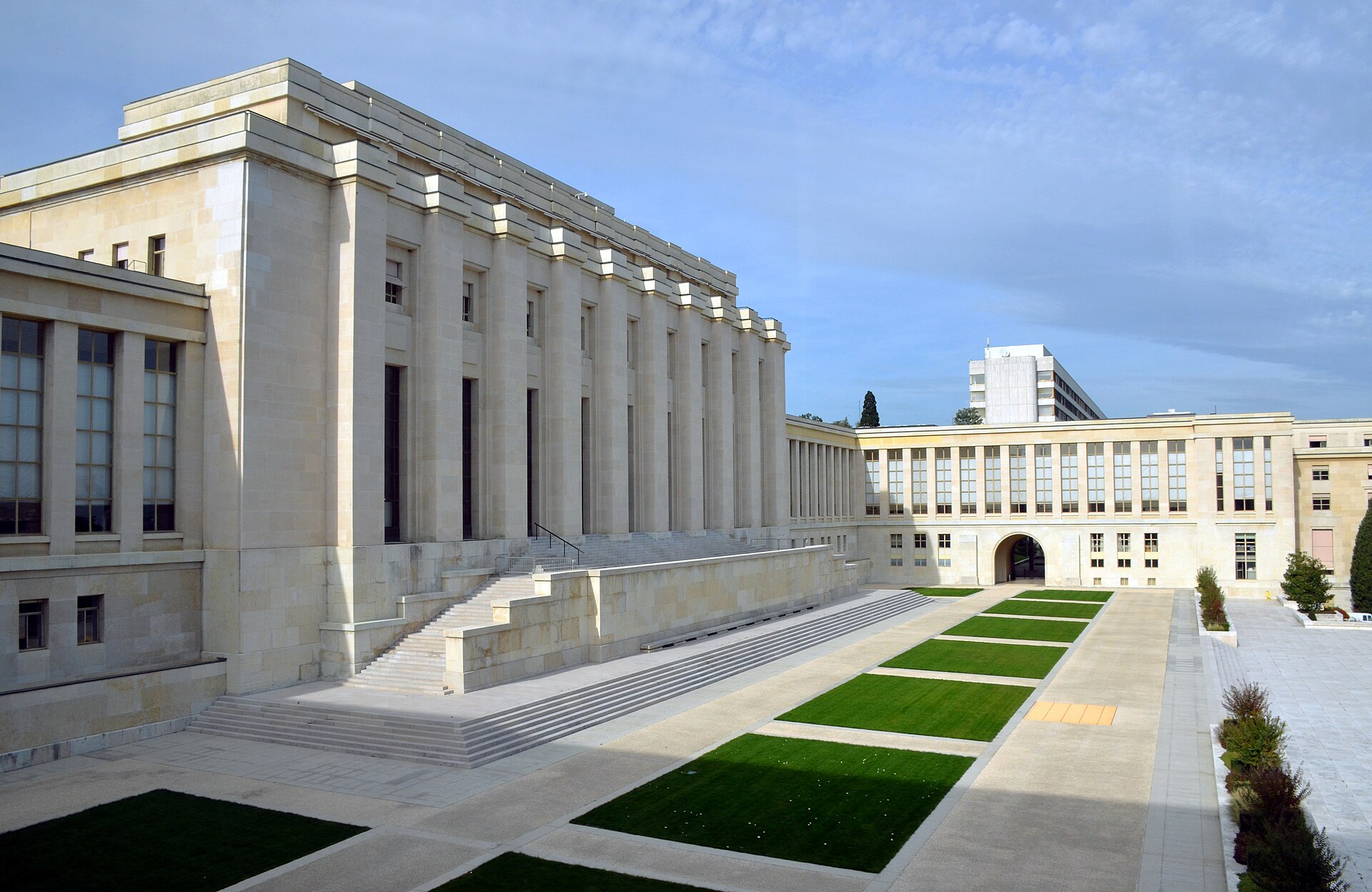
Image: Palace of Nations Geneva 20102014 02.jpg by Vassil, CC0, via Wikimedia Commons. Illustrative photo; it does not show the events described.


