


Physicl Raises $10 Million Seed Led by Inovia Capital for Synthetic Training Data for Physical AI

Physicl, a start-up that generates synthetic 3D training data for robots and other physical-AI models, announced a $10 million seed round on 6 November 2026, according to a post by its founder and chief executive Alex de Vigan and a TechCrunch report by Tim Fernholz. The round was led by Inovia Capital. The company’s post, The Next Web (TNW), Unite.AI, Robotics 24/7 and Silicon Report also name US Venture Partners as a participant; TechCrunch and IT Brief Asia name no other investor. No valuation was disclosed, and no source Lens read mentions earlier funding for Physicl.
The round
The company’s post says the money supports its team in Paris and the San Francisco Bay Area and the platform behind its first app, Studio. IT Brief Asia, Robotics 24/7 and TNW describe the funds as going to expanding the team and developing the platform. Steve Woods, a partner at Inovia Capital, is the investor named in the announcement. De Vigan previously founded nfinite, a Paris company that made 3D product images for online retail; TNW says it raised $100 million in 2022, a figure Lens saw only as a one-line reference there. TechCrunch reports that Physicl is built on nfinite’s 3D pipeline.
What Physicl does
Physicl describes a platform for generating simulated scenes to train and test models for robots and world models. Its first app, Studio, lets researchers recreate scenarios in which their models fail, generate variations such as different lighting, clutter, camera positions and objects, and train on them. According to the company, depth, surface normals, segmentation, bounding boxes and camera pose come from the scene geometry rather than being estimated. The company says its library holds 10,000 environments and 100,000 base assets built from real geometry; TechCrunch reports the same counts. Descriptions of Studio’s status differ: the company post says beta access is free and opens in waves to labs, universities and companies working on vision, world models and robotics; the physicl.ai site describes a private beta with access by request; and IT Brief Asia says the company released Studio alongside the funding. Physicl’s first public appearance was a PR Newswire release on 17 March 2026 at NVIDIA’s GTC conference, which described a data infrastructure layer for physical AI, said it was launched by members of the team behind nfinite, and mentioned no investors or funding. De Vigan told TNW and IT Brief Asia: “Models fail on edge cases.”
The SpAItial result
The company says SpAItial, which is led by Technical University of Munich (TUM) professor Matthias Niessner, saw its reconstruction error on real rooms more than halved after training on Physicl data, in an evaluation run by Niessner’s team at TUM. TechCrunch, TNW and IT Brief Asia report this as the company’s claim and it has not been independently verified. Unite.AI notes that Niessner is SpAItial’s chief executive, a TUM professor and a listed Physicl advisor. The company’s post lists Thomas Wolf of Hugging Face, Christoph Lassner of World Labs, Niessner, Yaser Sheikh and Sébastien Deguy as advisors.
Customers
Sources differ on who uses the platform. The company post names SpAItial, which TechCrunch calls an early customer. IT Brief Asia, describing company-stated customers, lists Meta, World Labs, Epic Games, SpAItial and TUM, plus AWS and NVIDIA; TNW, describing claimed customers, lists Meta, World Labs, Epic Games, Amazon Web Services, Nvidia and TUM. The physicl.ai site shows logos including Mistral AI, TUM, SpAItial, Stanford, Microsoft, Epic Games, Adobe, NVIDIA, Meta, Unity and World Labs under the heading “Working with teams building physical AI”, without describing the relationships. The March 2026 release listed Meta, DeepMind, World Labs and Getty Images as existing users. Unite.AI says no paying customers are named.
Sources and notes
Sources, read through summaries: Physicl’s post “Physical AI fails in the long tail. We’re building every edge case.” (physicl.ai, 6 November 2026); TechCrunch (Tim Fernholz, 6 November); IT Brief Asia (Karen Joy Bacudo, 10 November); TNW (Ana-Maria Stanciuc, 6 November); Robotics 24/7 (9 November); Unite.AI (6 November); RuntimeWire (7 November); Silicon Report (6 November); Signalbase; the PR Newswire release of 17 March 2026; and physicl.ai. Lens did not find the GlobeNewswire release that RuntimeWire cites. Sources differ on where the company is based: TNW, IT Brief Asia and Robotics 24/7 call it Paris-based, the company post refers to teams in Paris and the Bay Area, Unite.AI says offices in New York, San Francisco and Paris with about 30 people, and Signalbase says a US headquarters and 44 employees; physicl.ai states no location. They also differ on the team’s experience: about ten years in 3D (company post), six years in 3D infrastructure, simulation and machine learning (IT Brief Asia, Robotics 24/7), and close to a decade (the March release). TechCrunch describes Niessner as a professor of robotics at TUM, while the company post and IT Brief Asia call him a professor of computer science. The earlier company is written nfinite by TechCrunch and Nfinite elsewhere.
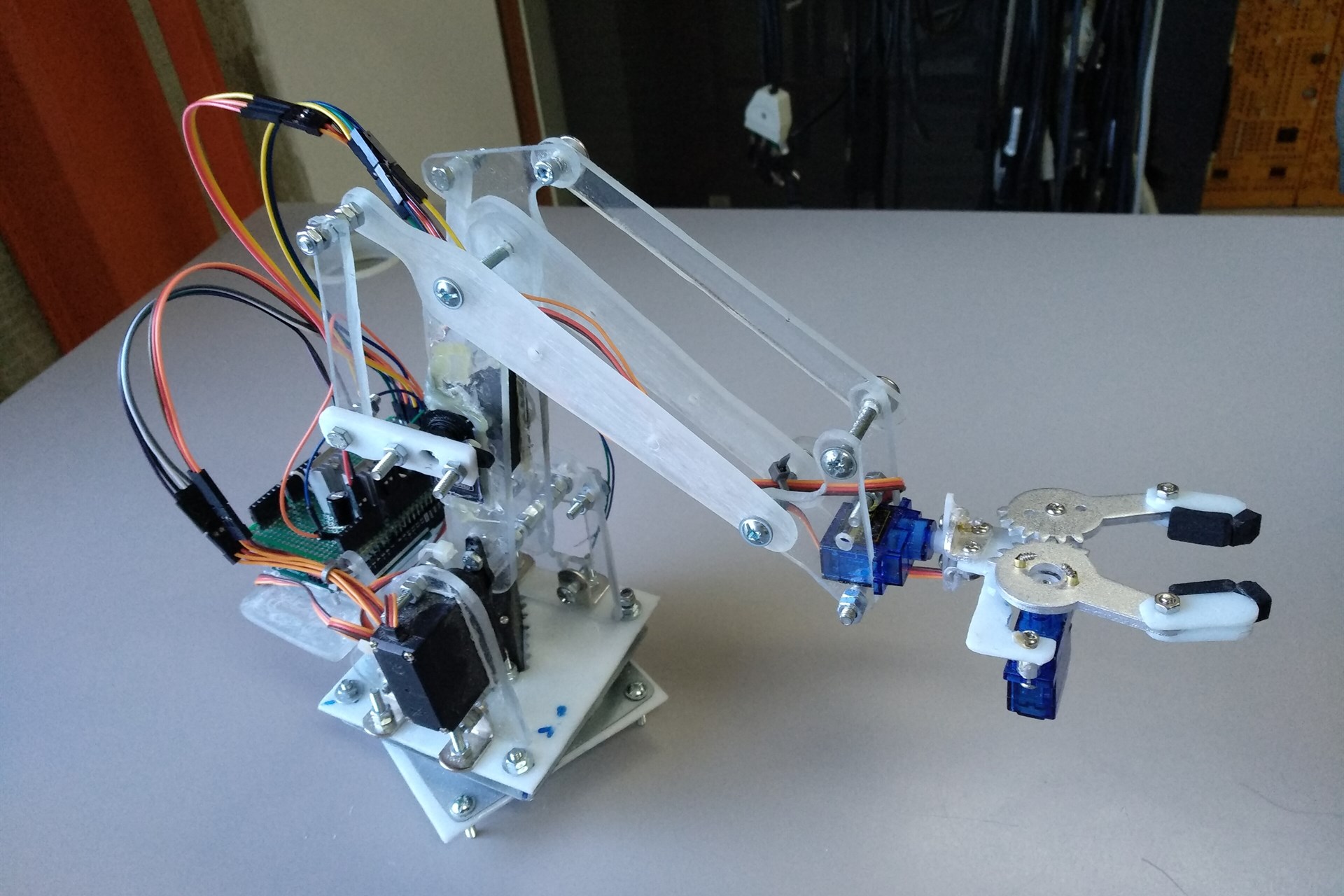
Image: A hand-built robotic arm with an Arduino-style controller and a two-finger gripper on a lab bench, December 2021. Photo: Nicolò Bertuccioli, CC BY-SA 4.0, via Wikimedia Commons; cropped. Stand-in image of a hobbyist robot arm; it does not show Physicl’s software, Studio or any customer’s robot.

