OpenAI Chief Scientist Jakub Pachocki Publishes Internal Perplexity Figures and Proposes Shared Limits for AI Labs; the Post Names No Numeric Limit and Expects Further Gains Near 0.68 to 0.7

OpenAI published a post titled “Perplexity and Intelligence,” by its chief scientist, Jakub Pachocki, dated 22 November 2026. The post argues that perplexity, a measure of how well a model predicts the next token (“lower perplexity means better predictions”), can serve as a shared progress measure across developers, reports figures from OpenAI’s own evaluations, and proposes that developers commit to common limits on development. The figures are OpenAI’s own, and the post itself lists reasons they cannot be compared directly across labs.
The figures OpenAI reports
The post tracks the log of perplexity, which it says is also called cross-entropy loss; lower is better. It says the figures come from OpenAI’s “current main evaluation dataset,” and a footnote says the primary held-out datasets used since GPT-3.5 are sourced from OpenAI’s internal codebase.
- GPT-3.5: a log-perplexity of about 0.99.
- GPT-4: about 0.91.
- Unnamed models: the post says OpenAI has “reached losses below 0.8,” and that “Once we upgraded to a model of log-perplexity ~0.76, it started producing groundbreaking results.” It says OpenAI has been posing open mathematics problems to its models, with resolutions “coming out of the model one after another,” and it names no specific problems or counts.
- Forecast: the post says OpenAI should expect “further transformative capabilities” “as we enter the ~0.68-0.7 log-perplexity window.”
What the post proposes
The post says frontier model developers “should jointly endeavour to establish shared norms for how to evaluate such models.” It then proposes “common limits, based on perplexity and other measurements,” that developers are “committed to not crossing until” the ability “to understand and monitor AI behavior achieves a certain concrete milestone,” such as “the development of a successor to CoT monitors.” It calls for “an industry standard that specifies a first limit on development, measured by some key metric we can track across labs,” and “a common framework for setting successive limits and pacing further development.” The post gives no numeric value for any limit and names no other lab or government.
Limits of perplexity that the post lists
The author’s own list of challenges includes that “different developers use different evaluation datasets and train on different data mixtures” and that perplexity “does not directly correspond to a task we care about.” It also says chain-of-thought reasoning “does not reduce perplexity achieved by the model,” and that OpenAI does not expect a loss of 0 to be achievable. The post argues that perplexity “has stood the test of time.”
Where reports differ
- The 0.68 to 0.7 figure: The post presents it as a window in which OpenAI expects further transformative capabilities, not as a limit. AI Weekly’s summary says labs would commit not to cross a window of 0.68 to 0.70; Kill The AI’s summary says the post names no numeric limit and expects a capability jump there. Lens read the OpenAI post and found no limit stated.
- “Loss” or “perplexity”: TopFive calls the published numbers “loss figures”; the post says log-perplexity, “also called cross-entropy loss.” These are the same quantity as the post defines it.
Sources and notes
OpenAI, “Perplexity and Intelligence,” by Jakub Pachocki, 22 November 2026, read by Lens on 23 November. The text Lens read has no section headings, and Lens did not see the plot the post refers to. Digest summaries from The Neuron, TopFive, Kill The AI and AI Weekly were read only to compare how they describe the post. OpenAI’s figures cannot be checked independently and are not comparable with other developers’ evaluations, as the post itself says.
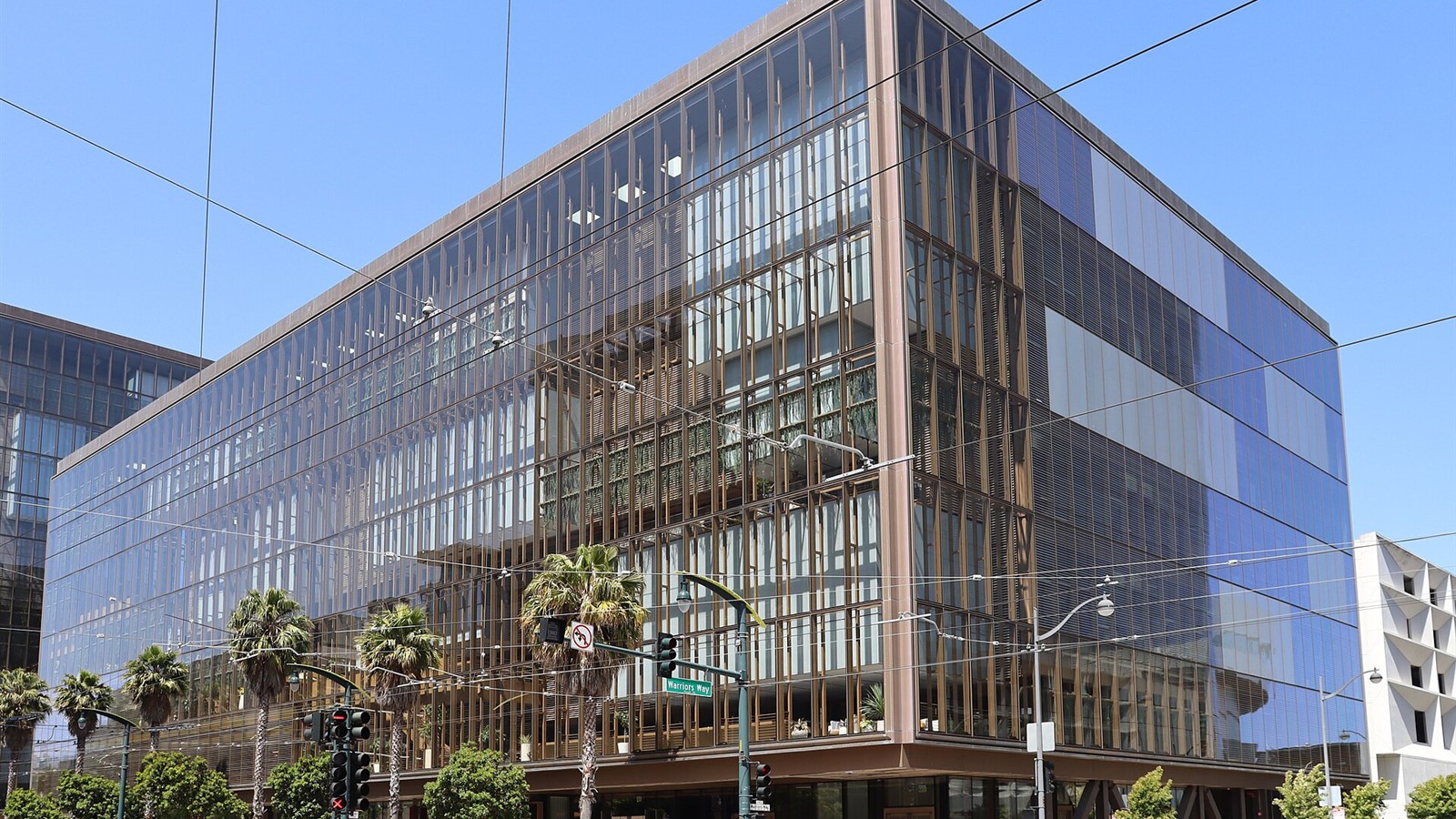
Image: The building at 1515 Third Street in San Francisco’s Mission Bay, which Wikimedia Commons describes as OpenAI’s headquarters when the photo was taken on 15 June 2025. Credit: Coolcaesar, CC BY 4.0, via Wikimedia Commons; cropped. File photo; Lens has not checked that OpenAI still occupies the building.