OpenAI Disbands Its Stand-Alone Robotics Team and Moves Staff to Research and Applied Groups, Fortune Reports

OpenAI has disbanded its stand-alone robotics team and moved its members to other parts of the company, Fortune reported on 13 November 2026. According to Fortune, OpenAI confirmed the reorganization when asked about it, and a company spokesperson said robotics remains a core part of OpenAI’s long-term vision and described the change as a sign of commitment, not a retreat. As of 14 November 2026, Lens has not found a separate OpenAI statement, and the follow-up coverage Lens read repeats Fortune’s account.
What changed
- Robotics researchers: reassigned to OpenAI’s main research team, which reports to Chief Research Officer Mark Chen, according to OpenAI as Fortune reports it.
- Applied robotics and hardware teams: reassigned to OpenAI’s larger Applied organization, which reports to President Greg Brockman.
- Headcount: Fortune’s article does not say how many people were affected.
Fortune also reports that OpenAI had registered a booth, number 208, at the Conference on Robot Learning (CoRL), an academic robotics conference held in Austin this week. When Fortune visited, the booth was empty and the OpenAI logo was nowhere to be seen. Fortune says a few former members of the robotics team were at the conference, and it updated its story on 13 November to clarify their status.
OpenAI’s stated reason
Per Fortune, the spokesperson said that at the start of the year OpenAI’s researchers assumed the best route to progress in robotics was to build on work on models such as Sora, a video-generation model. Since then, the spokesperson said, OpenAI’s general-purpose frontier models, including GPT-6 Astra, have shown that they can be applied directly to robotics. Fortune says this is what led the company to move the researchers onto teams working on more general models, and that OpenAI described the move as the best way to speed progress toward general-purpose robots. Fortune paraphrases the spokesperson and does not give a direct quote.
Fortune cites an Nvidia study in which an agent powered by GPT-6 Astra reached a 74.8% success rate on a simulated manipulation benchmark, compared with 51.0% reported for the best specialized robotics models on the same leaderboard. Fortune notes that the model commanded a simulated robot, not a real one. In the experiments Fortune describes, the model was given camera images, robot information and a control interface. Lens could not locate the Nvidia study itself.
Background and outside views
Fortune reports that OpenAI had a robotics team in its early years and wound it down in 2020, with co-founder Wojciech Zaremba later citing limited robot data and a more efficient route to artificial general intelligence through other methods. OpenAI rebuilt a stand-alone team in 2024 and announced a partnership with the robotics startup Figure. According to Fortune, that partnership ended in February 2025, when Figure said it would develop its own robot artificial intelligence. Fortune says OpenAI has said it is developing its own humanoid robot, and that chief executive Sam Altman is targeting a first public demonstration in 2027.
Fortune notes that the reorganization comes as OpenAI is under pressure to reduce costs and focus on a few core products. It says OpenAI’s operating losses reportedly totaled $10.9 billion in the most recent quarter, and that the company is seeking a new funding round and preparing for a possible initial public offering in early 2027. Fortune also quotes researchers from a university and from robotics startups, and they differ on what the change means. Lens does not reproduce their opinions.
Sources and notes
Sources: Fortune, “OpenAI disbands its stand-alone robotics team as its general models start running robots” by Wen Shao (13 November 2026, 12:05 p.m. Eastern), read in full as text, including its update note. Follow-up coverage read as text: MLQ.ai, BigGo Finance, PANews and AI Weekly. All four credit Fortune and add no independent reporting. A Seeking Alpha item returned a 403 error and was not read. Lens did not find an OpenAI announcement or the Nvidia study. One aggregator gives a per-attempt cost for GPT-6 Astra robot control; that figure is not in Fortune’s article and is not used here. The history, the 2027 demonstration target, the loss figure and the benchmark numbers are as Fortune reports them.
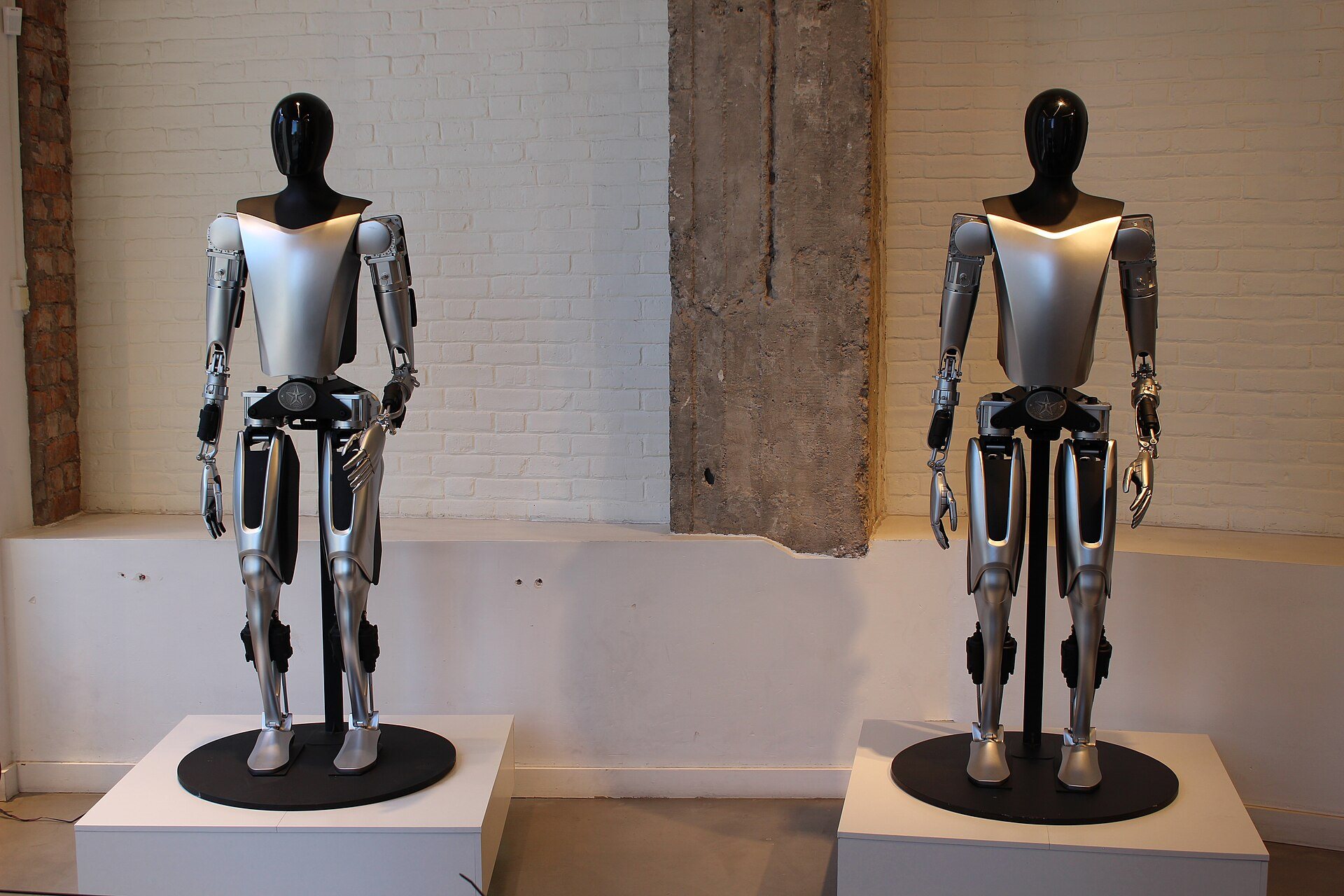
Image: Two Tesla Optimus humanoid robots on display on white plinths, photographed in Stockholm on 13 May 2024. Photo: Ulf Klingström (public domain), via Wikimedia Commons. Stand-in image: not a photo of OpenAI's robotics team or of any robot built by OpenAI.