Nvidia Shares Rise 31.5% to $165.05 After Board Reinstates Jensen Huang, Their Best Day Since 2003, Then Fall 5.9% and 3.9%
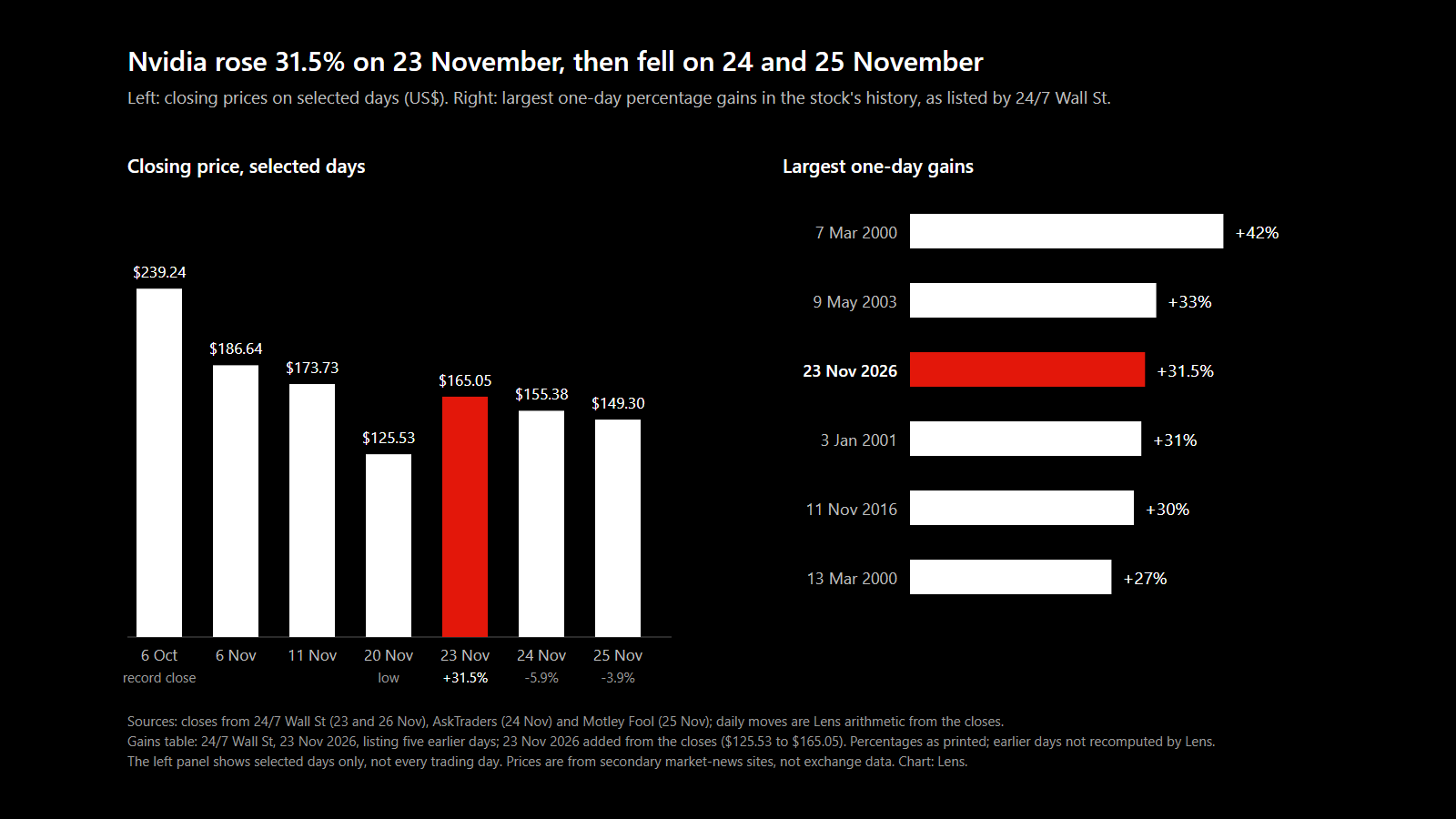

Nvidia’s shares closed at $165.05 on Monday 23 November 2026, up 31.5% from $125.53 on Friday 20 November, on the day the company’s board reinstated Jensen Huang as president, chief executive and director. 24/7 Wall St described the gain as the stock’s third-best one-day gain since at least 1999 and its best since 2003. The shares then closed at $155.38 on Tuesday 24 November and $149.30 on Wednesday 25 November, according to AskTraders and Motley Fool. Lens reported the reinstatement in its report on the board’s announcement and the previous Friday’s 14.01% fall in its report on the 20 November market close.
The 23 November move
CNBC reported that Nvidia shares “gapped higher at the open by more than 30%” after the announcement just before the opening bell, and gave $171.50 as the day’s intraday high. That is 36.6% above Friday’s close by Lens arithmetic; a StockTwits report on Yahoo Finance said the shares rose as much as 37%. The closing gain of 31.5% is Lens arithmetic from the two closes ($165.05 divided by $125.53); 24/7 Wall St, StockTwits and Yahoo Finance round it to 31%.
24/7 Wall St reported that the jump added about $954 billion to Nvidia’s market value in one session. SentiSight, citing MarketWatch and Yahoo Finance, put it at roughly $950 billion and gave market values of about $3.03 trillion on Friday and $3.98 trillion at Monday’s close. A teaser on the 24/7 Wall St page gives $990 billion, which conflicts with that article’s own figure.
The close left the shares 31% below their record close of $239.24 on 6 October, according to 24/7 Wall St, which also reported that they fell 33% between their 6 November and 20 November closes. By Lens arithmetic, Monday’s $39.52 per-share gain recovered 82% of the $48.20 per-share decline between the 11 November close of $173.73 and the 20 November close. CNBC reported that most analysts had restored price targets above $200, the highest at $270.
What the reports say about the cause
CNBC wrote that the shares jumped “following the news just before the bell” of the reinstatement, and it did not attribute any of the move to the broader market. A StockTwits report on Yahoo Finance said the announcement “sparked a broader technology rally on Monday.” 24/7 Wall St wrote that “Monday’s came from a boardroom vote: the company’s sales forecast did not change,” that the board’s investigation will continue and that Nvidia’s quarterly report for the period ended October is still delayed.
Other stocks and the major indexes also rose that day. According to market wraps from Longbridge, Proactive Investors and Newsquawk, the S&P 500 closed at 7,237 (up 4.7%), the Nasdaq Composite at 24,089 (up 6.5%, or 1,471 points) and the Dow Jones Industrial Average at 49,595 (up 1,447 points, about 3% by Lens arithmetic); the wraps also reported Micron up about 19% and Arm up about 16%. The sources Lens read do not separate how much of Nvidia’s move reflected the reinstatement and how much reflected the wider rally.
How the reinstatement was reported
Nvidia’s announcement said the board had unanimously reinstated Huang and had received input from senior levels of the US government. In a CNBC interview on Monday, according to Yahoo Finance, President Donald Trump said he had spoken “directly and indirectly” with the board and “convinced” them; Yahoo Finance quoted him as saying “we gave them assurances at least with everything we know. And we know a lot.” Bloomberg, as relayed by the StockTwits report on Yahoo Finance, reported that the board’s decision was finalized on Sunday afternoon after pressure from Trump and without consulting senior management, and that interim chief executive Colette Kress and other top executives were left out of the discussions, according to people familiar with the matter. 24/7 Wall St instead wrote that the board “voted unanimously on Monday morning.” Lens did not read Bloomberg’s report.
The pullback on 24 and 25 November
AskTraders reported that Nvidia closed at $155.38 on Tuesday, down 5.86% (a $9.67 fall, matching Lens arithmetic), after trading between $150.50 and $159.92. Yahoo Finance reported declines of more than 7% during the afternoon. AskTraders described the fall as profit-taking without naming a source and said no new Nvidia announcement accompanied it; Yahoo Finance wrote that “the broader chip sector faced selling pressure as investors rotated out of tech.”
On Wednesday Nvidia closed at $149.30, down 3.91%, after a range of $141.17 to $150.37, according to Motley Fool, which wrote that “Investors are trimming AI exposure as spending worries and inflation fears weigh on Nvidia and other chip names” and that “New tariff proposals added to the angst.” Motley Fool reported that the PCE index rose at a seasonally adjusted 3.8% annual rate in October, in line with estimates. The Associated Press reported that the S&P 500 closed at 7,182.78, down 0.3%, after falling as much as 3.2% earlier in the session; the Nasdaq Composite closed at 23,585.80, down 0.6%, and the Dow at 50,182.95, up 0.3%.
By Lens arithmetic, the two days’ decline of $15.75 per share reversed about 40% of Monday’s $39.52 gain. The $149.30 close is 18.9% above Friday’s close and 37.6% below the 6 October record close.
StockAnalysis.com, IBTimes (citing Reuters) and ExplainX reported that S&P Global Ratings placed Nvidia’s “AA” ratings on CreditWatch with negative implications on Wednesday, citing management and governance, with a decision expected within 90 days and any downgrade limited to one notch, to “AA-.” StockAnalysis.com and ExplainX quoted S&P as saying Huang’s reinstatement “does not sufficiently answer our questions regarding board oversight of executive code of conduct.” S&P’s own research update was not available to Lens, and the Motley Fool and AP accounts of Wednesday’s trading that Lens read do not mention the rating action.
Sources and notes
Lens read the CNBC article of 23 November; 24/7 Wall St articles of 23 and 26 November; a StockTwits article on Yahoo Finance of 23 November; SentiSight of 26 November; AskTraders of 24 November; Yahoo Finance’s live blog and an article of 24 and 25 November; Motley Fool of 25 November; an Associated Press summary on Yahoo Finance of 25 November; and StockAnalysis.com, IBTimes and ExplainX on the S&P action. Lens did not read Benzinga or Kalkine (access refused), CNN (unavailable), Kiplinger (headline only), Bloomberg, Reuters, S&P Global Ratings’ release or Nvidia’s filings. The share prices come from secondary market-news sites, not exchange data. The 6 November ($186.64) and 11 November ($173.73) closes are derived from per-share values in the 24/7 Wall St article of 26 November, and the 11 November figure also appears in CNBC. The index figures for 23 November come from market wraps that differ slightly from one another (for example Dow 49,595 and 49,599).
Figures differ between sources: the Monday gain is 31%, 31.2% or 31.5%; the market-value gain is about $950 billion, $954 billion or $990 billion; and Tuesday’s decline is 5.86% at the close against more than 7% during the afternoon. CNBC dates Huang’s resignation 12 November, while Nvidia’s filing, which Lens reported on 13 November, gives 11 November. US markets were closed on Thursday 26 November for Thanksgiving, and Lens did not find a close for Friday 27 November, so the latest close here is 25 November. Several of the pages Lens read also discuss personal allegations about Huang; Lens does not repeat them. A claim that Moody’s kept Nvidia’s rating unchanged appeared only in one rewrite and was not verified or used. Lens did not contact Nvidia, S&P Global Ratings or the outlets cited.
Image: Chart by Lens from 24/7 Wall St, AskTraders, Motley Fool and CNBC figures. Thumbnail: Nvidia’s headquarters in Santa Clara, California, photographed on 4 August 2018 by Coolcaesar via Wikimedia Commons, licensed under CC BY-SA 4.0; cropped. File photo; it does not show the events described.