


MindStudio Reports an Nvidia RTX Spark Laptop Runs GPT-OSS-120B at 13.9 Tokens per Second on Linux Versus 65.4 on Windows

A MindStudio blog post published on November 1, 2026 reports that an Nvidia RTX Spark laptop ran the GPT-OSS-120B model at 13.9 tokens per second on native Linux against 65.4 on Windows, and attributes the gap to a Windows-only power-management component. The post reached the front page of Hacker News on November 4, where it had 509 points and 227 comments when Lens checked. Nvidia’s response was not reported in the article. Lens covered the platform’s launch in an earlier post.
What was tested
The main test machine was an MSI Prestige N16 Flip AI Plus, an RTX Spark laptop with up to 128GB of unified memory. The article also names Asus ProArt and Dell XPS RTX Spark laptops and uses Nvidia’s DGX Spark desktop, which it says uses the same GPU design and ships with Nvidia’s Linux build, as a comparison. It gives no version numbers for the kernel, Nvidia driver, CUDA or Windows build. On Linux it used Nvidia’s open kernel driver and tried the Omarchy (Arch-based) and Debian distributions, with tools including vLLM, SGLang and LM Studio.
Reported figures
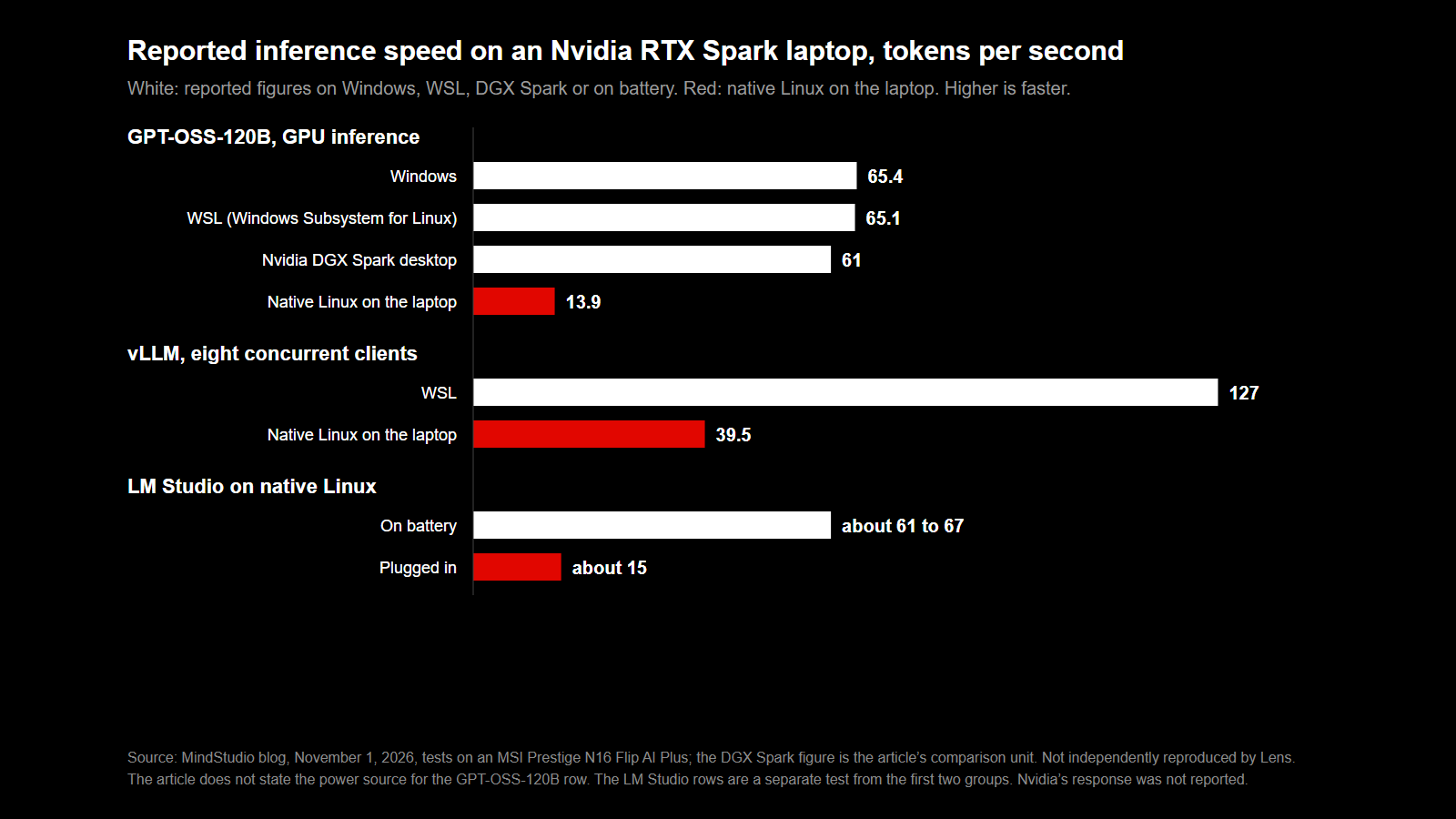
- GPT-OSS-120B on the GPU, tokens per second: Windows 65.4; WSL (Windows Subsystem for Linux) 65.1; DGX Spark 61; native Linux on the laptop 13.9. The article does not state the power source for this test.
- vLLM with eight concurrent clients: WSL 127; native Linux 39.5.
- Longer run: Windows finished in about 8 minutes with the GPU near 2.2 GHz; Linux took about 37 minutes with the GPU near 790 MHz. Temperatures stayed between 40°C and 47°C, and the author says thermal throttling was ruled out.
- LM Studio on Linux: about 61 to 67 tokens per second on battery, comparable to Windows, against about 15 when plugged in, with GPU clocks of about 1,800 MHz on battery and about 780 MHz plugged in.
- Windows control test: disabling the Nvidia Platform Controllers and Framework dropped throughput from about 83 to about 31 tokens per second and the clock from roughly 2 GHz to about 786 MHz; re-enabling it restored normal speed.
The claimed cause
The author says the Windows-only Nvidia Platform Controllers and Framework manages the power budget shared by the CPU and GPU, and that its power table is encrypted so that only the Windows driver can decrypt it. Software workarounds the author tried did not restore speed, and one caused a kernel panic. The author describes extracting the decryption key from the Windows driver as a fragile, single-machine hack and says a real fix would require Nvidia to add equivalent power-management logic to its Linux driver. The article presents WSL as the practical option until then.
Other findings in the article
- Firmware reserves 96GB for the GPU by default. Linux initially saw only 28GB; lowering the Windows-side GPU reservation to 4GB let Linux see 120GB. WSL reserves 14GB by default and needs a manual increase for large models.
- Omarchy worked on the Asus and Dell hardware but produced a flickering display on the MSI model. Debian needed a USB Ethernet adapter for installation and did not detect the keyboard, touchpad or GPU out of the box.
Different ratios in circulation
The Hacker News submission’s title says Linux slows inference “to 35%.” By Lens’s arithmetic, the article’s 13.9 against 65.4 is about 21%, and 39.5 against 127 is about 31%. The article figures Lens reviewed do not include a 35% ratio.
Sources and notes
This post is based on the MindStudio blog article “Linux on the Nvidia RTX Spark Laptop: What Actually Works,” published November 1, 2026 and edited by Luis Chavez-Mattos, and on the Hacker News front page on November 4. All figures are the author’s; Lens did not reproduce the tests. The chart at the top is a Lens graphic of those figures. Nvidia did not comment in the article, and Lens did not contact Nvidia or MindStudio.
Image: a laptop running the GNOME desktop on Linux (a 2016 Lenovo ThinkPad T460, not an RTX Spark machine), by Albert György via Wikimedia Commons, licensed under CC BY 4.0; cropped. Stand-in photo; it does not show the events described. Chart: Lens, from figures reported by MindStudio.

