


Naval Group Shows SCX 26 Destroyer Concept at Euronaval With Up to 96 Missile Cells, Laser and Electromagnetic Gun

Naval Group presented the SCX 26 destroyer concept at Euronaval 2026 in Paris, according to Defense Express, and The War Zone reported on it on November 3, 2026. The War Zone reported that Naval Group describes it as “a platform for testing ideas about future naval combat, rather than a design intended for immediate construction,” and called it “a research project rather than a production design” that reportedly underwent “model testing in a towing tank.” Defense Express wrote on November 5 that even Naval Group calls it a research exercise; its article contains no direct quote from a named Naval Group spokesperson.
Reported specifications
- Displacement: about 8,000 metric tons at full load, according to both articles.
- Length: about 558 feet, or roughly 170 m, according to The War Zone; 127 m according to Defense Express. Neither article reconciles the two.
- Speed and range: a maximum speed of 30 knots and a range of up to 8,000 nautical miles, according to both. The War Zone adds a width of 79 feet and combined diesel-electric and gas turbine propulsion.
- Crew: about 150, with accommodation for another 100 people, according to both.
Armament and systems
- Vertical launch: The War Zone reports 12 Sylver installations, eight forward and four aft, holding up to 96 missiles including Aster 30 and MdCN land-attack missiles, with capacity that could exceed 100 using quad-packed CAMM and future Sylver NG launchers. Defense Express quotes Naval Group as saying “over 100 missiles can be deployed in Sylver vertical launch systems” and says renders show roughly 64 to 96 cells, depending on configuration. A social media post embedded in The War Zone’s article cited “at least 64 missile cells”; the article does not reconcile it.
- Two Rampart multifunctional launchers for short-range missiles, guided rockets and decoys.
- A “large-caliber electromagnetic weapon,” which The War Zone says is a concept only, a conventional 57 mm gun, and a proposed 100 kW laser mounted high on the forward superstructure.
- Defense Express says the sensors include a UHF radar for detecting ballistic and hypersonic missiles such as the Oniks and Zirkon.
- A large internal mission bay for helicopters and uncrewed air, surface and underwater vehicles, one NH90-sized helicopter spot and two smaller spots for vertical takeoff drones. Naval Group calls the bay a “small onboard drone factory,” The War Zone reports.
Status
Neither article ties the SCX 26 to a French Navy program or buyer. The War Zone links the design to France’s eventual replacement for its Horizon-class air-defense destroyers and writes that “whether these ideas eventually inform a future French or export warship remains to be seen.” Defense Express says France “currently has financial difficulties” and that the concept could become the basis for a practical project if a buyer is found. It compares the SCX 26 with Italy’s DDX destroyers, which it gives as 64 vertical launch cells, 180 m and 13,500 tons with a crew of 251, at €3.7 billion for two ships. The War Zone notes that a laser’s effectiveness is constrained by atmospheric conditions and range, and that electromagnetic guns have faced power-generation and barrel-wear problems.
Sources and notes
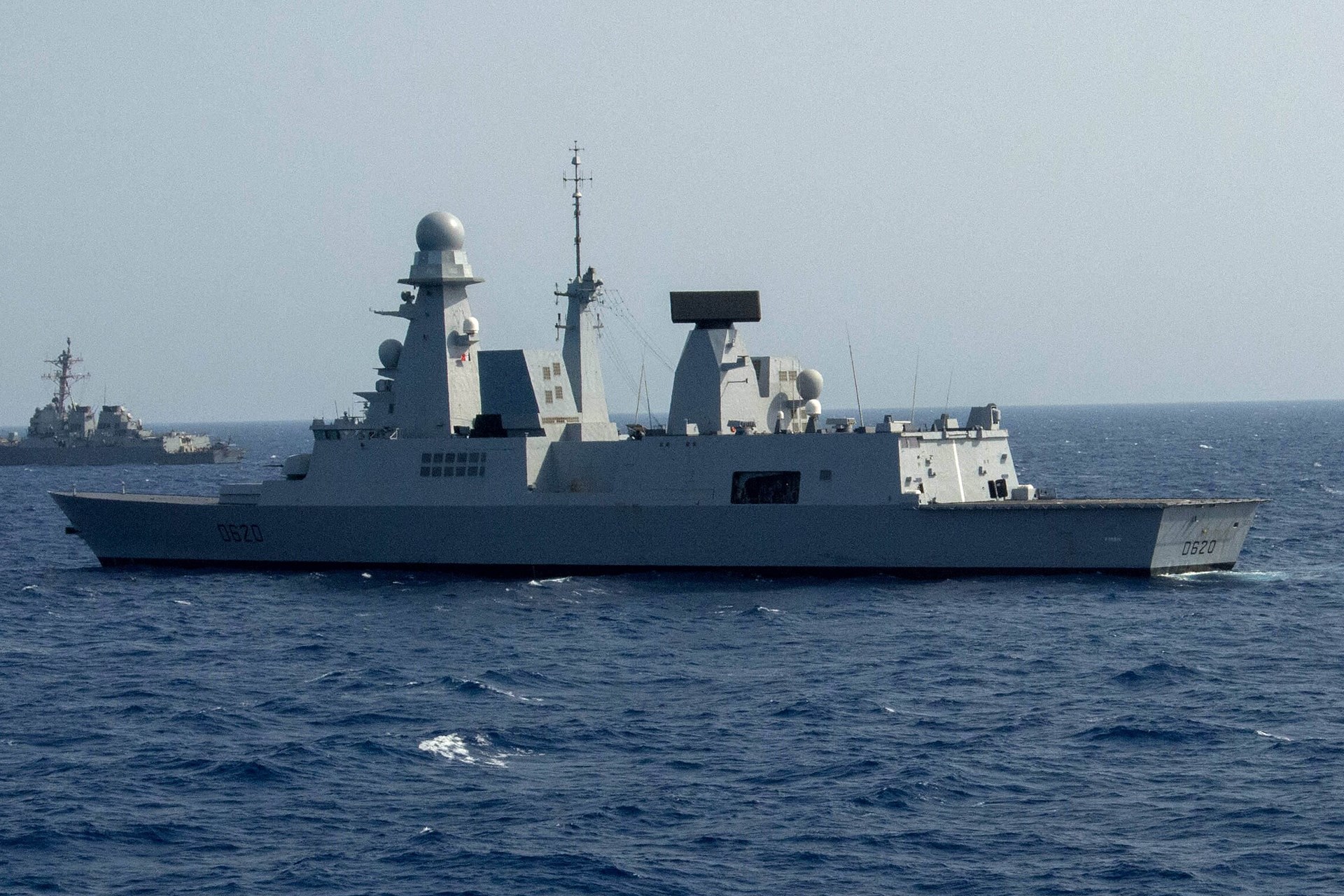
Sources: The War Zone, Thomas Newdick, November 3, 2026; Defense Express, Borys Gulkevych, November 5, 2026. Notes: Lens did not read Naval Group’s own release, and the exact date of the Euronaval presentation is not given in the articles it read. Many figures in The War Zone are hedged as approximate or reported. Defense Express uses the term electromagnetic gun for the weapon its headline calls a railgun. Thumbnail photo: the French Navy’s Horizon-class destroyer Forbin (D620) at sea, U.S. Navy photo by Mass Communication Specialist 3rd Class Janweb B. Lagazo, public domain, via Wikimedia Commons, taken February 13, 2017; cropped. Illustrative stand-in: it shows an existing Horizon-class ship, not the SCX 26.
Image: U.S. Navy photo by MC3 Janweb B. Lagazo (public domain), via Wikimedia Commons.

