


Moonshot AI releases the weights of Kimi K3.1 Pro, a 2.8-trillion-parameter model, under a custom license

Moonshot AI has published the model weights of Kimi K3.1 Pro on Hugging Face. The Chinese company launched the model through its apps and API on October 23, 2026, and said the weights would follow by November 4. A LinkedIn post announcing the release linked to the repository and said, “We’ll keep advancing open intelligence.”
The repository is public and does not require access approval. It holds 96 safetensors files totaling about 1.56 terabytes.
What was released
- Size: 2.8 trillion total parameters and 104 billion active parameters, in a mixture-of-experts design with 896 experts, according to the model card. Moonshot also calls it a “3T-class” model.
- Input: text and images, with a context length of 1,048,576 tokens.
- Changes from Kimi K3: Moonshot says it spent more compute on post-training and ran joint reinforcement learning across hundreds of domains. The model card says full-attention layers were replaced with a type intended to make long-context modeling more efficient.
- Running it: the card recommends the vLLM, SGLang and TokenSpeed engines and gives no hardware requirements. Wafer reported in July that Kimi K3, which also has 2.8 trillion parameters, needs more than 1.5 terabytes of GPU memory for its weights alone, as Lens has reported.
- Hosted access: Vals.ai lists API pricing of $2 per million input tokens and $10 per million output tokens. Moonshot also offers K3.1 Pro Highspeed, which it says runs two to three times faster.
License
The weights are released under the Kimi K3.1-Pro License, not a standard open-source license. Lens compared the text with the Kimi K3 license and found that only the model name differs. It allows use, modification, fine-tuning, distribution and sale at no charge, subject to these terms:
- Hosting services: a company offering the model as a service, whose revenue with its affiliates exceeds $20 million over any consecutive 12 months, must sign a separate agreement with Moonshot before commercial use. The definition excludes end-user products with the model embedded in specific features, and services that only relay requests to models hosted by others.
- Large products: commercial products with more than 100 million monthly active users or more than $20 million in monthly revenue must prominently display “Kimi K3.1-Pro” in the user interface.
- Exemptions: those two terms do not apply to internal use that makes nothing available to third parties, or to use through Moonshot’s official products or certified inference partners.
The license requires compliance with applicable laws and contains no list of prohibited uses.
Benchmark results
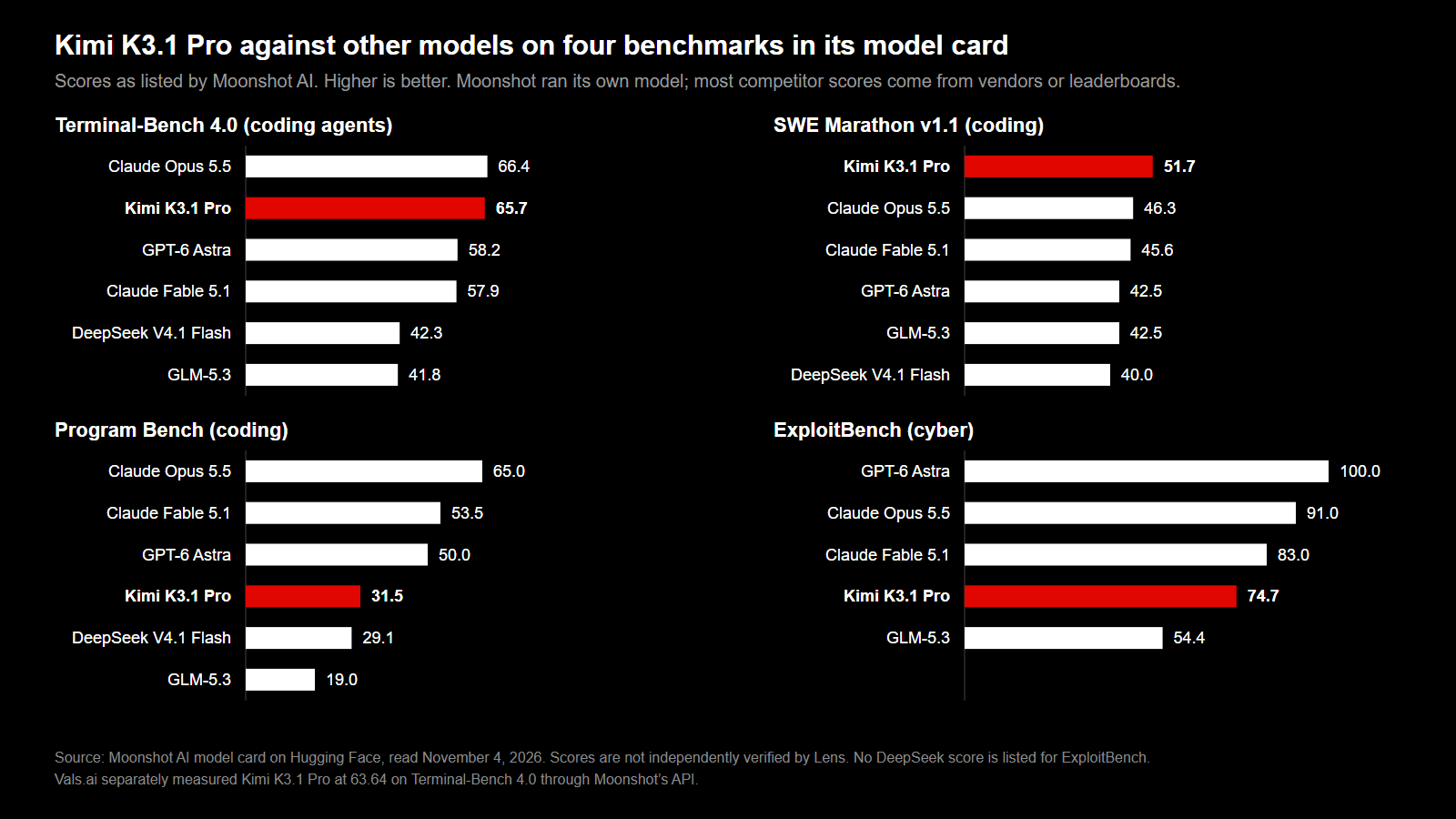
The model card compares Kimi K3.1 Pro with Claude Fable 5.1, GPT-6 Astra, Claude Opus 5.5, DeepSeek-V4.1-Flash-1017 and GLM-5.3 on more than 40 tests, several of them Moonshot’s own. Moonshot ran most of the tests of its own model, and it says most competitor coding scores come from vendor blogs or public leaderboards. Among the coding results:
- Terminal-Bench 4.0: Kimi K3.1 Pro 65.7, Opus 5.5 66.4, GPT-6 Astra 58.2, Fable 5.1 57.9.
- SWE Marathon v1.1: Kimi K3.1 Pro 51.7, the highest listed; Opus 5.5 46.3.
- Program Bench: Kimi K3.1 Pro 31.5, Opus 5.5 65.0, Fable 5.1 53.5, GPT-6 Astra 50.0.
- Terminal-Bench-Science 0.1: Kimi K3.1 Pro 38.1, GPT-6 Astra 68.1, Opus 5.5 63.3.
Vals.ai, which tested the model through Moonshot’s API, measured 63.64% (± 1.75) on Terminal-Bench 4.0, third of 59 on its list. Its Vals Index score was 62.52% (± 1.14), ninth of 32, up from 52.96% for Kimi K3. Vals described K3.1 Pro as the top open-weights model on that index in an October 24 update, ahead of DeepSeek V4.1 Flash 1017 at 61.26%. On Vals’s legal index it ranked 25th of 33, and on its finance index 20th of 35.
Cyber capability
Moonshot says it found cyber content in its general mid-training data and cyber tasks in its reinforcement learning environments, and removed both for the open-weight release while keeping general coding data. It says it aims “not to release open weights that would extend the absolute frontier of cyber capability,” and that it intends to raise the capability available in open weights gradually.
- On xdev-bench-hard, Moonshot’s internal test, a checkpoint without these controls scored 90.5%, the released model 81.0% and Kimi K3 33.3%. DeepSeek-V4.1-Flash scored 85.7% and GLM-5.3 57.1%.
- On ExploitBench, the model card lists Kimi K3.1 Pro at 74.7, GPT-6 Astra 100, Opus 5.5 91.0, Fable 5.1 83.0 and GLM-5.3 54.4.
- On ExploitGym, it lists Kimi K3.1 Pro at 20.7, GPT-6 Astra 42.4, Opus 5.5 34.5, Fable 5.1 30.4 and GLM-5.3 15.0.
Moonshot ran these tests of its own model, and the model card attributes the comparison scores to reports by OpenAI, Anthropic and Z.ai. Moonshot says K3.1 Pro’s cyber capability remains behind frontier proprietary models, comparing it with those public for more than three months. The model card has no separate safety section.
Sources and notes
Sources: Moonshot AI on Hugging Face, Kimi K3.1 Pro model card and license; Kimi K3 license; Moonshot AI, technical blog post; Vals.ai; VKTR, Michelle Hawley, October 25, 2026; Let’s Data Science. Notes: Lens read the repository’s file list and sizes on November 4, 2026, and did not download or run the weights. The repository shows one commit, dated November 2, so its data does not show when it became public. Lens read the announcement text as supplied to it and followed its link to the repository; it did not open the original LinkedIn post or confirm the posting account. Benchmark figures are as listed by Moonshot and Vals.ai and were not verified by Lens, and scores from different harnesses may not be directly comparable. Vals.ai tested the API, and Lens found no independent tests of the released weights or independent cyber evaluations. The chart shows four of the card’s benchmarks, chosen to include ones where Kimi K3.1 Pro leads and trails. The license summary is not legal advice. Thumbnail photo: “Front of server racks at NERSC” by Derrick Coetzee via Wikimedia Commons, CC0; cropped. Illustrative photo; it does not show Moonshot’s systems.

Image: Chart by Lens from Moonshot AI’s model card. Thumbnail photo by Derrick Coetzee via Wikimedia Commons (CC0).

