Anthropic’s Levent Alpöge Releases a Lean Proof of the Riemann Hypothesis Built With Claude; the Lean and Mathlib Groups Certify the Formal Proof, While Mathematicians Say It Will Take Time to Understand

Levent Alpöge, a number theorist who works at Anthropic, released on 20 November 2026 what is described as a proof of the Riemann Hypothesis, written as a computer-checkable library in the Lean proof language and produced, according to Alpöge, in work with Claude. Anthropic is the maker of Claude. The Next Web quotes Alpöge’s note: “I believe I have, working with Claude, discovered a proof of the Riemann Hypothesis,” and “This time Claude far outpaced me near the finish line.” The Next Web says Alpöge did not publish a traditional paper.
What the Lean and Mathlib groups certify
In a joint statement dated 21 November, the Lean FRO and the Mathlib Initiative say: “We hereby certify that both the statement and the proof of the Riemann Hypothesis are correct.” The statement describes the proof as a library of 17 million lines of Lean code that depends directly only on Mathlib, and lists four checks:
- The statement being proved is Mathlib’s own definition of the Riemann Hypothesis, which the groups say has been “carefully vetted by experts in Lean and number theory.”
- The library compiles correctly; the statement says “dozens of people” have reported correct compilation.
- The theorem the library proves matches Mathlib’s statement, checked with two tools, comparator and con-leche.
- The exported proof was checked by several proof checkers, including Lean’s official kernel, con-leche, con-ron and third-party checkers.
The statement does not claim that peer review is finished or that a human-readable explanation exists. It says the groups “look forward to all the activity in the mathematical community that will help explain the new ideas in this proof.”
Checks still running
Andrew Sutherland of MIT keeps a public page of independent checks, credited as “checks run with Claude Code,” last updated on 23 November at 14:35 UTC. It reports that all 175,187 modules compile with no errors under Lean v4.33.1 and Mathlib. The nanoda checker took 27 minutes 42 seconds on 80 threads; Lean’s default kernel took 48 hours 3 minutes on one thread to check the exported proof; con-leche took 3 minutes 15 seconds and con-ron 7 minutes 6 seconds on 64 threads. A run of the lake comparator and a replay with Lean’s “paranoid” kernel were still listed as running when Lens read the page. The page says the “GRH” it checks means Dirichlet L-functions only, that the proof uses only the standard axioms propext, Classical.choice and Quot.sound, and it lists caveats on some runs, such as a comparator pass that used a stub for the lake build step.
What mathematicians say
TechCrunch, on 20 November, wrote that “It will be a while before the mathematics community feels like it has a handle on the proof,” and that most participants “appear confident that the formalized Lean result will hold.” It reported that Sutherland confirmed the library compiles, and quoted Chris Birkbeck on the argument: “The cohomology bound is proved by what looks like an automorphy-lifting argument.” The Next Web, citing Al Jazeera, quotes Kevin Buzzard of Imperial College London as saying “nobody yet understands what the proof shows,” and says the proof “has not been formally accepted.” Lens did not read the Al Jazeera report.
Anthropic and other claims
TechCrunch calls Anthropic Alpöge’s employer and says Alpöge messaged Anthropic chief executive Dario Amodei about how to announce the result. The Next Web says Anthropic declined to comment to Bloomberg. TechCrunch also reports that a separate proof of the general Riemann hypothesis by Alessandro Masullo was posted by the mathematician Ravi Vakil, who described it as “all human, with no AI”; TechCrunch says that without being expressed in Lean it is “too early to say whether the proof checks out.”
Where reports differ
- Accepted or certified: The Next Web says the proof “has not been formally accepted”; the Lean and Mathlib statement certifies the formal Lean proof and statement as correct. These describe different things: machine verification of the formal text, and acceptance by the mathematical community.
- Verification status over time: The Neuron, on 20 November, said independent verification was still pending; Sutherland’s page on 23 November shows most checks passed and two still running. The Lean statement is dated 21 November, while Sutherland’s page lists the default kernel check finishing on 22 November, so Lens could not tell whether the statement was later updated.
- Scope: The Next Web says the proof also covers the generalized Riemann hypothesis; Sutherland’s page says its “GRH” check covers Dirichlet L-functions only.
- Size: The Lean statement and The Next Web say 17 million lines; Sutherland’s page gives 175,187 modules and an exported proof of about 61.6 GB unpacked, with no line count. The Neuron says the proof is published in 14 archive parts.
Sources and notes
Lean FRO and Mathlib Initiative joint statement (21 November); Andrew Sutherland’s check page at MIT (23 November, 14:35 UTC); TechCrunch (Tim Fernholz, 20 November); The Next Web (Alina Maria Stan, 22 November); The Neuron (Corey Noles, 20 November). Alpöge’s own note was not read: the PDF Lens fetched returned unreadable data, so quotations from it come from The Next Web. Not opened: Bloomberg, Science, Scientific American, Al Jazeera, New Scientist and the Clay Mathematics Institute’s rules. Lens has not checked the mathematics; this post reports what the named groups and outlets say.
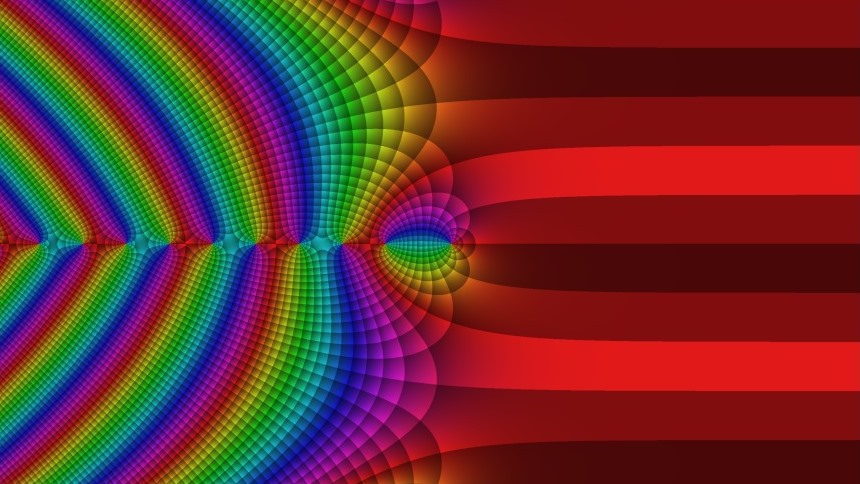
Image: A domain-colouring plot of the Riemann zeta function over the complex plane. Credit: Empetrisor, CC BY-SA 4.0, via Wikimedia Commons; cropped. It illustrates the function, not the new proof.