Japan Signs ¥4.3 Billion Security Grant to Provide the Philippines a Coastal Radar System and Surveillance Drones

Japan and the Philippines signed a ¥4.3 billion security grant in Manila on Monday 9 November 2026. Under it, Japan will provide a coastal surveillance radar system to the Philippine Navy and unmanned aerial vehicles (UAVs) to the Philippine Air Force. The Associated Press (AP), citing a statement from Japan’s Foreign Ministry, reports that Japanese Ambassador to the Philippines Katsuro Kitagawa and Philippine Foreign Secretary Theresa Lazaro signed the deal, which AP values at $27 million. USNI News published a report on the package on 13 November 2026; Lens could not open that page. Details below are as reported by the outlets named, as of 14 November 2026.
What the grant covers
- Programme: Official Security Assistance (OSA), which AP says was established in 2023 as a military counterpart to Japan’s official development assistance. The Philippine News Agency (PNA) says OSA provides grants for equipment, supplies and infrastructure to the armed forces of recipient countries.
- Paperwork: PNA says Lazaro and Kitagawa signed and exchanged notes for the fiscal year 2026 project.
- Equipment: a coastal radar system for the Navy and UAVs for the Air Force, which AP says the ministry described as meant to strengthen maritime security and surveillance.
- First of its kind: AP says it is the first transfer of finished Japanese-made defence equipment through OSA. PNA says the ministry classified the radar as defence equipment and called it the first such transfer under the programme.
What officials said
According to PNA, the ministry cited the Philippines’ location near the South China Sea and the Luzon Strait and described the country as a Comprehensive Strategic Partner under Japan’s updated Free and Open Indo-Pacific policy. PNA says the ministry expects the project to deepen security cooperation, improve the security of sea lanes that are vital to Japan, and contribute to regional peace and stability. ASTIG, a Philippine news site, reports that Kitagawa said, as reported by Japan’s public broadcaster NHK, that Japanese technology would help safeguard vital sea lanes. ASTIG also reports that Lazaro said in a post on X that the signing reaffirmed a shared commitment to Philippine defence capability. Lens did not find a statement from the Philippine Department of National Defense.
Earlier grants and context
Naval News reported that on 11 February 2026 Japan handed over five coastal surveillance radar systems to the Philippines under the fiscal year 2023 OSA package, worth ¥600 million, with the Navy as end user. Naval News also said the Philippines was the only country to receive OSA for three years in a row, that the second-year package was ¥900 million of rigid-hulled inflatable boats, and that the current year would fund facilities for those boats. The new grant is about 7.2 times the 2023 radar package (Lens arithmetic: ¥4.3 billion divided by ¥600 million).
AP reports that Japan lifted a ban on lethal weapons exports earlier this year and has agreed with the Philippines to begin talks on a deal that would let Japan provide used destroyers to the Philippine Navy. AP says China and the Philippines have overlapping claims in the South China Sea, and describes the grant as coming while the two partners face growing tensions with China.
What is not yet public
Afterburner, an aviation news site, reports that the news agencies Kyodo and Jiji Press did not name the radar’s manufacturer or the drone type, and that Jiji described the drones as dual-use. ASTIG reports that no delivery schedule has been announced. ASTIG also says NHK described the package as the largest OSA project to date; Lens did not see that claim in the AP or PNA text.
Where reports differ
Value: AP gives $27 million, PNA gives about 1.72 billion Philippine pesos, and Euronews gives €24 million, all for the same ¥4.3 billion. Lens has not converted them. Timing: AP and PNA date the signing to 9 November 2026, while the USNI report is dated 13 November 2026.
Sources and notes
Sources: AP (WRAL copy), Philippine News Agency, ASTIG, Naval News and Afterburner were read in full; Euronews was read in part. The USNI News page returned 403 to both a command-line request and the fetch tool and could not be opened. Pages from Japan’s Ministry of Foreign Affairs and the Embassy of Japan in the Philippines also returned 403, so the ministry statement is known only as relayed by AP, PNA and Afterburner. Copies from the Washington Times, Manila Bulletin and BusinessMirror returned 403. Kyodo, Jiji Press, NHK and Philstar were not opened; their reporting is known only through Afterburner and ASTIG.
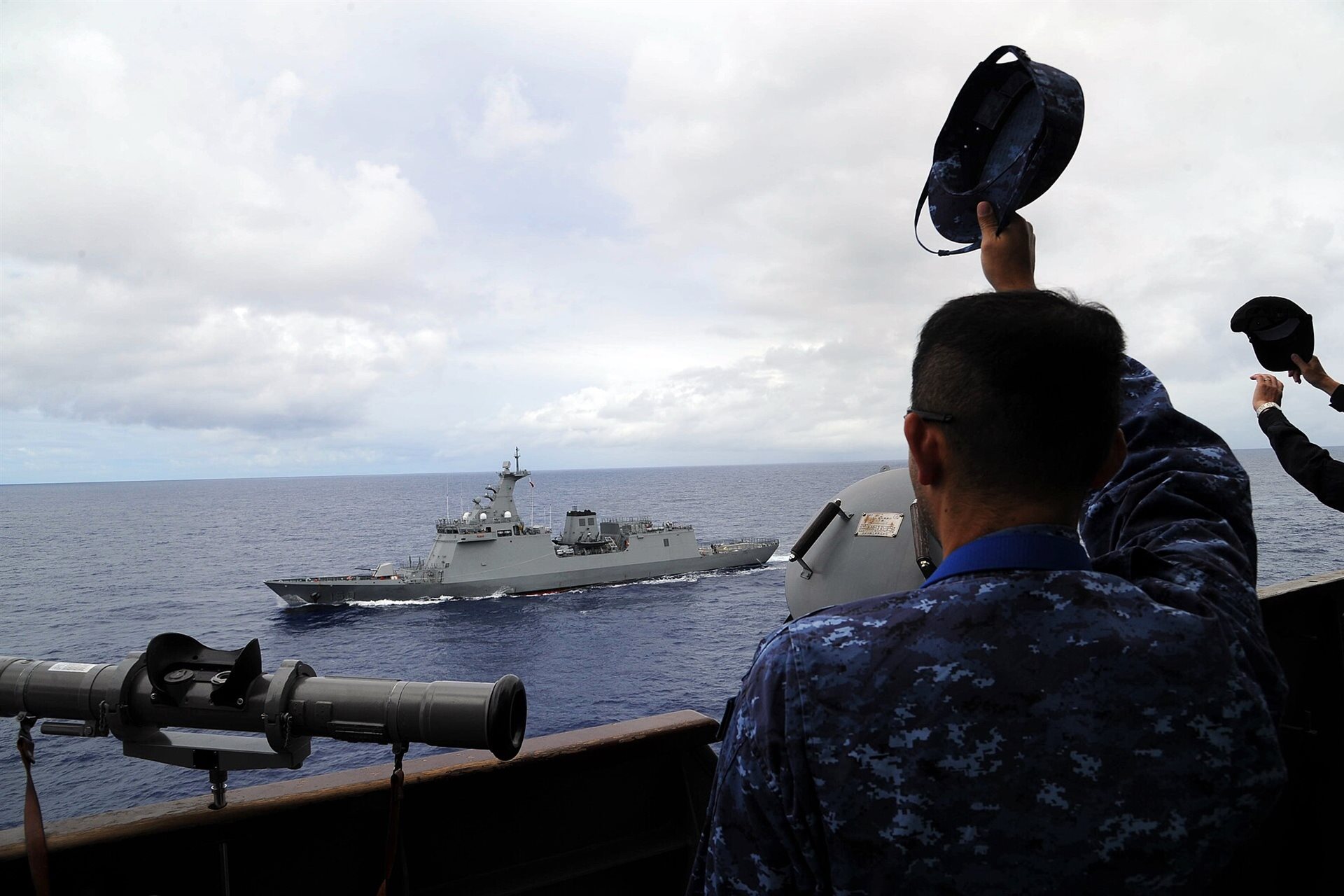
Image: Japan Maritime Self-Defense Force sailors wave as the Philippine Navy frigate BRP Jose Rizal (FF 150) sails by in the Pacific Ocean during exercise RIMPAC, 18 August 2020. Photo: Lt. Cmdr. Tony Wright, U.S. Navy (public domain as a work of the US federal government), via Wikimedia Commons. Stand-in image: not a photo of the drones or the coastal radar Japan has pledged.