


After Intel’s 29% one-day drop, attention turns to its Guadalajara engineering center

Intel’s shares fell 29% on October 30, their worst day since the 1970s, after the chipmaker beat third-quarter estimates but forecast fourth-quarter revenue and earnings far below what analysts expected, CNBC reported. Mexican business media then turned to the company’s operations in Mexico, where Intel does not make chips but employs engineers at a design and validation center in Guadalajara. Mexico Business News wrote that the sell-off does not directly affect those teams. Lens found no Intel statement on the point, and no report of any change to its Mexican operations.
What Intel reported
Intel’s earnings release for the quarter ended September 26 shows revenue of $16.5 billion, up 21% from $13.7 billion a year earlier. Adjusted earnings were 52 cents a share against 23 cents in the same quarter of 2025, and the GAAP figure was 60 cents. CNBC said analysts surveyed by LSEG had expected adjusted earnings of 40 cents on revenue of $16.5 billion, so the quarter itself cleared the bar.
The segments moved in different directions. Data Center and AI revenue rose 78% to $7.3 billion. The Client Computing and Physical AI Group, which sells PC chips, fell 5% to $8.1 billion. Intel Foundry revenue rose 58% to $6.7 billion, with an operating loss of $1.85 billion. Gross capital spending was $4.2 billion, compared with $3.0 billion a year earlier, and adjusted free cash flow was $1.64 billion.
The trouble was the outlook. Intel guided to fourth-quarter revenue of $15 billion to $16 billion and adjusted earnings of 25 cents a share. CNBC reported that analysts had expected $17.1 billion and 43 cents.
Mexico Business News, reporting on October 30, wrote that Client Computing Group revenue fell 9% sequentially to $7.3 billion. That does not match Intel’s release, in which $7.3 billion is the data center and AI segment, up 78% from a year earlier, and the PC group’s revenue is $8.1 billion, down 5%. Lens relies on the company’s release for these figures.
Why the shares fell
Intel stock dropped more than 20% in after-hours trading on Thursday, CNBC and Mexico Business News both reported, and the decline reached 29% by Friday’s close. The shares had been up about 150% in 2026 before the report, according to CNBC. The U.S. government’s roughly 10% stake in Intel lost about $12 billion in value on the day, CNBC said, though the investment remains profitable.
CNBC pointed to two causes. The first is the PC market. Chief financial officer David Zinsner said Intel expects the PC slowdown to continue at least through the first half of next year, and CNBC cited Counterpoint Research for a 4% year-over-year fall in global PC shipments in the second quarter, which it tied to soaring memory and component costs. The second is an explosion at an Intel fab in Israel earlier in October that killed two workers and injured a third. Zinsner estimated about $600 million in lost revenue over two quarters from the resulting extended shutdown, which affected shipments of 10-nanometer chips.
CEO Lip-Bu Tan said he was disappointed that Intel could not meet strong customer demand in the quarter, according to CNBC. The brokerage D.A. Davidson downgraded the stock to neutral from buy in a report titled “Not fixed yet.” The wider market also fell that day: CNBC reported the Nasdaq Composite down 2.9%, with Qualcomm off 11% and Nvidia off 4%.
Expansión, in a separate October 30 report, added a supply angle. It said Intel is struggling to meet demand for its low-cost Wildcat Lake processors, aimed at entry-level computers, and that Zinsner said the chips had sold out, a remark Expansión attributes to The Verge. According to the same article, Intel’s quarterly report expects shortages of memory, substrates and other components to last through 2027, and Intel acknowledged limited ability to offset them. Expansión added that Intel has announced no general price increases and has given no date for normalizing inventory. Lens could not open The Verge and did not find these supply remarks in CNBC’s coverage or in the earnings release, so they rest on Expansión alone.
The Xeon connection
In the release, Tan said Intel’s immediate priority is to unlock additional supply to meet extraordinary demand for its Xeon server processors. Xeon is the chip family at the center of the Mexican story. Expansión reported in August that João Bortone, Intel’s recently named director for Latin America, said part of Xeon’s design is done in Guadalajara.
Lens analysis: Xeon belongs to the data center business, the one part of Intel’s results growing quickly, so the Guadalajara work is tied to the product line that management calls its priority. That is a connection between a product and a place, not evidence about hiring or budgets in Mexico, and no source Lens opened reports either.
What Intel does in Mexico
Mexico Business News said the Guadalajara Design Center in Jalisco has roughly 1,000 specialists who run power, firmware and compatibility testing on enterprise silicon, including Xeon. It also said the share-price fall does not directly affect those regional engineering operations, a statement the article does not attribute to Intel. Expansión’s August report also counted nearly 1,000 people in the Guadalajara lab, including engineers, physicists and chemists. Bortone said Intel is not importing workers to staff it, and he acknowledged that design is not the stage of chipmaking that creates the most value.
Earlier coverage gave a larger number. DPL News reported in July 2022 that the center employed more than 1,800 engineers, 700 of them hired in the preceding year, according to its director at the time, Jesús Palomino. The 2026 articles do not explain the gap between that figure and the 1,000 reported now, and the two may not count the same people.
Palomino said in 2022 that silicon is not manufactured in Mexico. The Guadalajara center instead designs modules with other Intel labs, works on packaging, thermal systems and the final platform, and validates products before launch. Carlos Rebellón, Intel’s Mexico general manager, described Guadalajara in August 2025 as a node for research, design and validation that serves global operations, according to DPL News, and called Mexico the most important country for semiconductors outside the United States in the Americas.
Mexico Business News also quoted Rebellón on AI-enabled PCs, which carry a dedicated neural processing unit. He argued that processing data on the device meets privacy and security needs without heavy spending on remote GPU clusters. The article said Intel estimates such PCs will exceed 50% of its regional business unit shipments by 2027 and 80% by 2028. Those are company estimates, and the PC segment is the weak spot in this quarter’s results.
Mexico’s place in the chip chain
DPL News, in a July 30 article in its series on the U.S.–Mexico–Canada trade framework, described Mexico’s role as mostly design plus assembly, testing and packaging, with no large-scale wafer fabrication in North America outside the United States. The industry group Canieti told the outlet that Mexico is the leading North American candidate for new assembly, testing and packaging plants because of lower labor costs, matching time zones and established electronics clusters. It put the investment for one such plant between $300 million and $1 billion.
Canieti’s master plan, published in October 2024, aims to double design activity and relocate more than $10 billion of assembly, testing and packaging operations by 2030. The government’s Plan México, launched in January 2025, names semiconductors a strategic sector and mentions Jalisco as a key region. Researchers from the National Polytechnic Institute quoted in the same article said Mexico’s participation in the global chain remains limited and that it lacks the energy and water infrastructure for advanced manufacturing.
What to watch
Intel’s stated manufacturing expansion is in the United States. CNBC reported that its 18A chip is in high-volume production at a new Arizona fab, that the next Arizona fab is expected to begin operations by the end of 2028, and that Tan said Intel would announce a couple of external customers over the next two quarters. None of that involves Mexico, whose role remains design and validation.
Three questions follow for the Mexican operations. One is whether Intel says anything about Guadalajara hiring or budgets after the sell-off. Another is whether the memory and component shortages Expansión describes persist through 2027 as Intel’s report is said to expect. The third is whether the assembly, testing and packaging investment that Canieti wants for Mexico materializes under Plan México, a decision that depends on many companies besides Intel.
Sources
- CNBC: Amazon, Intel shares fall after earnings amid AI spending concerns (Katie Tarasov and Arjun Kharpal, October 30)
- CNBC: Intel Q3 earnings report 2026 (Katie Tarasov, October 29)
- Intel Corp. Form 8-K with third-quarter 2026 earnings release (SEC)
- Mexico Business News: Intel shares tumble 20% as cash burn clouds turnaround (Victoria Castro, October 30)
- Expansión: Intel agota sus chips para laptops económicas y anticipa más presión sobre los precios (Selene Ramírez, October 30)
- Expansión: El renacer de Intel se diseña en México (Fernando Guarneros Olmos, August 12)
- DPL News: T-MEC digital, ¿puede México afianzar su rol en la cadena norteamericana de chips? (Raúl Parra, July 30)
- DPL News: Intel GDC, cómo México participa en el desarrollo de semiconductores (Efrén Páez Jiménez, July 8, 2022)
- DPL News: Intel coloca México en el boom de la Inteligencia Artificial (Jorge Bravo, August 26, 2025)
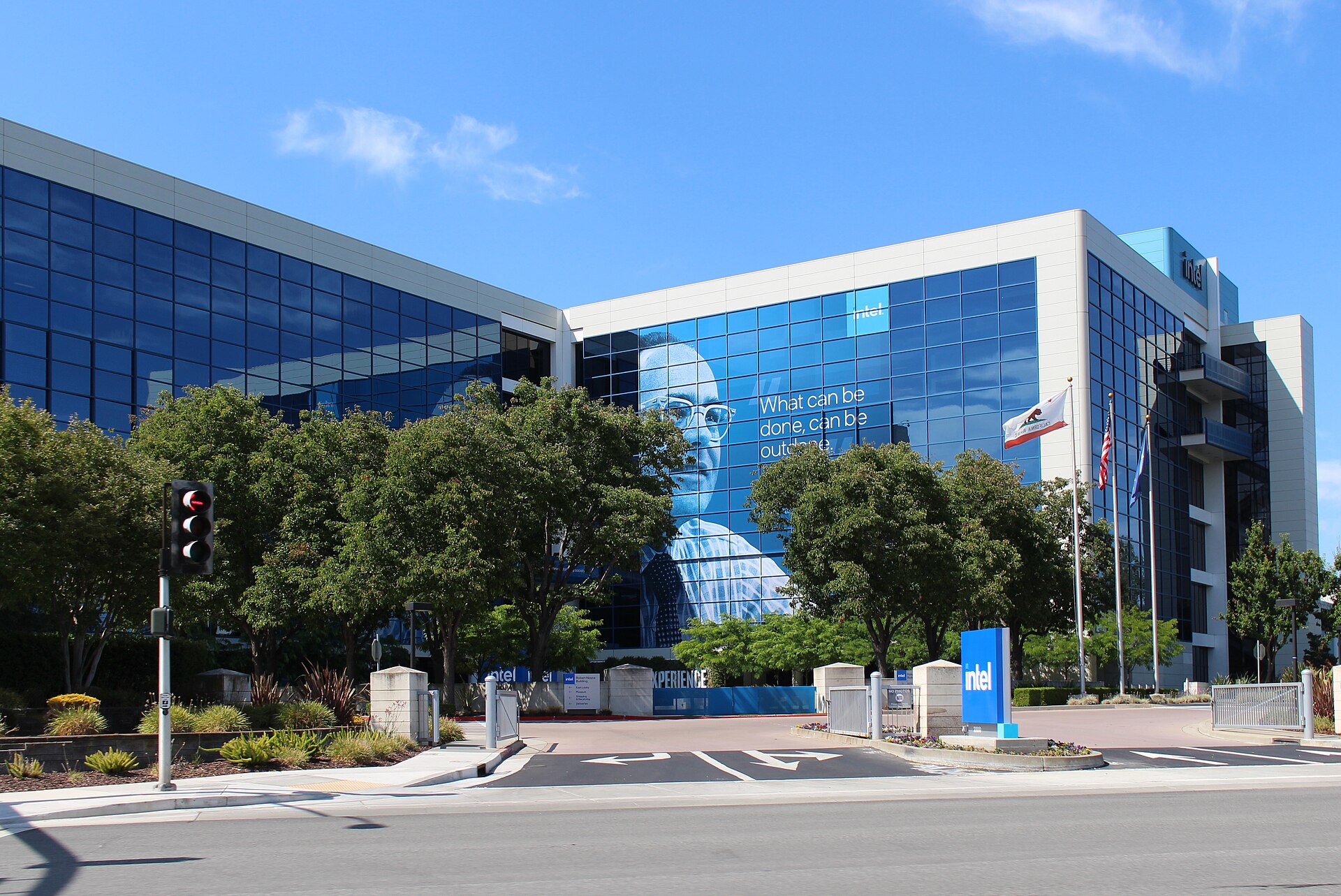
Image: Intel Headquarters in 2023.jpg by Coolcaesar, CC BY-SA 4.0, via Wikimedia Commons. Illustrative photo; it does not show the events described.


