


Ukrainian Radio Maker Himera Says a G1 PRO and R1 Repeater Chain Reached 44 km Across the Dnipro in a Zaporizhzhia-Direction Test

Ukrainian radio maker Himera Radios says a network deployed across the Dnipro River reached 44 km using two HIMERA G1 PRO radios and an R1 repeater, according to Oboronka, which reported on November 4 on the company’s account of tests with a military unit in the Zaporizhzhia direction. The article relays a company post on Facebook, so the distances are the manufacturer’s own.
The test
Himera tested deploying a network across the Dnipro, from the right bank to the left, with an unnamed unit. The aim was to provide coverage over the area that formed on the site of the former Kakhovka Reservoir. The article says several configurations were tested but reports three.
Distances reported
- 24 km between a HIMERA G1 PRO radio and a B1 repeater.
- 20 km between an R1 repeater and a HIMERA G1 PRO radio.
- 44 km with a G1 PRO radio, an R1 repeater and a second G1 PRO radio in a chain, the longest result.
What is not reported
The article gives no terrain, elevation, antenna height or line-of-sight conditions, and no frequencies, transmit power, antenna types or data rates. It does not say how distance or link quality was measured, and it gives no unit name, test date or number of runs. The R1 and B1 are described only as repeaters. It reports no independent or military evaluation, so the distances cannot be read as general performance figures.
The maker’s framing
Himera says it keeps developing mesh and MANET (mobile ad hoc network) communications so that units can build networks around their operational needs and terrain.
Earlier tests
Oboronka’s article also refers to an earlier test of the G1 PRO and B1 by a GUR unit, and it carries a manufacturer claim from that test that the radios ran up to four days on one charge in low temperatures and high humidity. It gives no battery data for the Dnipro test. A separate earlier report, under a dev.ua headline, describes G1 PRO radios providing stable communication at 45 km without additional equipment; that is a different test from the 44 km result above, and Lens did not read that article.
Sources and notes
This post is based on Oboronka’s report by Iryna Levytska, published in Ukrainian on Mezha, with translation by Lens. The page shows the date as November 4 without a year, and Lens has read it as 2026. Lens did not read Himera’s Facebook post or contact the company.
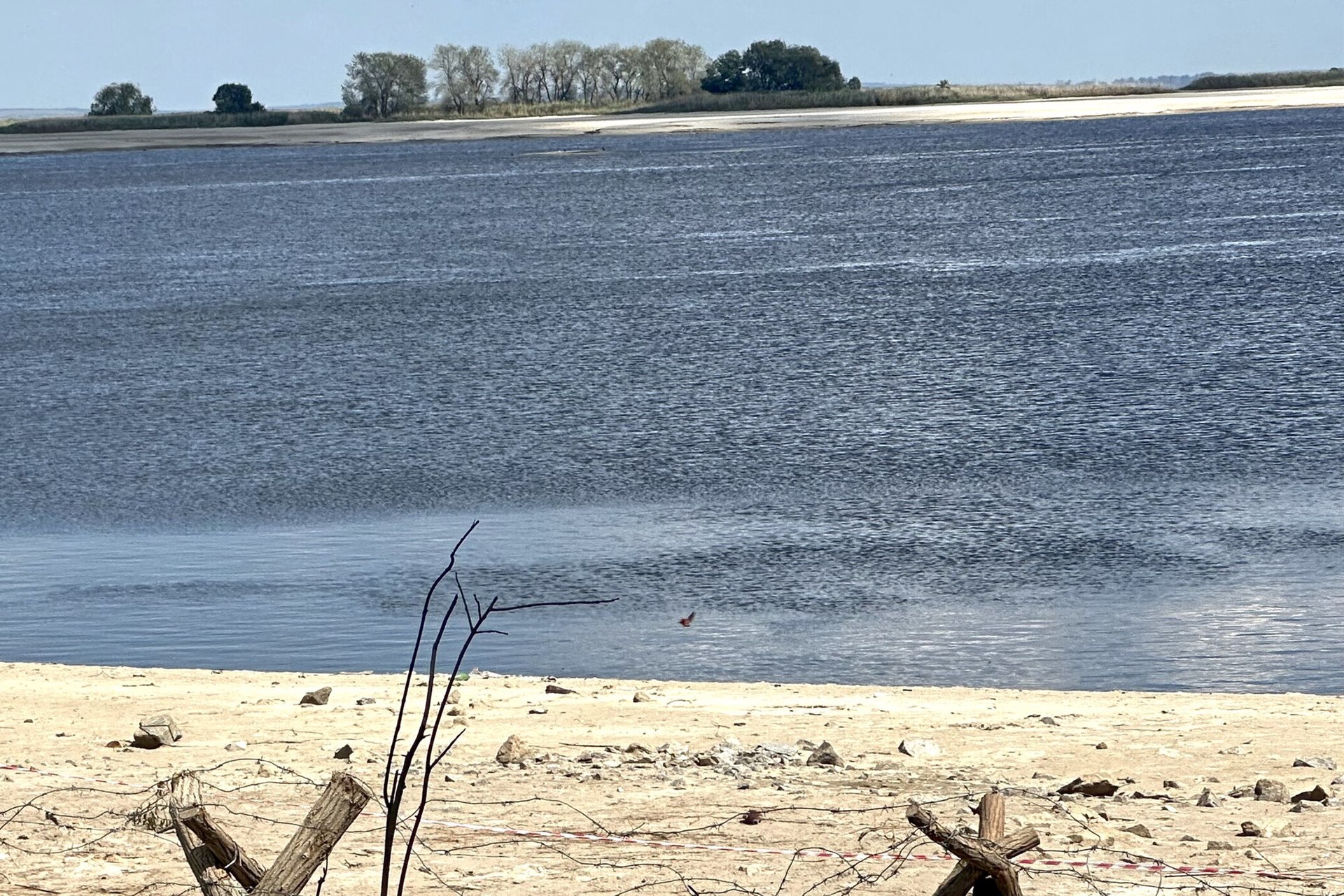
Image: the sandy shore and remaining water of the Kakhovka Reservoir near Zaporizhzhia in July 2023, by Enno Lenze via Wikimedia Commons, licensed under CC BY 2.0; cropped. Illustrative photo; it does not show the test or the radio equipment.

