


Researchers Trace a Once-a-Minute Dip in Grid Frequency on Several Continents to Batteries That Check Their Charge on Synchronized Clocks, TechCrunch Reports

Researchers at Germany’s Forschungszentrum Jülich say they have traced a once-a-minute dip in electricity-grid frequency, seen on several continents, to stationary batteries that check their state of charge on nearly synchronized clocks, according to a TechCrunch report published November 8, 2026. TechCrunch says the batteries include data-center backup power systems and large grid-scale batteries.
What the researchers found
- TechCrunch reports that Tennet Germany, the country’s largest transmission system operator, asked Dirk Witthaut of Forschungszentrum Jülich to investigate, and that after years of investigation and modeling his team identified the cause.
- Grid frequency dips slightly every minute, and the dips coincide across grids on different continents, with the same pattern in data from Europe, Australia, the U.S. and Malaysia, according to the article. It says the drops occur “Every 60 seconds, without fail.”
- Because the devices are connected to the internet, their clocks are nearly synchronized. Each check is negligible alone, but together they create a visible disturbance, according to TechCrunch.
The evidence
According to TechCrunch, the team first suspected hydropower turbines, a known source of very slow oscillations, and a model of a Scandinavian hydropower control system could produce a once-per-minute resonance but could not explain why the oscillation persisted so long. On the Jülich campus the team installed more than 80 smart power-quality meters that sampled every three seconds, and a transformer linked to the campus battery storage system peaked every minute. In Ireland, where data centers made up 18% of grid load by 2022, the minute-by-minute frequency drop rose from 3 millihertz in 2016 to 12 millihertz in 2021, and some recent drops exceeded 20 millihertz. Tests on internet-connected devices, including a smart oven and Raspberry Pi clusters, showed similar periodic fluctuations.
Risks and proposed fix
TechCrunch says Ireland’s 50 Hz grid can withstand swings of plus or minus 200 millihertz, though its operator prefers to stay within 100 millihertz. Larger swings could contribute to blackouts, and unchecked sags can damage power-plant equipment, especially hydropower turbines, according to the article. The researchers recommend that manufacturers of uninterruptible power supplies and grid-scale batteries randomize when devices check their charge, and that internet-connected devices be fixed with a software patch. TechCrunch quotes the article’s own conclusion: “The problem is entirely preventable.” It adds that regulators can only act within their own regions, so a global fix would need international coordination and the problem could persist for years. A recent study found fewer than 3% of internet-connected devices run the latest firmware, according to the article.
Lens covered another part of the data-center power story in its post on data centers turning to converted jet engines.
Sources and notes
This post is based on TechCrunch’s article by Tim De Chant, published November 8, 2026. Lens did not read the researchers’ study or data, so the findings are as TechCrunch described them. Lens did not contact the researchers, Tennet or any battery maker.
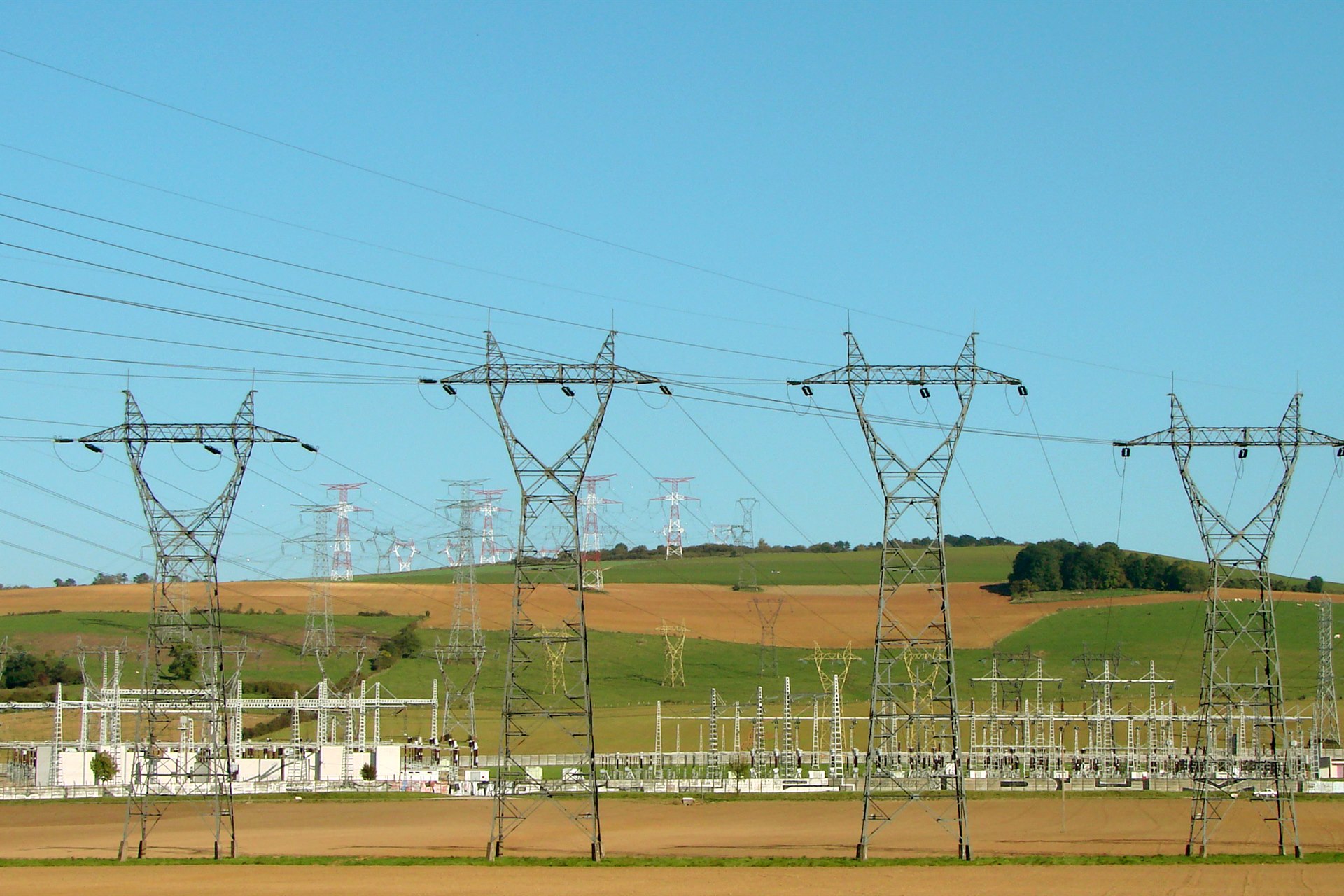
Image: A row of high-voltage transmission pylons crossing farmland in front of a substation, in France, by Vassil via Wikimedia Commons, released into the public domain by the author; cropped. Stand-in photo; it does not show the events described.

