


Fed Survey: 29% of Small-Business Credit Applicants Went to Online Lenders; Small Banks Fully Approved 57%

Twenty-nine percent of small US employer firms that applied for a loan, line of credit or merchant cash advance in the year before the survey applied at an online lender, up from 17 percent in the 2020 survey, according to the 2026 Report on Employer Firms from the 12 Federal Reserve Banks, published on 3 March 2026. Large banks remained the most common place to apply, used by 41 percent of these applicants, and applicants at small banks were the most likely to be fully approved, at 57 percent, the report said.
Who sought financing
The findings come from the 2025 Small Business Credit Survey (SBCS), fielded from 3 September to 14 November 2025. It drew 6,525 responses from a nationwide convenience sample of employer firms with 1 to 499 employees. The Reserve Banks state that the survey is not a random sample and that results should be read with the potential biases of convenience samples in mind.
Sixty percent of firms applied for some type of financing in the 12 months before the survey. The most common reasons were meeting operating expenses (56 percent of applicants) and expanding, pursuing a new opportunity or acquiring business assets (46 percent). Of all applicants, 42 percent received the full amount sought, 36 percent received some or most of it, and 22 percent received none. Among firms that did not apply, 63 percent said they did not need financing or already had enough.
Thirty-eight percent of all firms applied for a loan, line of credit or merchant cash advance. Counted separately, 26 percent applied for a loan, 24 percent for a line of credit and 8 percent for a merchant cash advance. Among applicants for these products, 43 percent sought a business line of credit, 32 percent a business loan and 20 percent a Small Business Administration (SBA) loan or line of credit.
Where firms applied and how they fared
Among applicants for loans, lines of credit or cash advances, 41 percent applied at a large bank (one with at least $10 billion in assets), 29 percent at an online lender, 28 percent at a small bank, 14 percent at a finance company, 7 percent at a credit union and 7 percent at a community development financial institution (CDFI), according to the report’s data appendix. Medium- and high-credit-risk applicants applied at online lenders more often (49 percent) than low-risk applicants (19 percent). Online lender applicants most often cited speed of decision or funding (64 percent) and their chance of being funded (49 percent) as reasons for their choice, while 61 percent of large bank applicants cited an existing relationship.
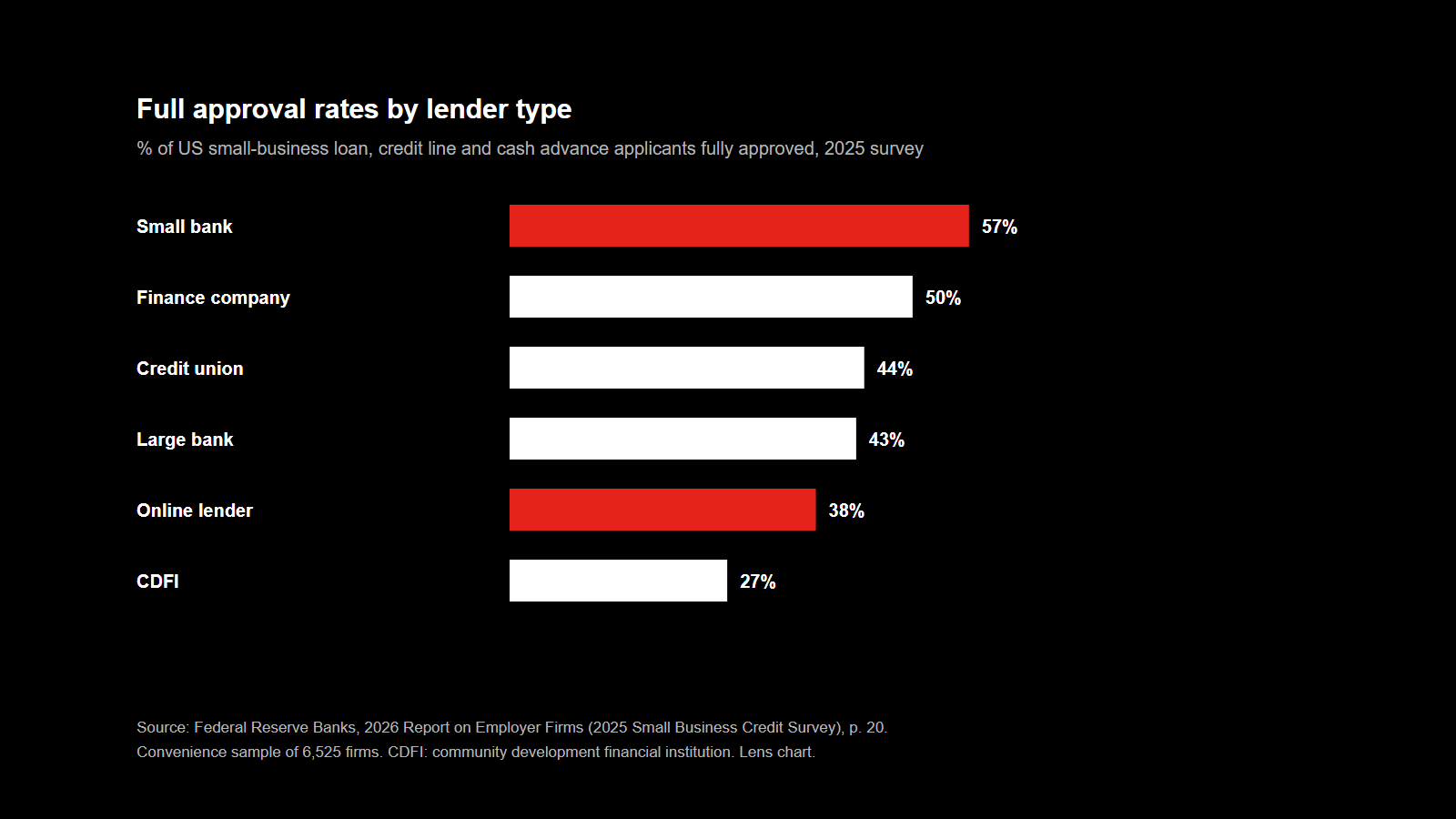
Overall, 52 percent of these applicants were fully approved, which the report says was steady year over year but below prepandemic levels. Full approval rates were 57 percent at small banks, 50 percent at finance companies, 44 percent at credit unions, 43 percent at large banks, 38 percent at online lenders and 27 percent at CDFIs. Denial rates were 31 percent at large banks, 23 percent at online lenders and 20 percent at small banks.
Costs and satisfaction
Among borrowers who accepted financing, 60 percent of those at online lenders said actual borrowing costs were higher than expected and 4 percent said they were lower, according to the report. The share reporting higher-than-expected costs was 44 percent at finance companies, 37 percent at small banks, 32 percent at large banks and 31 percent at credit unions. Respondents were told to count interest, fees, penalties and any other charges.
Among applicants approved for at least some financing, 76 percent of credit union applicants said they were satisfied with their lender, as did 65 percent at small banks, 64 percent at large banks, 57 percent at finance companies and 35 percent at online lenders, where 51 percent were neutral and 15 percent dissatisfied. High interest rates (61 percent) and unfavorable repayment terms (38 percent) were the challenges online lender applicants cited most often.
Sources and notes
Primary sources read in full: the Federal Reserve Banks’ 2026 Report on Employer Firms web page, the full report PDF and its data appendix, which Lens used to confirm figures that are hard to read from the PDF charts. Lender figures are shares of firms that applied for loans, lines of credit or merchant cash advances (2,388 respondents for the lender question), not of all firms; the lender shares, including 5 percent at other lenders, sum to 131 percent (Lens arithmetic). Cost figures cover borrowers who accepted approved financing, and satisfaction figures cover applicants approved for at least some financing. Secondary source: a Coleman Report article of 1 June 2026, which describes 43 percent as the share of employer firms that sought a business line of credit and 32 percent as the share that sought a business loan; the Fed report gives these as shares of loan, line of credit and cash advance applicants (2,450 respondents), and the data appendix puts the shares of all employer firms at 24 percent for a line of credit and 26 percent for a loan. Coleman also gives regular use of loans at 51 percent, lines of credit at 44 percent and trade credit at 38 percent of employer firms; the Fed data appendix gives 44, 36 and 19 percent. Thumbnail photo: “Eccles Building (26088200676)” by Federal Reserve (Flickr account “Federalreserve”) via Wikimedia Commons, in the public domain as a work of the US federal government; cropped. The Marriner S. Eccles Federal Reserve Board Building on Constitution Avenue in Washington, D.C. Illustrative photo.
Image: Lens chart built from the figures above. Thumbnail: Federal Reserve (Flickr account “Federalreserve”) via Wikimedia Commons (public domain).

