CBS News Records Show Years of Audit Warnings on FAA Telecom Systems Before 13 November Ground Stop

Federal audits and congressional testimony warned for years about the risk of failures in the Federal Aviation Administration’s (FAA) aging air traffic telecommunications systems, according to a CBS News Investigative Unit report published on 16 November 2026. It followed the nationwide ground stop of Friday 13 November 2026. As of 16 November 2026, officials have not announced a root cause. Earlier Lens posts covered the ground stop and the preliminary cause.
The inquiry so far
According to CBS News, the FAA ordered the stop at 3:36 p.m. Eastern Time on Friday with about 3,500 flights in the air, and it was lifted around 8:20 p.m. CBS reported that airlines were close to normal early Monday.
Transportation Secretary Sean Duffy said on Saturday that, preliminarily, contractor L3Harris was replacing a router at a remote FAA site while switching copper lines to fiber, and the router began flooding other routers. FAA Administrator Bryan Bedford said the instability spread to 17 facilities. Fox News reported Duffy as saying on Sunday that two routers, from Texas and Arkansas, were being tested at L3Harris’s Florida headquarters and that investigators had found no indication of a foreign cyberattack. On Face the Nation, Duffy said officials are examining whether L3Harris’s installation or the router was the cause. CBS wrote that he said the fault may trace back to one router that was supposed to be replaced in 2006.
Audits and reports on the record
- 2002: Harris Corporation, now part of L3Harris, won the contract to modernize and operate the FAA’s telecommunications infrastructure.
- 2006: an audit warned the program was falling behind schedule. Computerworld reported on 2 May 2006 that the inspector general judged the program unlikely to meet its December 2007 date.
- 2008 and 2009: a 2008 follow-up report identified continuing reliability concerns. A 2009 outage delayed more than 800 flights, and CBS wrote that the inspector general found the FAA had not adequately overseen Harris.
- 2012 to 2018: a $291 million Harris voice communications contract awarded in 2012 was terminated in 2018 with $160 million spent.
- 2024: an inspector general audit found 10 of 11 extensions of the 2002 contract improperly authorized, adding 57 months and $1.5 billion. The Government Accountability Office (GAO) found that of 138 FAA air traffic systems, 51 were unsustainable and 54 potentially unsustainable, per its report of 23 September 2024.
- March 2026: Deputy Inspector General Mitch Behm told the House Appropriations Committee of a pattern of cost increases and schedule overruns across 50 audits, per CBS.
- 14 September 2026: a GAO report said the FAA lacks a lifecycle cost estimate and an integrated master schedule for its modernization plan and could be prioritizing speed over costs and air traffic disruptions. It said the FAA reported replacing 2,560 of 5,170 copper wires with fiber as of May 2026.
Funding and responses
CBS reported that Congress approved $12.5 billion for FAA modernization in the One Big Beautiful Bill Act, including $4.75 billion for telecommunications. The Transportation Department says it is using the money for projects including replacing paper-based systems at 25 towers and modernizing 469 tower radios. CBS wrote that Duffy said on Friday the FAA needs $50 billion for its telecom network, and that the administration raised its air traffic control request to $30 billion. Representatives Rick Larsen and Andre Carson, Democratic ranking members on House transportation panels, said the administration has used only $1 billion of the $12.5 billion, per CBS.
L3Harris said on Saturday it has completed 70 percent of the copper-to-fiber switch. It did not respond to CBS about the inspector general’s criticisms.
Where reports differ
- Length of the stop. CBS’s investigative report says about five hours. CBS’s explainer gives 3:36 p.m. to about 8:20 p.m. (4 hours 44 minutes, Lens arithmetic).
- Copper-to-fiber progress. Duffy, Bedford and L3Harris cite about 70 percent. GAO cites 2,560 of 5,170 wires as of May 2026, about 50 percent (Lens arithmetic). The dates differ, and the sources do not say the measures match.
- September report. CBS’s investigative report cites a September inspector general report on the risk of moving too quickly. On Face the Nation, host Margaret Brennan cited a September GAO report. Lens found only the GAO report.
- The 2006 router. CBS attributes it to Duffy; it is not in the Face the Nation transcript. CBS’s explainer says senior government sources told it on Friday that the issue was isolated to Cisco 600 series routers made between 2001 and 2006.
Sources and notes
Lens read in full the CBS News investigative report (16 November 2026), its explainer (updated 16 November), the Face the Nation article and transcript (15 November), the Fox News article (15 November) and NPR (14 November). The GAO pages and Computerworld were read through a summarizing tool, so their wording is paraphrased. The 2002 contract, the 2008 and 2009 findings, the 2012 contract, the 2024 inspector general audit and the March 2026 testimony are as CBS reports them; Lens could not locate the audit or the testimony. The Transportation Department’s inspector general site and the Wall Street Journal were not opened.
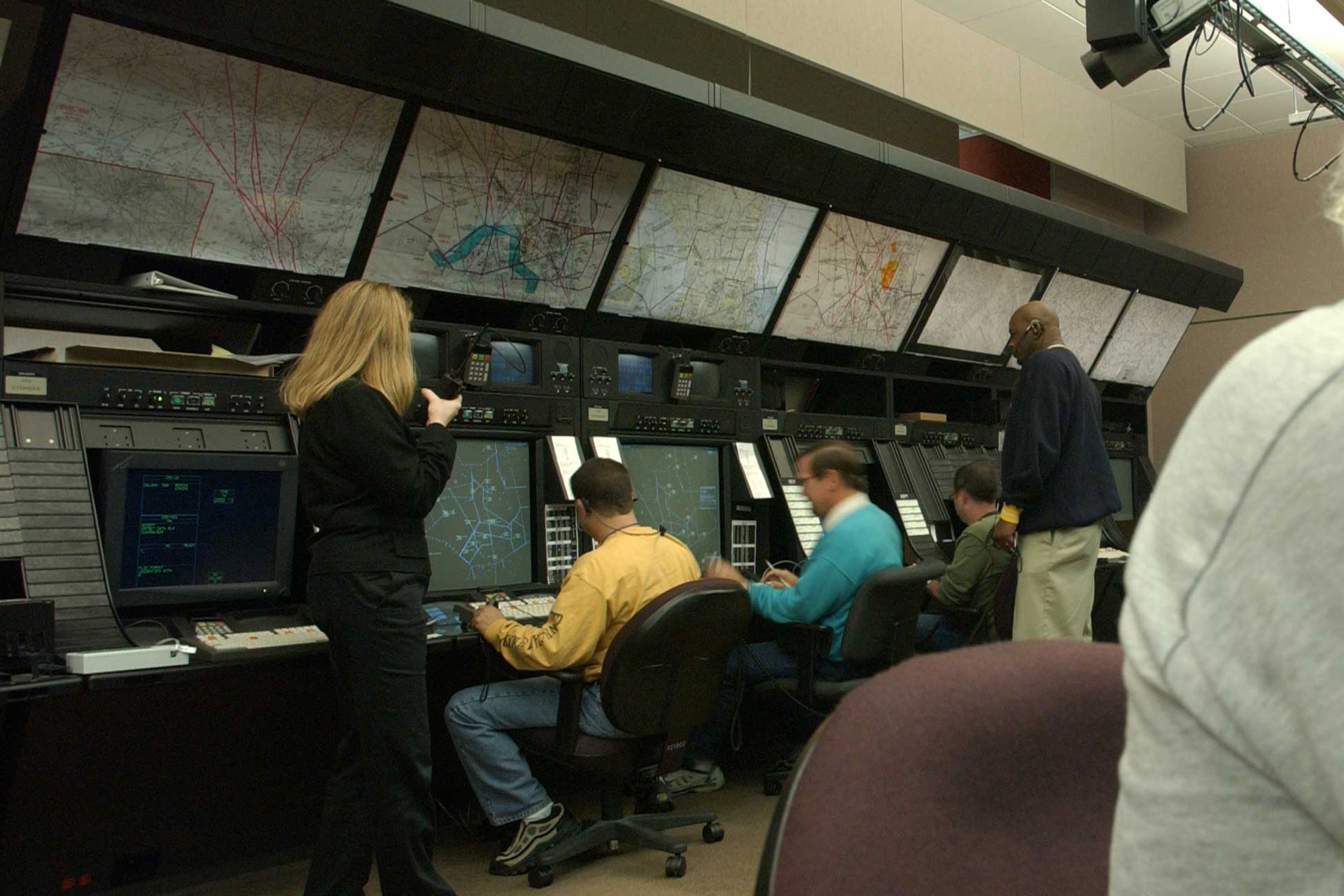
Image: Air traffic controllers work at radar consoles under wall maps at the Federal Aviation Administration’s Washington Air Route Traffic Control Center, in an undated FAA press photo (the FAA page it came from was archived in May 2007). Photo: Federal Aviation Administration (public domain), via Wikimedia Commons; cropped. Stand-in image: it does not show the FAA ground stop or the events in the post.