


Voters in More Than 30 Localities Across Nine States Backed Data-Center Bans or Limits, Semafor Reports; Meta Warns of a Harder Path

Voters in more than 30 localities across nine states backed moratoriums, outright bans or other measures on data centers in Tuesday’s elections, according to Semafor, which reported on November 4, 2026 that “American voters roundly rejected data centers nearly anywhere they were on the ballot.” Meta’s president told a Wall Street Journal conference the next day that building them will be harder, TechCrunch reported.
What Semafor reports
- Edgewater, Florida, voted “overwhelmingly” to embed a data-center ban in the city charter.
- Perry, Ohio, passed a measure placing financial and operational constraints on hyperscalers seeking tax breaks.
- Some measures responded to specific projects already under way. Semafor gives no vote counts or percentages and names only these two places.
- Per one analysis Semafor cites, Democrats ran anti-tech or anti-data-center ads in more than 130 federal and gubernatorial races, and some Republican candidates, including Texas Gov. Greg Abbott, moved toward promising tougher regulation. Abbott lost his race.
Industry response
Semafor says banks and asset managers financing the buildout have begun “treating local opposition” as a credit risk, hyperscalers are hiring community liaisons, and tech companies are trying to rebrand data centers as “compute campuses,” with mixed results.
Meta’s comments
Speaking on Wednesday at the WSJ Tech conference, Meta president Dina Powell McCormick said the industry has “not done as good a job as we needed to explain the benefits of these investments,” and that “there’s an underlying bigger issue, which is how people feel about AI in general.” She said “the visible sort of manifestation of AI is a data center” and “I think it’s going to be harder” to build them, and she expects projects to face more scrutiny. TechCrunch’s account says Meta has been building data centers for 20 years, has them in 23 states and has five planned projects of 1 gigawatt or larger, including one in Texas. It says she also said, “We’re getting calls every day to lease that compute,” which Meta sees as a path to revenue even if its consumer AI agent, Muse, does not scale as hoped. TechCrunch gives no capital-spending figures and says Meta worries it could lose some planned investments.
Sources and notes
This post is based on Semafor’s report by J.D. Capelouto (November 4, 2026, 8:54 a.m. EST) and TechCrunch’s report by Sarah Perez (November 5, 2026, 11:12 a.m. PST), which relays Meta’s remarks. Lens did not read the underlying ballot results, so no vote totals are reported, and the “more than 30 localities across nine states” figure is Semafor’s. The Semafor submission on Hacker News had 349 points and 741 comments. Lens covered a related power constraint in an earlier post on converted jet engines.
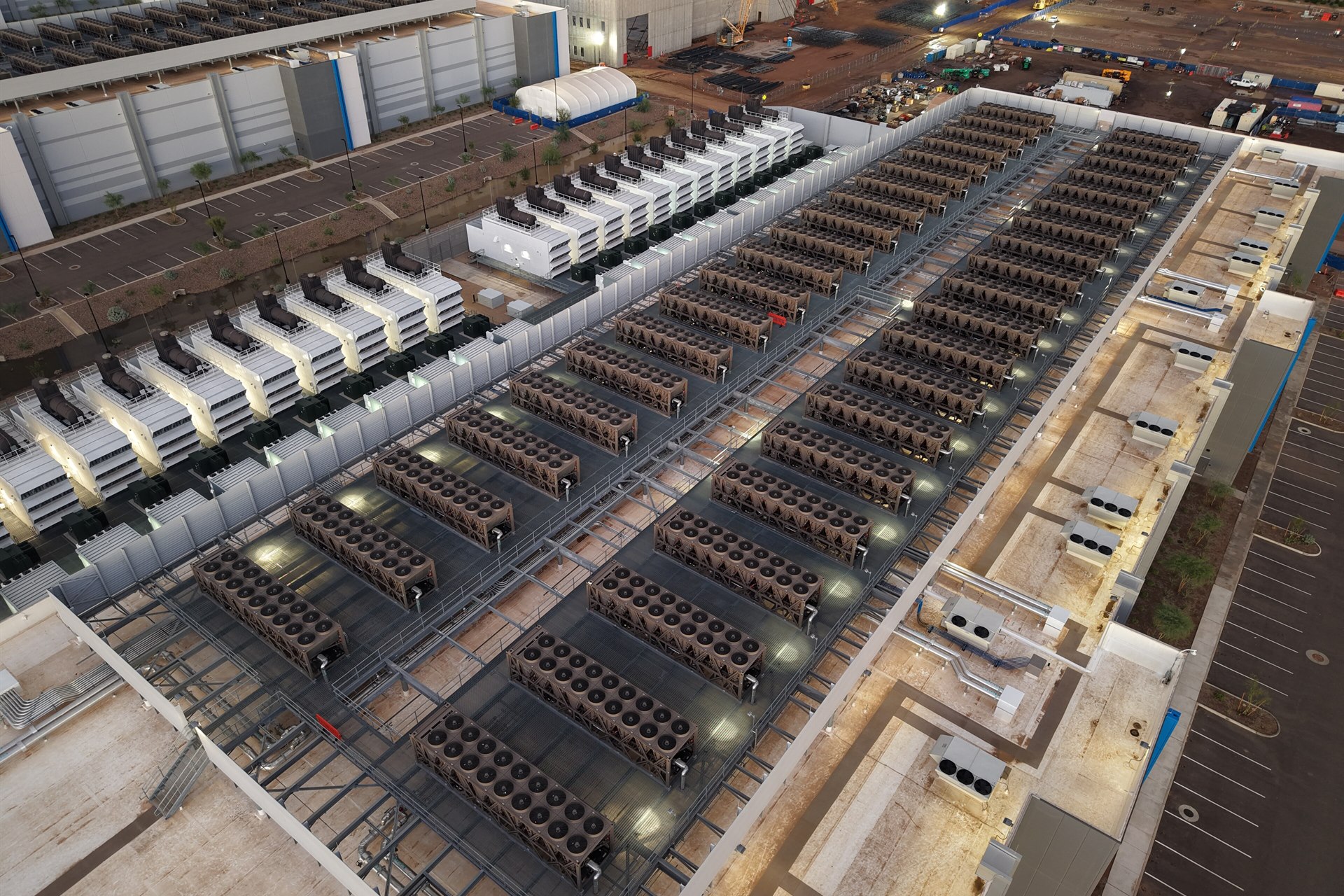
Image: aerial view of a data center roof with cooling units and backup generators, by Rsparks3 via Wikimedia Commons, licensed under CC0; cropped. Illustrative photo; it does not show the events described.

