


In the week of September 14, Chinese models accounted for between 57% and 67% of the tokens processed on OpenRouter, a marketplace where developers buy access to many AI models through a single API, according to usage data the company shared with CNBC. In February the same measure stood at 6% to 13%. OpenRouter’s own newsletter, published September 22, put Chinese labs at 69% of tokens that week.
Peter Walker, OpenRouter’s head of insights, told CNBC that Chinese open models released this year “can credibly perform in advanced agentic use cases, especially in regards to coding,” which he said was not true in late 2025. He described them as “incredibly cost-effective compared to most models from American labs.”
That is the market signal. The rest of this story is about what sits behind it: Moonshot AI’s new Kimi K3.1 Pro, MiniMax’s models and video app, and the video and image systems from ByteDance and Alibaba. It is also about the policy response in Washington, where the evidence that restrictions have backfired is strong in some places and thin in others. Lens has tried to separate what is documented from what is merely claimed, because several of the most repeated numbers in this debate do not hold up well when traced to their source.
Counting the gap: from 2.4x to 14x, depending on the ruler
Claims about how much more Chinese AI inference is being consumed than American inference have been circulating widely. They span an order of magnitude because they measure different things. Lens found four published measures that can be compared, and calculated the ratios itself from the underlying figures.
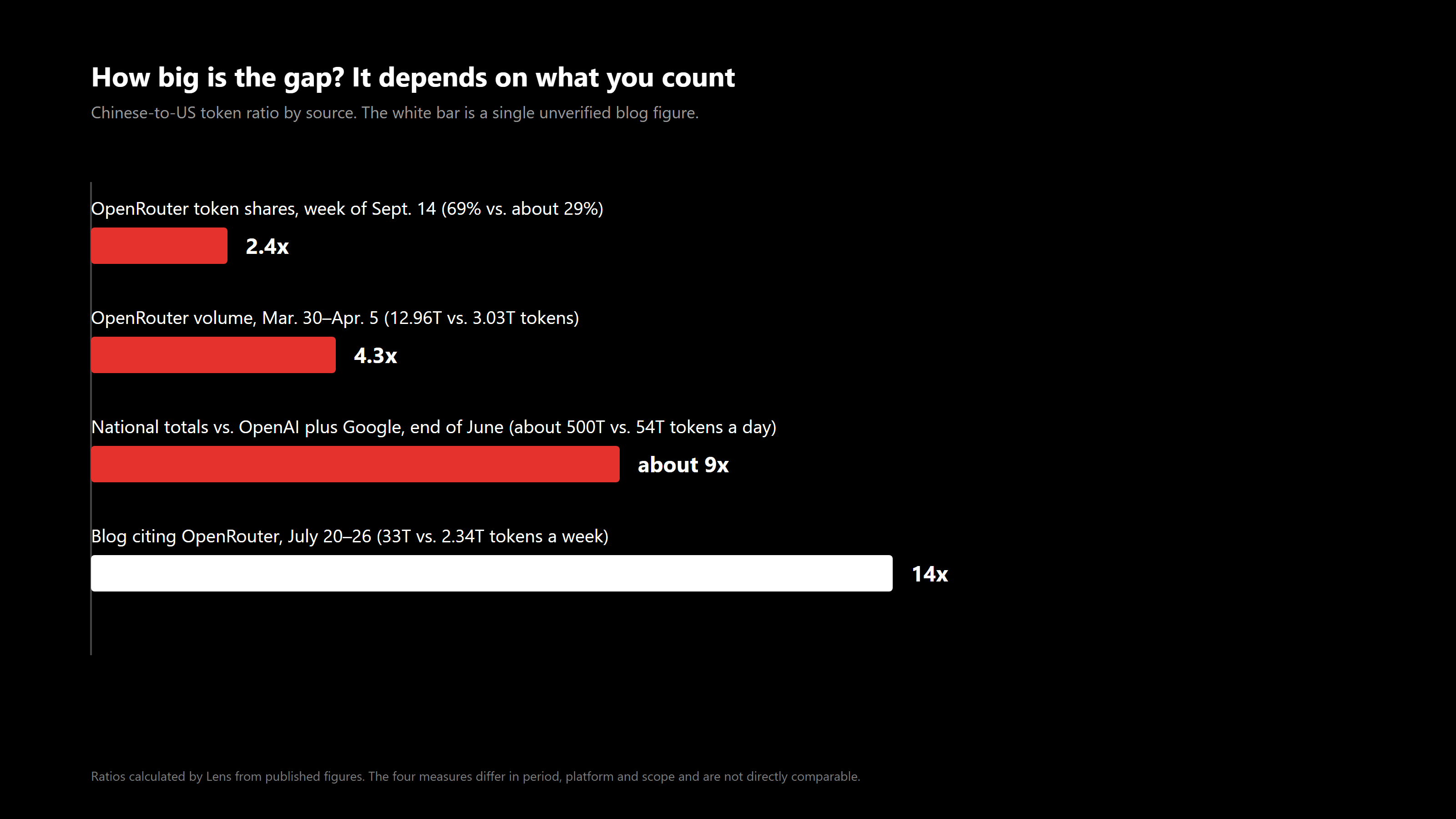
OpenRouter token shares, week of September 14: about 2.4 to 1. The newsletter reports 69% of tokens from Chinese labs and about 2% from labs outside the US and China. That leaves roughly 29% for US labs, a figure Lens derived by subtraction; the newsletter does not state it. Total volume that week was 128.4 trillion tokens, up from 0.5 trillion in the week of January 13, 2025, a roughly 250-fold increase.
OpenRouter volume, March 30 to April 5: about 4.3 to 1. A column by a professor at the China Europe International Business School reported Chinese models at 12.96 trillion tokens that week against 3.03 trillion for US models, out of roughly 27 trillion on the platform. The column does not reproduce the underlying dataset.
National totals, end of June: about 9 to 1, with large caveats. Liu Liehong, head of China’s National Data Administration, said in March that China’s daily token consumption had passed 140 trillion. An analysis by Weijin Research cited about 500 trillion a day by the end of June, 16 times the level a year earlier. Its author argued that the figure most likely counts supply, meaning tokens served by models and model-as-a-service platforms, including overseas customers and ByteDance’s internal calls, rather than Chinese users. On the US side, the same analysis cites company disclosures: OpenAI’s API at more than 15 billion tokens a minute, about 22 trillion a day, in April, and Google at about 32 trillion a day in July. Together that is about 54 trillion, which makes the Chinese figure roughly nine times larger. But the author warns that the US figures leave out Anthropic, app traffic and internal use, and that Chinese open models hosted on American clouds would arguably count on the American side. The analysis concludes that China having surpassed the US “cannot yet be considered a highly certain conclusion.”
A blog’s 14 to 1. A post on happyrock.cloud reports 33 trillion weekly tokens for Chinese models and 2.34 trillion for US models in the week of July 20 to 26, a ratio of 14.1 to 1. It attributes the data to OpenRouter but gives no link. Its US figure implies that US models handled about 4% of the platform’s 58 trillion tokens that week, which is hard to square with OpenRouter’s own mid-September shares. Lens’s reading, which is an inference, is that the blog’s US number covers only some US models. Lens did not find a 20-to-1 ratio in any published source it reviewed.

The spread comes down to scope. The Weijin analysis notes that OpenRouter’s users skew toward small and medium developers, so its rankings do not map onto the whole US market; it cites Ramp data showing that only 5.8% of that company’s customers used model-serving platforms as of June.
Tokens are also not dollars. Coverage of the Mozilla Foundation’s State of Open Source AI report, version 1.1, published September 15, says open models account for roughly a third of real-world usage but about 4% of revenue. The report estimates that the best Chinese open-weight models trail the leading closed US models by about 4.4 months on METR’s task-length measure, at per-task costs as low as a fifth. Mozilla’s chief technology officer reportedly described the report as partly advocacy. Juniper Research said in September that Chinese models cost up to 90% less to run than leading US alternatives, and that the OpenRouter share of work done by Google, OpenAI and Anthropic models had fallen from about 70% to about 30%. Its press release does not describe a methodology.
Lens’s reading: the direction is not in doubt, the multiple is. Any single ratio, including the ones above, is a property of the ruler used to measure it.
Kimi K3.1 Pro: strong on agents, weaker on pure reasoning
Moonshot AI released Kimi K3.1 Pro on October 23, according to DataCamp and MarkTechPost. Coverage uses the full name Kimi K3.1 Pro, and Moonshot calls it the first model in the K3.1 series. It is a post-trained version of Kimi K3 with 2.8 trillion total parameters, of which MarkTechPost reports about 104 billion are active, and a one-million-token context window. DataCamp lists API pricing of $2 per million input tokens and $10 per million output tokens, down from $3 and $15 for K3.
The benchmark table is Moonshot’s own and should be read that way. Run at maximum reasoning effort, K3.1 Pro scored 65.7% on Terminal-Bench 4.0, against 66.4% for Anthropic’s Claude Opus 5.5 and 58.2% for OpenAI’s GPT-6 Astra. It led both on SWE-Marathon v1.1 (51.7% against 46.3% and 42.5%), on Humanity’s Last Exam with tools (70.0% against 67.7% and 57.2%) and on BrowseComp (92.1% against 90.8% and 91.5%).
The same table shows where it trails. On HLE-Diamond it scored 39.4%, against 60.9% for Opus 5.5 and 65.8% for GPT-6 Astra. On ProgramBench it scored 31.5% against 65.0% and 50.0%, and on Terminal-Bench Science 0.1 it scored 38.1% against 63.3% and 68.1%. DataCamp’s summary is that pure reasoning lags the closed models while long-horizon agentic work is competitive, which matters because OpenRouter estimates that agent traffic passed human use in token volume in February. Independent index scores conflict: one aggregator lists the model at 46 on the Artificial Analysis Intelligence Index, another cites The Decoder at 55, and the sources do not reconcile the two.
Two details matter beyond the scores. Moonshot said the full open weights will follow by November 4, without announcing a license. And it deliberately removed cyber-related data from training for the open release: on a benchmark called xdev-bench-hard, a checkpoint without the removal scored 90.5% against 81.0% for the shipped model. That is a Chinese lab restricting its own release, which complicates the picture of unconstrained Chinese open models.
An allegation also hangs over the K series. Jacob Klein, Anthropic’s head of threat intelligence, said in an interview reported by CNBC on September 3 that Kimi K3 was trained illegally on the newest version of Claude. Moonshot did not respond to requests for comment, and the claim has not been independently verified.
MiniMax: a listed company with a lawsuit and an accusation
According to Wikipedia’s account, MiniMax was founded in December 2021 in Shanghai by researchers from SenseTime, with Yan Junjie as chief executive. Alibaba led a $600 million round at a $2.5 billion valuation in March 2024, and the company listed on the Hong Kong Stock Exchange on January 9, 2026.
Its text models have moved quickly: M2.5 in February, M2.7 in March and M3 in June, which OpenRouter says is served by 12 providers. On revenue, MiniMax disclosed annualized revenue above $150 million in February. The research firm Sacra estimates, and the company has not confirmed, that the run rate reached about $800 million in August, up from about $100 million at the end of 2025.
MiniMax also shows the legal exposure that comes with the territory. Disney, Universal and Warner Bros. Discovery sued in the United States in September 2025, alleging that its Hailuo video app infringed their characters. In February, Anthropic said that DeepSeek, Moonshot and MiniMax had created more than 24,000 fraudulent accounts and generated more than 16 million exchanges with Claude to extract its capabilities. In September, The Hacker News reported that Anthropic said it had disrupted similar campaigns from seven China-based labs, including Alibaba, Moonshot, DeepSeek, Z.ai and MiniMax. OpenAI has made a similar accusation against DeepSeek in a memo to House lawmakers. These are company allegations, not findings by a court or regulator, and the labs named had not responded to CNBC’s requests for comment.
Video and image models: where law, not chips, set the pace
ByteDance launched Seedance 2.0 in China in February. Short clips from it, including one of Tom Cruise fighting Brad Pitt, went viral and drew a furious response from Hollywood. Disney’s lawyers accused the company of a “virtual smash-and-grab of Disney’s IP,” TechCrunch reported, and other studios reportedly sent letters of their own. In mid-March, The Information reported that ByteDance had paused a planned global rollout while its engineers and lawyers tried to head off further legal trouble. ByteDance did not comment on the pause to TechCrunch but said it would strengthen its intellectual-property safeguards. Whether the model has since launched globally is unclear: one blog says it returned with face-blocking, IP filters and watermarking, a claim Lens could not confirm.
This is the clearest case in this story where outside pressure visibly changed a Chinese lab’s behavior. It did not remove Chinese video models from the market. Kuaishou’s Kling, MiniMax’s Hailuo and Alibaba’s Wan line compete for the same customers, and Weijin Research estimated that Seedance alone could account for nearly 50 trillion overseas calls a day, about a tenth of China’s reported total. That is one analyst’s estimate, not a disclosed figure.
Chinese image models are also competitive, though the evidence is patchier. Aggregator snapshots of public arena leaderboards place ByteDance’s Seedream 5.0 Pro in the top ten, eighth in one snapshot dated August 28 and sixth in another dated October 31, which use different scoring scales. They place Alibaba’s Qwen-Image 3.0 Pro ninth and eleventh respectively. Model naming and scoring differ across these trackers, and Lens could not confirm the figures against the arenas themselves.
Washington’s response: restrict the app, the chips and the access
The most concrete recent action is a Department of Homeland Security directive, dated July 24 and made public on October 19, CNBC reported. It orders federal civilian agencies to remove DeepSeek technology from their systems and bars them from buying DeepSeek products, including third-party products built on its technology. It names the Treasury, State and Justice departments, excludes the Defense Department, and lets agencies seek exceptions within 60 days. DHS cited the risk that sensitive government data could be sent to China and said DeepSeek’s models “present multiple threat vectors.” China’s foreign ministry spokesperson Mao Ning replied: “China consistently opposes the over-generalization of national security.”
It builds on earlier steps. The Defense Information Systems Agency moved to block DeepSeek in January 2025, Commerce Department bureaus banned it on government devices in March 2025, and Congress restricted it in intelligence-community systems in December 2025. New York, Texas and Virginia have banned it on state devices. A federal No Adversarial AI Act was introduced in June 2025, and Lens found no sign that it has passed. As of July 22, one tally counted no sanctions on Chinese AI models, and there is no broad US restriction on private companies using them.
Other pressure has come from the distillation fight. An April White House memo called distillation that undermines American research “unacceptable” and said the administration would explore ways to hold foreign actors accountable. The House Select Committee on China released a report on April 16 titled “Buy What It Can, Steal What It Must: China’s Campaign to Acquire Frontier AI Capabilities.” Congress has also moved on chips: the House Foreign Affairs Committee advanced the AI OVERWATCH Act, which would require licenses for certain high-performance chip transfers to countries of concern.
The executive branch has not been consistent. According to a Bloomsbury Intelligence and Security Institute summary, on January 14 the administration allowed exports of advanced AI chips to China under conditions, arguing that earlier restrictions had been counterproductive and had ceded ground to Chinese competitors. Rakesh Kumar, a University of Illinois engineering professor and author of Chip Age, says Washington keeps “shifting the goalposts.”
Where restriction has backfired
Kumar’s argument, laid out in Fortune on October 16, is blunt: “Not only have export controls failed in that sense, but they’ve had the opposite effect.” The evidence he cites is worth separating from his conclusion. DeepSeek and Z.ai have adapted flagship models to run on Huawei’s Ascend processors. Meituan said in June that it trained a 1.6-trillion-parameter model entirely on domestic chips. IDC data cited by Reuters shows Nvidia’s share of China’s data-center chip market fell to 34% in the first half of 2026, with its AI accelerator shipments down 44% from a year earlier.
The second line of evidence is efficiency. A Chatham House analysis in April argued that controls alone will not stop China’s AI progress, noting that DeepSeek’s efficiency gains came from memory-management optimizations and synthetic data, not from access to top chips. It is a plausible but unproven inference that scarcity pushed Chinese labs toward the efficiency that now sells their models. The sales pitch itself is documented: Juniper puts the discount at up to 90%, and the Mozilla report’s per-task estimates run as low as a fifth of the cost.
The third is that the bans are porous. Kumar’s sharpest point is geographic: “These models get developed in China, but then they’re getting served on American chips, in America.” The DHS directive binds civilian federal agencies. It does not touch open weights that a US cloud hosts for a US startup. And the market moved well before the directive was published. According to reporting that cites a CNBC analysis of OpenRouter data, Chinese models held more than 30% of US companies’ token use on the platform every week since February 8, against an 11% average over the prior twelve months, with a peak of 46%; reports differ on the date of the peak. CNBC’s September reporting found the heaviest users in the Global South, where 67% of tokens went to Chinese models. A restriction on an app in government offices is not a restriction on a model in a data center.
Where it has not backfired, and what the argument leaves out
The backfire case is strongest on chips and bans. It is weaker everywhere else. Compute is the first problem. Epoch AI estimates, as cited by Weijin, put US AI compute at about 13.7 gigawatts in the first quarter against about 0.72 gigawatts for China, and even under extreme assumptions Weijin’s conversion of Chinese capacity reaches only about 4.4 gigawatts. A gap that large suggests controls are imposing a real cost, whatever else they have done.
The frontier is the second. Mozilla’s 4.4-month estimate describes a lag, not an overtake, and closed models still lead on the hardest reasoning tasks. Moonshot’s own table for K3.1 Pro shows deficits of more than 20 points on some benchmarks. Third is money. Open models carry about a third of usage but about 4% of revenue, and Weijin notes that revenue at China’s independent AI firms trails OpenAI’s and Anthropic’s annualized revenue by roughly two orders of magnitude. Kumar himself says China’s chip self-sufficiency is a strategic success but not necessarily a commercial one, that workarounds may cost more, and that how far they scale is something “we still don’t know the answer to.”
The distillation argument cuts the other way. If Anthropic’s allegations are accurate, and they remain unverified, part of the Chinese cost and capability advantage rides on outputs from American frontier models. Anthropic’s own argument is that restricted chip access limits both direct model training and the scale of illicit distillation, which is a case for controls, not against them. The Seedance pause is a second counterexample: legal pressure from studios changed a Chinese lab’s plans in a way no chip rule had.
Lens’s reading is that “backfire” is accurate for a specific set of measures: broad chip controls that spurred a domestic ecosystem, and government-device bans that arrived after the market had moved. It is not proven for narrower measures aimed at intellectual property or account abuse, which target a different problem. The defensible version of the argument is not that restrictions never work. It is that the ones Washington has used most visibly have not slowed adoption, and that buyers outside the United States were never covered by them.
What to watch
- November 4. Moonshot’s deadline for releasing Kimi K3.1 Pro’s full weights, and the license that comes with them. If US cloud providers list the model within days, that tests Kumar’s “served in America” point directly.
- Commerce. A July report said the administration was reviving plans for Entity List additions, security advisories and federal procurement rules aimed at Chinese AI. Lens found no sign that any had been enacted.
- Comparable US data. Weijin’s analysis flags the lack of market-wide US token statistics as the main obstacle to settling whether the ratio is closer to 2x or 10x. Third-quarter figures from OpenAI, Google and Anthropic would narrow it.
- A primary source for the headline multiples. Until the 14-to-1 figure can be traced to OpenRouter’s own data, treat it as unverified.
The market has moved faster than the rules written to contain it. What the evidence supports today is a narrower claim than the one in the headlines: Chinese models are winning a large and fast-growing share of the open market on price and agentic capability, and the restrictions in place were built for a different problem.
Sources and method
Figures are as reported by the cited sources and have not been independently verified by Lens. Ratios described as Lens calculations were derived from published numbers. Secondary and aggregator sources are flagged in the text, and vendor benchmark scores are the vendors’ own. The Mozilla figures come from press coverage, including Tom’s Hardware, not from the report itself, which Lens did not review.

