


Boston Dynamics Puts Wheels on Atlas to Test Learned Whole-Body Control and Calls It a Research Testbed, Not a Product

Boston Dynamics published a blog post titled “Atlas On a Roll” and an accompanying video showing its Atlas humanoid with wheels in place of feet. Coverage dates the release to Monday 9 November 2026; the blog page itself shows no date. The post is by Xiaoyu (Andy) Wu, a controls engineer on the Atlas team, who writes: “A wheeled Atlas isn’t a product. It’s a research testbed.” He also writes: “The point was pushing the actuation to its limits.” According to the post, wheeled motion means that “every launch, turn, and stop pushes the motors across their full torque-speed range.”
What Boston Dynamics describes
On the hardware, the post says a single custom adapter mounts an off-the-shelf scooter rim onto the existing ankle actuator. The Robot Report, MLQ.ai and Humanoids Daily describe the adapter as the only new part; the post says the team swapped the feet, while Humanoids Daily says each foot was replaced. In the controller’s model, each wheel is treated as an ankle that can spin continuously.
The post says the team adapted its existing reinforcement-learning policy framework, and Humanoids Daily lists the changes as reward weighting, the command ranges used in training and posture holding. Training ran in simulation using MuJoCo, the open-source physics engine; the post credits Yuval Tassa and the MuJoCo team at Google DeepMind. Wu writes that the team tuned the simulated motor model to measured data from the robot and describes seeing the result transfer “basically perfectly on hardware”. He writes that the conversion “turned out to be wonderfully simple”.
The post describes two demonstrations. In one, a policy follows a human motion-capture recording of a 360-degree jump, and Wu writes: “It just worked first try.” In the other, Wu says he deliberately chose motion-capture clips with a lot of foot sliding, and that where a person would slide their feet the policy learned to steer the wheels and roll through. He writes: “Give the policy wheels, and it figures out how to use them.” The post gives no numbers for torque, speed or wheel size.
The standard Atlas
The post says Atlas was designed from the start to be produced at high volume and to be easy to service, and that insights from the wheeled work “are already being adapted back to our standard configuration”; it gives no examples. Wu writes that his next project is improving the policy’s response to failed actuators. The post does not mention Hyundai or Atlas customers.
Elsewhere, Boston Dynamics announced a production version of the all-electric Atlas at CES on 5 January 2026. Its press page, read through a summary, says fleets would ship to Hyundai’s RMAC facility and to Google DeepMind in the coming months, that all 2026 deployments were already committed, and that additional customers were planned for early 2027. The Robot Report says Boston Dynamics is preparing to ramp up Atlas testing at Hyundai facilities, and Humanoids Daily says the company has no plans to sell the wheeled version and that Hyundai plans to deploy the standard legged Atlas in its plants; neither is a Boston Dynamics or Hyundai statement.
Other coverage
The Robot Report (Mike Oitzman) says the combination of classical motor control and whole-body reinforcement learning yields “superior real-world agility” compared with either approach alone; that is the outlet’s statement, not one in Boston Dynamics’ post. It reports that Agility Robotics co-founder Jonathan Hurst said the company’s Digit is unlikely to get wheels, though the company is exploring other wheeled configurations. Humanoids Daily (Pontus Armini) notes that the Swedish company Hexagon designed its AEON humanoid around wheel-based locomotion. Korea JoongAng Daily describes the wheeled robot as appearing faster than the two-legged Atlas, an observation by the outlet.
Sources and notes
Sources: Boston Dynamics’ blog post “Atlas On a Roll”, read through a summary; its CES announcement of 5 January 2026 and its blog post on Atlas’s evolution; The Robot Report (Mike Oitzman, 9 November 2026); Humanoids Daily (Pontus Armini, 9 November); Interesting Engineering (Aamir Khollam, 9 November); MLQ.ai (9 November); TechEBlog (Jackson Chung, 9 November); and Korea JoongAng Daily (10 November). Lens could not retrieve the YouTube video’s description, channel name or upload date and saw only its title, “Atlas on a Roll | Classical Motor Controls and Whole-Body RL”. Archyde.com was blocked, and a TechRadar page with a 2028 factory-deployment headline was truncated, so that claim is unverified. Coverage adds terms that are not in Boston Dynamics’ post as Lens read it: The Robot Report mentions pirouettes, switching to legged stepping, proprioceptive feedback and unstructured terrain, and TechEBlog says lessons improved the walking Atlas’s recovery from disturbances. Outlets also quote Wu slightly differently, with Humanoids Daily printing “basically perfect” where the post, as read, says “basically perfectly”, and attribute the testbed line to Boston Dynamics or to Wu; it appears in Wu’s post on the company’s blog. Humanoids Daily also reports that Hyundai said in July 2026 it is buying SoftBank’s remaining stake in Boston Dynamics; Lens did not verify this elsewhere and does not rely on it.
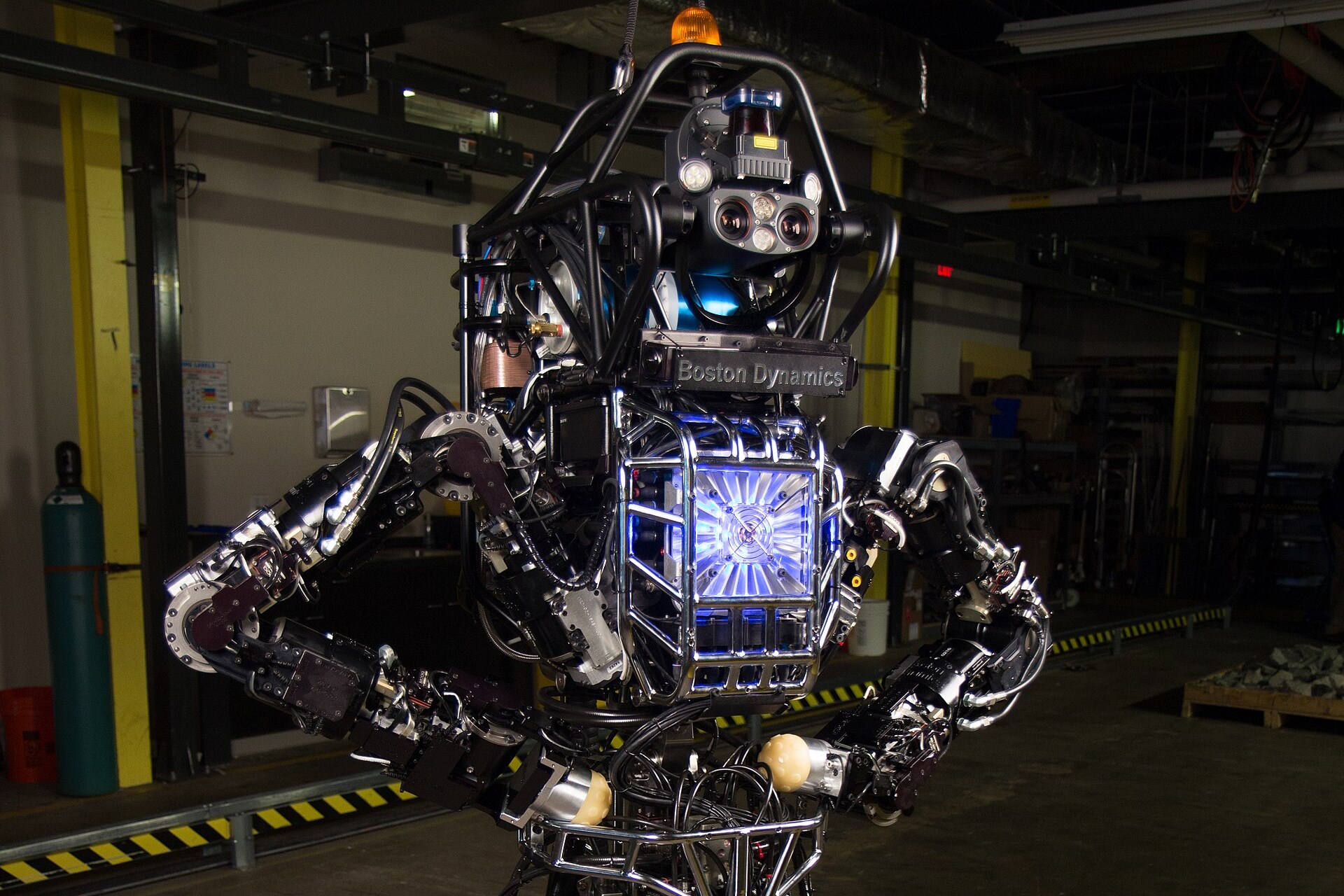
Image: The 2013 hydraulic Atlas humanoid robot, built by Boston Dynamics for DARPA, in a workshop during testing. Photo: DARPA, public domain, via Wikimedia Commons; the file record gives 2013; cropped. Archive image of an earlier version; it does not show the wheeled Atlas or the current electric Atlas.

