


Bootstrapped for Years, Then Venture-Backed: Atlassian, GitHub, Qualtrics, Grammarly and Calendly
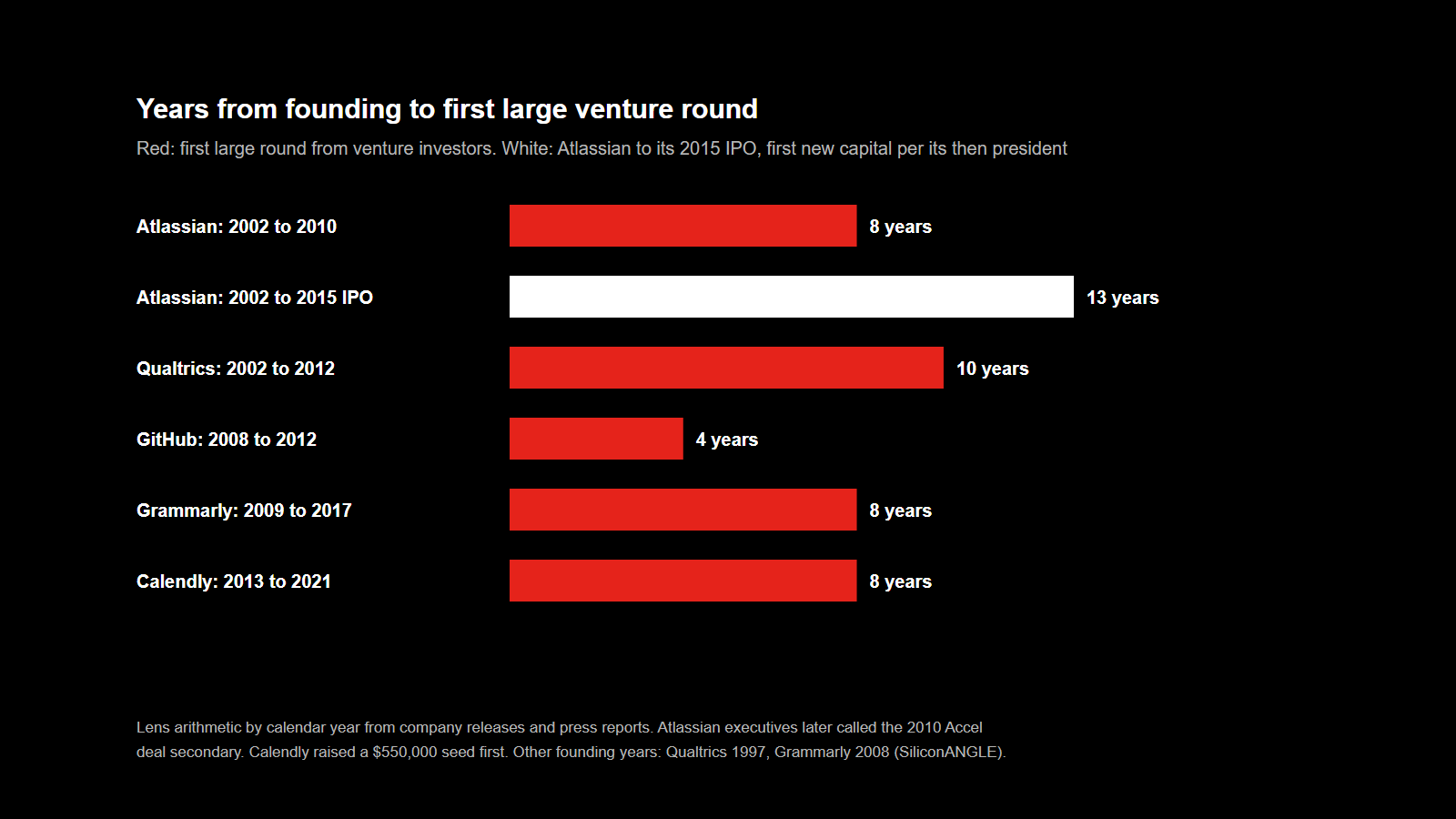

Atlassian, GitHub, Qualtrics, Grammarly and Calendly each operated for four to ten years before announcing a first large round from venture investors, according to company announcements and press reports from the time (Lens arithmetic). Their dated histories follow, with conflicting accounts side by side. The largest disagreement concerns Atlassian’s 2010 deal with Accel, announced as its first outside financing and later described by company executives as a sale of existing shares.
Atlassian: one deal, several descriptions
Mike Cannon-Brookes and Scott Farquhar co-founded Atlassian in Sydney in 2002, according to the company, starting with $10,000 of credit card debt, according to TechCrunch. An Indie Hackers account from 2021 says revenue reached $1 million by the end of 2002.
On 14 July 2010, Atlassian announced that it had closed a $60 million investment from Accel Partners for a minority stake. The release said the self-funded company had been profitable since inception, had taken no outside financing until then, and would also use the money for employee liquidity. TechCrunch called it Atlassian’s first venture money and reported revenue of $59 million for the year to 30 June 2010.
Later accounts differ:
- Cannon-Brookes told Fortune in April 2014 that the Accel deal and a new $150 million share sale were both secondary, meaning investors bought existing shares, and that the Accel round was mostly about the founders.
- Jay Simons, then Atlassian’s president, told Nathan Latka in July 2018 that the company first raised primary capital, or new money for the company, at its 2015 initial public offering (IPO). He described secondary rounds with Accel in 2010 and T. Rowe Price in 2013. Latka’s company page lists both deals as secondary sales, not new capital.
- Venture investor Matt Turck wrote in May 2019 that Atlassian raised no venture capital before its 2015 IPO.
- Indie Hackers puts the 2010 round at $160 million, against $60 million in Atlassian’s release.
TechCrunch reported the second sale on 8 April 2014: $150 million of shares sold by shareholders in a deal headed by T. Rowe Price, valuing Atlassian at $3.3 billion. Atlassian priced its IPO at $21 a share on 9 December 2015, selling 22 million Class A shares itself, and began trading on Nasdaq the next day.
GitHub and Qualtrics: first rounds in 2012
In a blog post dated 10 April 2008, GitHub wrote: “GitHub is officially live.” On 9 July 2012, Andreessen Horowitz announced a $100 million investment and said it was the only outside investment GitHub had ever taken. Microsoft agreed on 4 June 2018 to buy GitHub for $7.5 billion in Microsoft stock and completed the deal on 26 October 2018.
Qualtrics raised $70 million from Accel Partners and Sequoia Capital on 15 May 2012. TechCrunch called it the company’s first institutional investment and said the company reported being profitable since its founding in 2002. SiliconANGLE wrote that the company had existed since 1997 and had been profitable since 2002. SAP agreed on 11 November 2018 to buy Qualtrics for $8 billion in cash, days before Qualtrics’ scheduled IPO.
Grammarly and Calendly
Grammarly says Max Lytvyn, Alex Shevchenko and Dmytro Lider founded it in 2009; SiliconANGLE gave 2008. On 8 May 2017, TechCrunch reported a $110 million round as the first venture round for the then eight-year-old company. Bloomberg reported that General Catalyst led it, with Breyer Capital, IVP, SignalFire and Spark Capital, that the founders had avoided venture capital since 2009, and that Grammarly said it was profitable.
Tope Awotona founded Calendly in 2013, according to the company. On 26 January 2021, TechCrunch reported that Calendly had closed $350 million from OpenView Venture Partners and Iconiq at a valuation above $3 billion, mixing new money with purchases of existing shares. Before that, it had raised $550,000, TechCrunch reported. TechCrunch wrote in April 2021 that Awotona took no venture funding for about seven years after that seed.
Side by side
- Atlassian: 2002 to Accel deal in 2010, eight years; to IPO in 2015, 13 years.
- GitHub: 2008 to Andreessen Horowitz in 2012, four years.
- Qualtrics: 2002 (1997 per SiliconANGLE) to Accel and Sequoia in 2012, ten years.
- Grammarly: 2009 (2008 per SiliconANGLE) to its first venture round in 2017, eight years.
- Calendly: 2013, then a $550,000 seed, to OpenView and Iconiq in 2021, eight years.
Year counts are Lens arithmetic. For seven companies reported to have scaled on little or no outside money, see Lens’s $20,000 to $401 Million: Seven Companies That Scaled on Little or No Outside Money.
Sources and notes
Read in full: Atlassian, Accel investment release, 14 July 2010, and IPO pricing release, 9 December 2015; TechCrunch on Atlassian’s Accel round, 14 July 2010, and the 2014 secondary sale; Fortune, 10 April 2014; Latka’s Atlassian page, including its July 2018 Jay Simons interview transcript; Indie Hackers; Matt Turck, 5 May 2019; SaaStr, March 2016; GitHub’s launch post; Andreessen Horowitz and Fortune, 9 July 2012; Microsoft’s acquisition release and completion post; TechCrunch on Qualtrics in 2012 and the SAP deal; SiliconANGLE, 16 May 2012; the SAP–Qualtrics announcement as reproduced by Goodwin, Qualtrics’ law firm; Grammarly’s about page; TechCrunch, 8 May 2017; Bloomberg’s report as republished by Gulf News; SiliconANGLE, 9 May 2017; Calendly’s about page; TechCrunch on Calendly’s round, 26 January 2021, and Awotona’s interview, 8 April 2021. Wikipedia was used only as a pointer. Not read: Atlassian’s Securities and Exchange Commission filings (automated access was refused), Qualtrics’ IPO filing, SAP’s own release, and Bloomberg’s original page. Conflicts: the Latka transcript is machine-made and renders Accel as “Excel”; Simons dates the second secondary to 2013, while TechCrunch, Fortune and Latka date it to April 2014, and Latka gives a $3.2 billion valuation against TechCrunch’s $3.3 billion; Latka dates the Accel deal to June 2010 at a $400 million valuation, against the 14 July 2010 announcement, which gave no valuation; SaaStr’s Jason Lemkin wrote that Atlassian’s venture round was for secondary liquidity. Calendly’s seed is dated late 2013 by Wikipedia, citing Forbes, and 2014 by company databases seen in search results; TechCrunch lists the investors in the $550,000 as including OpenView, Atlanta Ventures, IncWell and Greenspring Associates, so OpenView, a 2021 lead, may have invested earlier. Turck labels GitHub’s round a Series A. Thumbnail photo: “Desks and cubicles (Unsplash)” by Crew (Unsplash) via Wikimedia Commons, licensed under CC0; cropped. Empty shared desks and private work booths in a coworking space set in a former banking hall at 360 Rue Saint-Jacques, Montreal. Stand-in photo; it does not show the events or organisations described.
Image: Lens chart built from the figures above. Thumbnail: Crew (Unsplash) via Wikimedia Commons (CC0).

