Blue Origin Will Not Bid in NASA's Next Commercial Space Station Round, Aviation Week and SpaceNews Report

Blue Origin will not take part in the next round of NASA’s competition for commercial space stations, according to reports from 12 and 13 November 2026. Aviation Week reports that the company is dropping out of the Commercial LEO Destinations (CLD) competition, where LEO stands for low Earth orbit, and quotes a statement Blue Origin emailed to it on 12 November. SpaceNews, which ran the story under the headline “Blue Origin bows out of NASA commercial space station competition,” also reported the decision. This post reflects sources as of 14 November 2026.
What Blue Origin said
Aviation Week quotes Blue Origin’s emailed statement: “As our role supporting NASA’s Artemis and Moon Base missions continues to grow, we’re focusing resources on capabilities that directly advance our lunar projects.” The statement as quoted by Aviation Week does not mention Orbital Reef, the station Blue Origin was developing with Sierra Space, or say whether the exit is permanent.
TechTimes reports, citing a post on X by Eric Berger of Ars Technica, that Blue Origin chief executive Dave Limp told employees on 12 November that the company will not bid Orbital Reef in the next round. Lens did not open that post or the Ars Technica reporting, and Blue Origin’s statement does not mention a staff meeting.
Where the competition stands
- Program: NASA (the National Aeronautics and Space Administration) released its final request for proposals for commercial low Earth orbit destinations on 9 October 2026, according to its release 26-086. Proposals are due on Tuesday 8 December, with contract awards expected in spring 2027. Aviation Week puts the awards at around April 2027 and calls this CLD Phase 2.
- Contracts: NASA says it intends to award firm-fixed-price, multi-award, indefinite-delivery, indefinite-quantity contracts. It would select two or more contractors for early development, followed by a competitive task order for final design, testing, certification and services from one or more of them.
- Phase 1: Aviation Week says NASA selected Blue Origin, in partnership with Sierra Space, in 2021 for one of three CLD Phase 1 contracts, alongside Voyager Technologies’ Starlab and a Northrop Grumman proposal. Northrop withdrew in October 2023 and joined the Starlab team, which Aviation Week describes as now a joint venture with Airbus. Axiom Space received an earlier award in 2020.
- Other participants: Aviation Week also says NASA works with the startup Vast under an unfunded Space Act Agreement, and that Vast plans to launch an early station, Haven-1, in the first quarter of 2027. Neither NASA’s release nor the Aviation Week article lists which companies will submit proposals, and Aviation Week does not say whether Sierra Space will bid on its own.
- Blue Origin’s other work: Aviation Week says Blue Origin holds an unfunded Space Act Agreement with NASA to mature technologies and build hardware for a crewed vehicle, and is a primary NASA contractor for lunar transportation services, including landing crews on the Moon.
Orbital Reef
Aviation Week’s picture caption says Blue Origin is shelving its plans for Orbital Reef, and its article describes the company as dropping out of the competition. TechTimes says Blue Origin has not announced a cancellation of Orbital Reef. Lens found no NASA statement about Blue Origin’s decision. NASA’s 9 October release says the agency wants credible plans and companies prepared to invest in destinations that can serve NASA while developing other customers.
TechTimes, citing the US Government Accountability Office, adds that NASA expects to spend $1 billion to $1.5 billion across fiscal 2026 to 2031 on two or more agreements, and that NASA officials said in March the amount might support only one station.
Where reports differ
Reports differ on wording rather than facts. Aviation Week says Blue Origin is shelving Orbital Reef, TechTimes says no cancellation has been announced, and the company’s quoted statement addresses neither point. SpaceNews’ page says its article was updated at 12 p.m. Eastern on 13 November with a revised deadline for proposal submissions; its text was not readable, so Lens could not see what changed. NASA’s release, Aviation Week and TechTimes all give 8 December.
Sources and notes
Sources: Aviation Week, read in full; NASA’s release 26-086 of 9 October 2026, read in full; TechTimes, read in full; and the SpaceNews article by Jeff Foust of 13 November, which is behind a registration wall, so only its headline, date, tags and update note were seen and its text was not read. Eric Berger’s post on X, the Ars Technica reporting, a Digg summary and any Blue Origin or NASA statement beyond those quoted above were seen only through search results or secondary coverage or not found. The GAO figures come from TechTimes and were not checked against the GAO report.
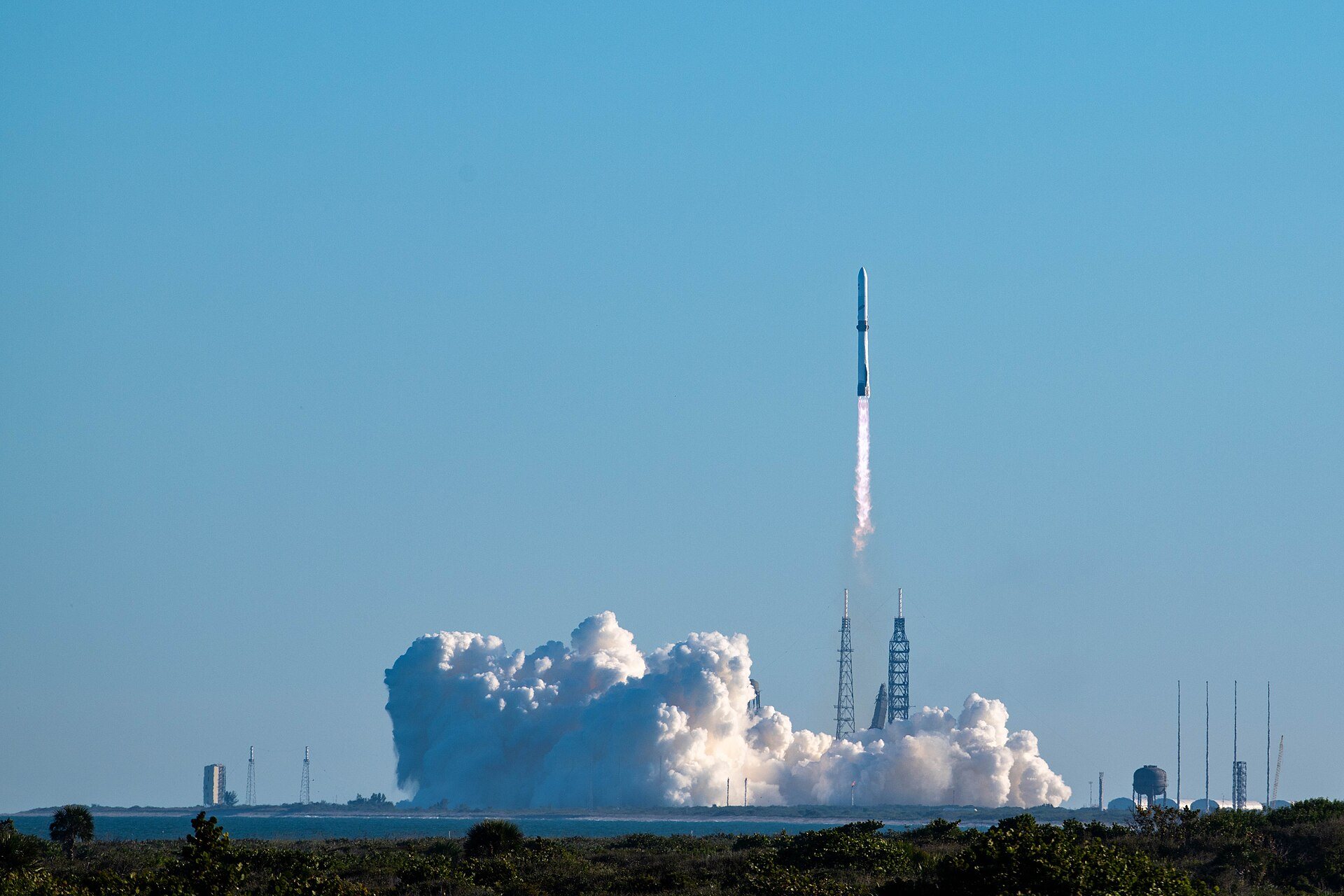
Image: A New Glenn rocket lifting off from Space Launch Complex 36 at Cape Canaveral Space Force Station, Florida, 13 November 2025. Photo: Samuel Becker, U.S. Space Force (public domain as a work of the US federal government), via Wikimedia Commons. Stand-in image: not a photo of Blue Origin's space station project.