


Arena Says Gemini 4 Carbon Scales Better on Cost Than Its Rivals: The Figures Behind the Chart

Arena, the AI evaluation company formerly known as LMArena, said in a LinkedIn post on November 4, 2026, that “Models by Google DeepMind scale better on cost than their rivals,” and called Gemini 4 Carbon “the prime example.” The post continued: “As tasks get more demanding, every rival gets more expensive relative to Carbon.”
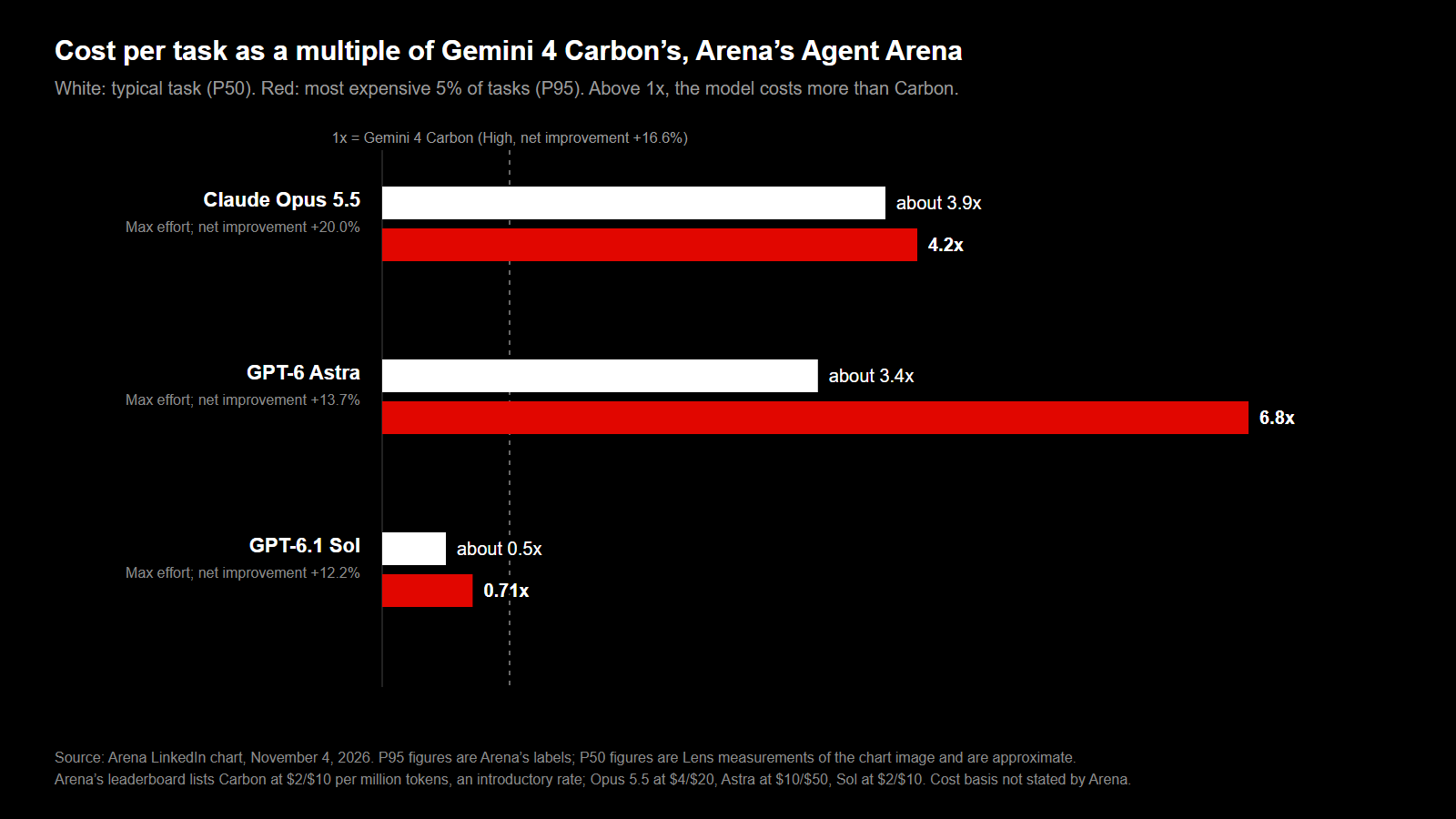
The accompanying chart, titled “On Complex Work, Carbon Scales Better Than Rivals,” draws on Arena’s Agent Arena, which records what AI agents cost and how users respond to them in real sessions. It shows cost per task for three rival models as a multiple of Carbon’s. At the 95th percentile of cost (P95), which the chart labels the “most expensive 5%” of tasks, Claude Opus 5.5 costs 4.2 times as much as Carbon, GPT-6 Astra 6.8 times and GPT-6.1 Sol 0.71 times. A footer describes cost as a “proxy for task complexity.”
Arena’s public leaderboard, Google’s pricing statements and three other benchmarks add context to those figures. Arena lists Carbon at an introductory price that Google has said will double. Lens found no announcement that the model is generally available. Cost comparisons from other testers give different multiples.
What the chart shows
Each bar on the chart has two parts: a base at the 50th percentile of cost (P50), which Arena labels the “typical task,” and a gold segment for the “increase on complex tasks” up to P95. Carbon is fixed at 1x. Arena printed the P95 labels. The P50 values below are Lens’s measurements of the bar heights in the chart image, so they are approximate.
- Claude Opus 5.5: about 3.9x at P50 and 4.2x at P95, with a net improvement score of +20.0%.
- GPT-6 Astra: about 3.4x at P50 and 6.8x at P95, with a net improvement score of +13.7%.
- GPT-6.1 Sol: about 0.5x at P50 and 0.71x at P95, with a net improvement score of +12.2%.
- Gemini 4 Carbon: 1x at both points, with a net improvement score of +16.6%.
All three multiples rise between P50 and P95, as Arena’s post says. The size of the rise differs: about 100% for GPT-6 Astra, about 40% for GPT-6.1 Sol and about 6% for Claude Opus 5.5, by Lens’s arithmetic. GPT-6.1 Sol stays below 1x at both points, so in the chart it costs less than Carbon on typical tasks and on the most expensive 5%. Claude Opus 5.5 has the highest net improvement score of the four.
What the leaderboard lists
Arena’s Agent Arena leaderboard, dated November 3, covered 59 models and about 2.7 million sessions. The table Lens could read gives median (P50) figures and no P95 column. For the four models in the chart it lists:
- Claude Opus 5.5 (Max): rank 1; net improvement 20.02% (±2.08%); median cost $6.80 per task; 18.7 minutes; 129,800 output tokens; price $4/$20; 14,089 sessions.
- Gemini 4 Carbon (High): rank 2; net improvement 16.54% (±0.78%); median cost $1.70; 11.1 minutes; 55,000 output tokens; price $2/$10; 42,599 sessions.
- GPT-6 Astra (Max): rank 4; net improvement 14.46% (±2.04%); median cost $6.17; 12.4 minutes; 42,900 output tokens; price $10/$50; 15,391 sessions.
- GPT-6.1 Sol (Max): rank 6; net improvement 12.46% (±1.10%); median cost $0.98; 10.3 minutes; 34,900 output tokens; price $2/$10; 30,088 sessions.
The page does not label the two price figures, which match input and output prices per million tokens reported elsewhere. The medians give multiples of 4.0x, 3.6x and 0.58x, close to the chart’s P50 bars. The chart’s net improvement scores for GPT-6 Astra and GPT-6.1 Sol are lower than the leaderboard’s, and the part of the post Lens could read gives no date for the chart’s data.
The leaderboard labels Carbon “Preliminary” without defining the term. The chart covers three of the 58 other models on the board. Among those not charted are Claude Sonnet 5.5 (Max) at 15.41% and $3.71, GPT-6.1 Terra (Max) at 10.91% and $0.79, and Gemini 4 Argon (High) at 10.60% and $0.98. On those medians, Carbon costs about 1.7 times as much as Argon, its Google predecessor. Launch-week reports put Carbon first on Arena’s Text board and fourth on its WebDev board.
Arena’s figures for Carbon have moved as sessions accumulate. A write-up citing Arena on October 30 gave a median of $1.80 from more than 21,900 sessions, 72% below Claude Opus 5.5. The November 3 medians put the gap at 75%.
What drives the median cost
The leaderboard’s own columns line up with much of the difference at the median. GPT-6 Astra used fewer output tokens per task than Carbon but has five times Carbon’s listed output price. Claude Opus 5.5 used about 2.4 times Carbon’s output tokens at twice the listed price. GPT-6.1 Sol used fewer output tokens at the same listed price.
Multiplying output tokens by output price alone gives about 3.9x, 4.7x and 0.63x for GPT-6 Astra, Claude Opus 5.5 and GPT-6.1 Sol, against reported medians of 3.6x, 4.0x and 0.58x. That Lens calculation leaves out input and cached tokens, and Arena does not publish a breakdown. Arena’s methodology post says, “We find some models more expensive in practice, despite cheaper on-paper pricing,” and attributes this to “model behavior (e.g. more steps per turn) or induced user behavior (e.g. more turns to reach satisfaction).”
Carbon’s price is introductory
The Register reported on October 29 that Google is selling Carbon at $2 per million input tokens and $10 per million output tokens for an “indeterminate introductory period,” rising to $4 and $20 afterward. The later rates equal the price Arena lists for Claude Opus 5.5. Google’s API pricing page, when Lens read it, did not list Carbon. It showed Gemini 4 Argon’s prices doubling on December 1, 2026.
Arena lists Carbon at $2/$10. Its posts do not say whether per-task costs use listed, discounted or billed prices, though its methodology post says it calculates “the exact cost of a session.”
If Carbon’s per-task cost doubled with its price and its token use stayed the same, the chart’s P95 multiples would become about 2.1x for Claude Opus 5.5, 3.4x for GPT-6 Astra and 0.36x for GPT-6.1 Sol, by Lens’s calculation. The median multiples would become about 2.0x, 1.8x and 0.29x. The rise between P50 and P95 for each rival would not change, because Carbon’s cost would double at both points.
Who can use it
Google announced Carbon on October 28 and said it would go first to a group of cybersecurity defenders, with wider access through its Fairwind program and broad availability “as soon as possible,” The Register reported. Lens reported the staged rollout on October 31. Lens found no announcement of general availability as of November 4, and Artificial Analysis labels some of its Carbon sections “No publicly available API.” Arena’s leaderboard shows 42,599 Carbon sessions, and the materials Lens read do not describe the terms of Arena’s access.
What other testers report
Other testers run models on fixed test sets instead of live user sessions, and they price Carbon at $4/$20. Their multiples differ from Arena’s and from one another.

- Artificial Analysis, cost per Intelligence Index task: Carbon (High) $7.76; Claude Opus 5.5 (Max) $10.04, or 1.29x; GPT-6 Astra (Max) $6.24, or 0.80x; GPT-6.1 Sol (Max) $1.27, or 0.16x. Index scores are 60, 59, 57 and 55.
- Vals.ai, cost per test on the Vals Index: Carbon (High) $10.51; Claude Opus 5.5 (Max) $28.12, or 2.68x; GPT-6 Astra (Max) $21.28, or 2.02x; GPT-6.1 Sol (Max) $3.61, or 0.34x. Accuracy scores are 70.45%, 70.18%, 65.02% and 63.94%.
- Zapier AutomationBench 1.0.6, list-price estimates at high effort: Carbon $2.12 and GPT-6 Astra $1.44, or 0.68x, with pass rates of 53.9% and 37.1%. Zapier lists Claude Opus 5.5 at max effort with a 42.5% pass rate and no cost on the same basis. GPT-6.1 Sol is not in the report.
GPT-6 Astra costs less than Carbon on two of these three measures and about twice as much on the third. Claude Opus 5.5 costs more than Carbon on both measures that price it. GPT-6.1 Sol costs less than Carbon on both measures that include it, as it does in Arena’s chart. Lens did not find P95 figures in these testers’ reports, so none of them tests Arena’s claim about the most expensive tasks directly. The tests use different tasks, harnesses and settings, so their figures are not directly comparable. A breakdown of Artificial Analysis’s Carbon figure published by eesel puts about 68% of the $7.76 on the input side, most of it cached tokens, which the output-only calculation above leaves out.
How Arena measures cost
Arena’s August post on task cost says the figures come from tasks completed by users in real Agent Mode sessions. It describes them as “an in-situ measurement of models doing real work in Agent Arena, not a controlled static benchmark.” Arena’s methodology post says randomizing the components of each session creates “a multi-intervention randomized controlled trial.” Several details affect how the chart can be read:
- Session cap: Arena tracks costs for “at most, the first three tasks” in a session, to limit the effect of context carried over from earlier work.
- Percentiles: Arena’s Pareto view offers p25, p50 and p95 cost per task. Its examples of task length are a simple website front-end for a median task and a mobile version of a web tool, over several hours, for a long one. The materials Lens read do not say whether a P95 figure covers the same tasks across models or each model’s own most expensive 5%.
- Effort settings: the leaderboard compares Carbon at High with the three rivals at Max, and the chart’s labels omit these settings. Zapier’s test put Carbon at $1.02, $1.65 and $2.12 per task at low, medium and high effort.
Net improvement, the performance score on the chart, is Arena’s estimate of the effect of choosing a given model, measured against a baseline distribution of models. It averages five signals: confirmed success, praise versus complaints, steerability, bash recovery and tool hallucination. Arena says cost is not a leaderboard signal and tracks it separately.
Arena’s position
Arena began as a research project and said in October that it raised a $200 million Series B at a $3.1 billion valuation, co-led by Lightspeed Venture Partners and Khosla Ventures. It reports annualized revenue above $100 million. Its funding post says, “The world needs a neutral third party to measure how safe and aligned AI actually is,” and that Arena is stepping into that role. The post does not name customers or say whether AI labs pay it. A Latent Space write-up of an interview with co-founder Anastasios Angelopoulos describes the public leaderboard as “a loss leader that does not meaningfully generate revenue” and says, “Payment cannot buy entry or removal.”
In April 2025, researchers from Cohere, Stanford, MIT and Ai2 published “The Leaderboard Illusion,” which alleged that some large providers, including Google, privately tested several variants on the earlier Chatbot Arena, and estimated that Google and OpenAI received 19.2% and 20.4% of its data. Arena said in a post on X that several of the paper’s claims did not reflect reality, TechCrunch reported. The paper concerned Chatbot Arena, not Agent Arena.
What is not yet public
The materials Lens read did not include:
- P95 dollar amounts for the four models, as opposed to ratios in a chart.
- Arena’s cost basis, including whether Carbon’s figures will be recalculated when its introductory price ends.
- An end date for Carbon’s introductory price, or a date for general availability.
- What Arena’s “Preliminary” label means for Carbon’s figures.
- P95 cost comparisons for these models from any tester other than Arena.
Sources and notes
Sources: Arena’s LinkedIn post, as shown in a screenshot supplied to Lens; Arena’s Agent Arena leaderboard, task cost post (August 14, 2026), methodology post and Series B post; The Register, Thomas Claburn, October 29, 2026; Google’s API pricing page; Artificial Analysis comparisons with Claude Opus 5.5, GPT-6 Astra and GPT-6.1 Sol; Vals.ai on Carbon, Claude Opus 5.5, GPT-6 Astra and GPT-6.1 Sol; Zapier; eesel; Hermes AI, October 30, 2026; Latent Space; “The Leaderboard Illusion”; TechCrunch, Maxwell Zeff, April 30, 2025. Notes: Lens read the LinkedIn post only up to the point where it is cut off by “...more,” and did not open the full post. The P95 multiples are Arena’s labels on its chart; Lens could not read P95 dollar figures, or the leaderboard’s Pareto view, and did not verify them. Multiples, percentage changes and recalculated prices are Lens calculations. All cost and score figures are as published by their sources and were not tested by Lens. Vals.ai’s Claude Opus 5.5 page also shows $32.77 per test in a September 22 update, and its Carbon page shows 70.36% in an October 28 update; the current page figures are used here. The Zapier report gives no date for its figures on other models. The Latent Space write-up is marked as pending editorial review. The Hermes AI page is an aggregator citing Arena, and it and The Register are the sources for the Text and WebDev ranks. Lens did not check eesel’s cost breakdown against Artificial Analysis’s underlying data. Lens did not contact Arena, Google, Anthropic or OpenAI for comment. Thumbnail photo: “Google Data Center, Council Bluffs Iowa” by Chad Davis via Wikimedia Commons, licensed under CC BY 2.0; cropped. Illustrative photo; it does not show the tests described.

Image: Charts by Lens from the sources listed. Thumbnail photo by Chad Davis via Wikimedia Commons (CC BY 2.0).

