


Amazon Says Prime Air Is the First in the World to Win a UK ‘SAIL 4’ Drone Approval; Eligible Darlington Customers Rise From About 600 to About 8,000

Amazon announced on 10 November 2026, in a release on its UK site, that the UK Civil Aviation Authority (CAA) has granted Prime Air a SAIL 4 Operating Authorisation and a SAIL 4 Flightworthiness Validation for its MK30 drone. Amazon describes it as a first for any operator in the world and says the CAA is the first regulator in the world to assess and approve an operation at this level. Amazon says the number of eligible customers in Darlington, County Durham, rises from about 600 to about 8,000. The CAA’s newsroom listing, which Lens checked on 12 November, has no item on the decision. The only CAA words are a quotation inside Amazon’s release, and the authorisation document is not public.
What Amazon says changed
According to the release, Prime Air could already fly beyond visual line of sight under CAA authorisation, but only over less densely populated areas. Amazon says the new approval lets it fly over more of Darlington, including denser communities. Customers need a garden or driveway within 7.5 miles (12 km) of the Darlington fulfilment centre. Items weigh up to 5 lb (2.2 kg), typically a large shoebox, in categories such as baby, household essentials, beauty, health and wellbeing, and office and tech. Amazon says delivery takes under two hours and is included with Prime at no extra delivery fee. It says the approval lays groundwork for expanding Prime Air across the UK and names no sites or dates.
What SAIL 4 means
SAIL stands for Specific Assurance and Integrity Level, a rating under the CAA’s UK Specific Operations Risk Assessment (UK SORA) method. The CAA’s guidance says: “Your SAIL level represents the overall risk of your operation, from 1 (lowest risk) to 6 (highest risk).” The level is set by the ground risk class and air risk class of the operation and determines which operational safety objectives must be met and how robustly. Amazon’s release describes SAIL 4 as medium-to-high risk and says the CAA reviewed the operation, the aircraft, the organisation and its approach to risk; the “medium-to-high” label is Amazon’s and does not appear on the CAA pages Lens read.
What was said
Theunis Scheepers, director of Prime Air Europe, said in the release: “Prime Air is the first in the world to receive a SAIL 4 approval from the UK Civil Aviation Authority.” He added: “Earning it took years of disciplined engineering and a commitment to safety from day one.” Sophie O’Sullivan, the CAA’s director of future safety and innovation, is quoted as saying: “Innovation is transforming aviation, and the UK Civil Aviation Authority’s role is to ensure that happens safely.”
The aircraft, as Amazon describes it
The following are Amazon’s claims. The MK30 is all-electric, with six motors and a three-cell battery for redundancy. Machine-learning detect-and-avoid software continuously scans for aircraft, people, animals and obstacles, and on descent avoids objects that are not on satellite maps, such as clotheslines and trampolines. An independent computer monitors the main flight-control system and, on an irregularity, hands control to a secondary system and starts an automated return or controlled landing.
What the release does not say
Amazon’s release does not give the authorisation’s expiry or conditions, any remote-pilot or detect-and-avoid requirements the CAA imposed, caps on flights, the number of deliveries completed, or where Prime Air will expand. DroneXL (Haye Kesteloo, 11 November) reports a separate trial permission that expires on 31 December and trial caps of 10 flights an hour and 100 deliveries per weekday; Amazon’s release does not mention either, and no source says whether the caps apply to the 8,000-customer area. DroneXL argues that the 8,000 homes were already inside the existing zone and that the map did not grow, since the 7.5-mile radius is the same as at launch; “unchanged” is DroneXL’s word, not Amazon’s. Business Matters says the service previously served about 600 customers through a pilot, which is a different meaning from “eligible”. No source explains how the 600 and 8,000 figures were counted.
Background
Amazon UK named Darlington as its first UK drone site in January 2025, and on 12 January 2026 said test flights had started. DroneXL, citing the BBC, reported that first parcel deliveries to customers began in early May. On 1 December 2025, DroneXL reported, Darlington Borough Council granted only temporary planning permission, cutting Amazon’s planned rate from 21 to 10 flights an hour. An MK30 came down in a garden at Beaumont Hill, Darlington, on 29 July 2026; no one was hurt. The Air Accidents Investigation Branch (AAIB) classified it an accident and opened an investigation, and DroneXL quoted an AAIB spokesperson as saying: “An investigation has been launched, and we have begun making inquiries.” Amazon’s account, as DroneXL reported it, is that an object extending above the roof of a moving vehicle contacted the drone and it came down as designed. DroneXL found no AAIB report as of 11 November, and a Lens search of gov.uk’s AAIB reports for the aircraft returned none. On 13 September, DroneXL reported, citing the BBC, that Amazon had applied to fly across all of Darlington. Amazon said the aircraft flew more than 500 flights and deliveries from February to September, according to DroneXL.
Sources and notes
Sources: Amazon UK’s release of 10 November 2026, read in full; DroneXL (Haye Kesteloo, 11 November, and articles of 7 May, 7 and 17 August, and 13 September), DroneDJ (Ishveena Singh, 11 November), DroneLife (11 November), Business Matters (Amy Ingham, 11 November), Retail Insight Network (12 November), UAS Weekly and sUAS News, all read through summaries; and the CAA’s UK SORA pages. Lens did not find a CAA statement, newsroom item or copy of the authorisation. BBC, Northern Echo, Guardian, Telegraph and Reuters coverage of the approval could not be read, FLYER and KamCity returned HTTP 403, and an ITV report timed out. The “first in the world” claim is Amazon’s; Lens found no regulator or third-party confirmation, and a search for other SAIL 4 authorisations found only lower-level examples, which neither supports nor refutes it. Two slightly different versions of the CAA quotation are in circulation, and Business Matters prints lines attributed to Scheepers that Lens did not find in Amazon’s release.
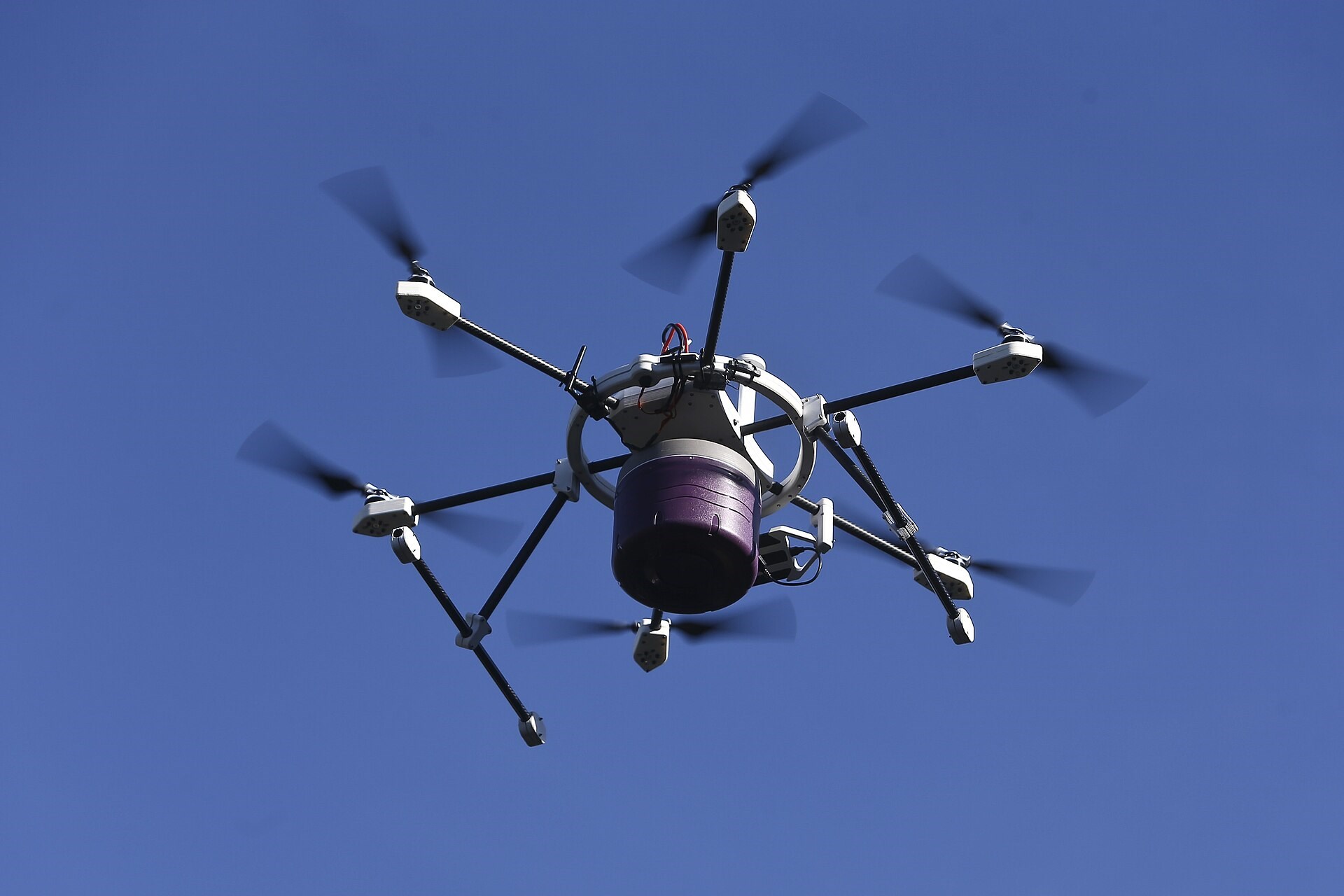
Image: A six-rotor delivery drone carrying a purple cargo canister, December 2016. Photo: Eduardofamendes, CC BY-SA 4.0, via Wikimedia Commons. Stand-in image of a drone operated by the Portuguese company Connect Robotics; it is not an Amazon MK30 and was not taken in the UK.

